



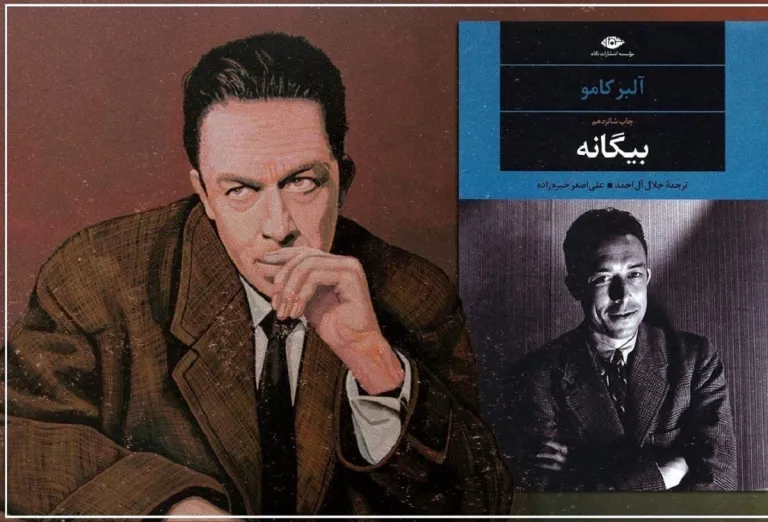
Revisiting a Literary Masterpiece |The Stranger by Albert Camus
In this part of the series “Revisiting a Literary Masterpiece,” we turn to one of the most important literary works of the twentieth century: The Stranger by Albert Camus. Before redefining the plot of this short novel, it is better to first examine its title closely.
The word The Stranger is the equivalent first chosen by Jalal Al-e Ahmad and Ali-Asghar Kherad-Zadeh for the French L’Étranger. This equivalent continues to be seen in the latest translations (such as those by Dihimi, Mirabbasi, Shahdi, Parsayar, and Golestan). Apart from the concept of alienation (aliénation), the very fabric of this word also contains the meaning of otherness (altérité). It seems the book’s title wants to convey that we are dealing with a character who is perceived not only as internally different but also socially as the Other. Society cannot understand or accept him because he does not follow or accept their emotional and moral codes. Now, one may ask: what story does the short novel The Stranger pursue?
The Stranger is narrated in two main parts. The first part begins with the death of the mother. Meursault attends the funeral without showing grief. After that, his life continues normally: he starts a relationship with a woman named Marie, goes to the sea, watches movies, makes love, and socializes with neighbors, especially Raymond. Later, at Raymond’s invitation, he goes on a picnic, where, because of Raymond, he gets into a fight with an unnamed Arab man. On a hot day, under the influence of the blazing sun and heat, Meursault shoots the Arab man with a gun and kills him — without any clear motive or feeling of remorse.
In the second part, Meursault is arrested and put on trial, but the court focuses not on the murder but on Meursault’s indifference to his mother’s death. Society cannot accept his emotional detachment. Others try to impose moral or religious meanings on his actions, but Meursault refuses to accept them. Eventually, he is sentenced to death. In the following sections, we analyze the form and content of the novel The Stranger.
Break from the Tradition of Realist Novel
Although Albert Camus inherits the tradition of French novel writing, in The Stranger there is a complete break from the French realist novel tradition—both in terms of form, technique, narration, and content. In The Stranger, there are no “mirror-like” descriptions typical of realist novels; descriptions that are often static and sometimes lengthy, aimed at representing the setting in the most detailed way possible for the reader, without intending to add any particular meaning to the work.
In contrast, in The Stranger, descriptions fully serve the narrative action and often become very important. For example, in the scene where Meursault kills the unnamed Arab man, the description of the beach and the sun is highly significant; the sun loses its natural meaning and takes on a symbolic dimension. This description is so important that one might even exaggerate and say if that scene had taken place at night, Meursault would not have committed the murder!
The same applies to other story elements. For instance, realist novels try to create typical characters who reflect their social class. However, Meursault is depicted independently of his social class. There is almost no description of his appearance; no mention of his clothes, body, or anything else. Meursault is fundamentally separate from his society and, like many characters in modern literature, is in absolute conflict with his community.
Regarding narration style and narrator typology, there are also striking differences between this novel and earlier realist novels. Realist narrators attempt to be as objective as possible, while the first-person narrator of The Stranger—Meursault himself—has an intensely subjective relationship with the world around him. This maximizes the reader’s empathy and identification with the work. Although Meursault fundamentally resembles no social type, he is highly believable and understandable to readers.
But who exactly is Meursault? Let us delve a little deeper.
Meursault; The Only Christian We Deserve
Albert Camus himself has a famous line about the main character of The Stranger: “Meursault is the only Christian we deserve.” What might Camus mean by this?
There are similarities between Christ and Meursault. First, Meursault never lies and does not deny his inner truth, even if it costs him his life. We will discuss this truthfulness in the next section. Another similarity is that Meursault, like Christ, is executed at the end of the story. The difference is that Meursault saves himself, while Christ, according to Christian belief, saves all humanity.
Meursault is truly human. He has no heavenly mission and is entirely earthly. He does not believe in God or supernatural powers and never accepts that the priest should pray at his deathbed. It seems Camus wants to say with this mysterious sentence that the twentieth-century man crucifies the Christian who never lies, who does not cry at his mother’s funeral, who does not wear social masks, and who does not practice hypocrisy.
A Man Who Never Lies
As mentioned before, one similarity between Meursault and Christ is that Meursault never lies. The novel opens with this sentence: “Mother died today. Or maybe yesterday, I don’t know.”
He is not affected by his mother’s death. He feels no remorse for killing the Arab man. He is not even willing to lie about these facts or wear a mask. Similarly, another important literary character who never lies is Prince Myshkin in Dostoevsky’s The Idiot. Neither of these characters ends well. One is crucified, and the other goes mad.
But what does Meursault’s truthfulness mean? Here, we can enter existentialist philosophy and say that by not lying, Meursault refuses to sacrifice his authentic life for the masks that society, family, and the Other impose on him. He accepts death but preserves his authenticity (authenticity in the existentialist sense).
In William Barrett’s book What Is Existentialism?, regarding The Stranger and Meursault’s connection with existentialism, we read:
“Meursault, the hero of The Stranger, perhaps remains the full embodiment of the intellectual mood of his time. Although this novel was a personal feeling for Camus himself, its hero is fully a literary symbol of the alienated man; a man who is both the offspring of Dostoevsky’s and Kafka’s outcasts and the prophet of the ragged leather-jacketed youth who appeared ten years later. Though Meursault begins as a poor, insignificant man, a clerk trapped in the lowest rank of social officials, by the end of the story he boldly confronts his death. He assumes a truly human face and achieves dignity and glory.”
Four Core Concepts of Existentialism in The Stranger
Irvin Yalom, in his book Existential Psychotherapy, identifies four fundamental human concerns: death, freedom, isolation, and meaning. These four main concepts are exactly the four key themes in The Stranger.
- Death: The novel begins with the mother’s death and ends with Meursault’s imminent execution. Meursault knows death surrounds all his existence and accepts it as inevitable.
- Freedom: Meursault loses his freedom in prison; he cannot even smoke or make love—actions he describes as “things that don’t harm anyone.” He later understands that the main punishment for killing the Arab man is precisely this loss of freedom.
- Isolation: He experiences isolation in prison. Even before prison, he never forms deep connections with others. When Marie asks if he loves her, he says he doesn’t know. He has no deep connection with his mother, and overall no deep human relationships occur for Meursault throughout the novel.
- Meaning: Meaning plays a crucial role and is one of the four main themes. In Meursault’s world, there is no absolute meaning. No fixed metaphysical value gives his life meaning or directs him to a specific destiny. As mentioned, neither God, family, love, friendship, nor other conventional concepts hold meaning for him. The world is meaningless, and he bravely accepts this meaninglessness and embraces it until death.
In Conclusion
The Stranger by Albert Camus is not just the story of a man who commits murder but a concise and brilliant narrative of human confrontation with the most fundamental existential concerns: death, freedom, isolation, and meaning. Camus artistically builds his philosophical world in a novel of modest length. Meursault, the main character, refuses to lie to survive. He embraces meaninglessness and death with open arms but lives authentically until the very end.