



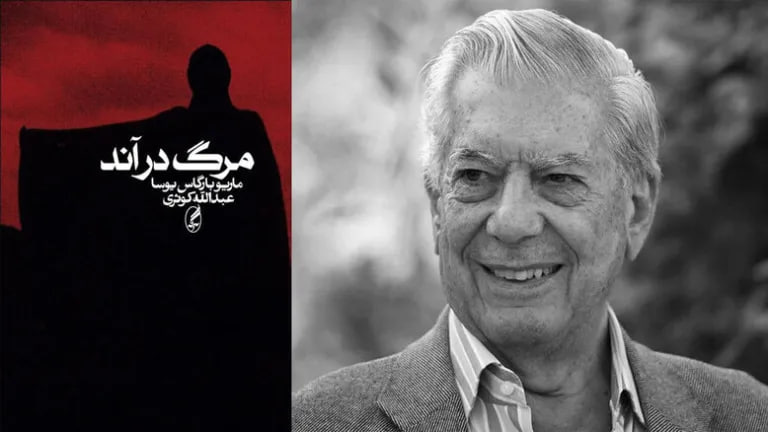
Revisiting a Literary Masterpiece | The Novel Death in the Andes by Mario Vargas Llosa
The novel Death in the Andes is a complex work and, like other novels by Llosa, features a tightly woven and intricate plot.
When the words “literary masterpiece” and “Mario Vargas Llosa” come together, novel readers often think of works like The Feast of the Goat, Conversation in the Cathedral, or even The War of the End of the World. Yet, one of the most important works by this Peruvian Nobel laureate is the novel Death in the Andes. Vargas Llosa published this work in 1993, at the peak of his artistic maturity, bringing the character of Lituma—first introduced in Who Killed Palomino Molero?—into a remote setting near the Andes mountains: a strange, mysterious, and frightening village called Naccos.
Like many of Llosa’s novels, Death in the Andes is built on a complex and tightly woven plot. On the surface, it appears to be a crime-detective story with streaks of politics and magical realism. Sergeant Lituma, together with his aide from the civil guard, Tomás Carreño—nicknamed Tomasito—is stationed in Naccos, a village where three locals have vanished under mysterious circumstances, leaving no trace of their fate. The novel’s protagonist, Lituma, must unravel this mystery. But the story is not as simple as a straightforward detective tale. Lituma tries, like any agent of order, to uncover the motivations of possible killers using logic and reason. Sometimes he suspects the leftist Shining Path guerrillas of killing them; at other times, he wonders whether they might have been abducted for indoctrination and turned into insurgents. Or perhaps they simply left of their own will? None of these explanations are conclusive—and indeed, uncertainty itself is one of the novel’s central themes.
What Lituma refuses to accept at first are the supernatural forces that the villagers of Naccos believe in. To him, these are mere superstitions—blind forces blamed by the locals for disasters like avalanches, or what philosophy would call “natural evil.” By the end of the novel, however, one interpretation—suggested by a drunk laborer’s confession to Lituma—is that the villagers, under the influence of the enigmatic and superstitious Señora Adriana (a local witch figure) and her husband Dionisio, who runs a tavern, sacrificed the three men to appease the blind forces of nature and the spirits of the mountains. But as mentioned, the novel refuses to remain a mere entertaining detective thriller. As in his other works, Llosa uses the detective framework as a pretext to delve into political, social, and cultural themes.
The Balance of Forces Shaping the Characters’ Fates
In Death in the Andes, Llosa places several competing discourses of power in direct tension with one another: The official military and police forces of Peru (represented by Lituma, Tomasito, Lieutenant Pancrudo, and others). The leftist Shining Path insurgents, who commit acts of terrorism (they are never personified as a single character but rather appear as a collective presence—often outcasts of Peruvian society, from the hungry and poor to abused women and children). The forces of superstition and local Andean folk beliefs (embodied in Señora Adriana and her husband Dionisio).
These forces are locked in constant conflict, perpetually threatening one another. From the very first chapter, there is the looming threat of a terrorist attack on Lituma and Tomasito’s outpost; they live in constant fear of being tortured and killed. Yet the threat is not one-sided. Midway through the novel, Lieutenant Pancrudo recounts how he tortured a man he suspected of being a terrorist:
“We burned him with matches and a lighter. Started from his feet and slowly went up. I’m telling you the truth. With matches and a lighter. Bit by bit. His ear was roasting, smelled like barbecued meat. I was so inexperienced back then, Sergeant. It sickened me, and I fainted.”
Later, it becomes clear that the tortured man was none other than Pedrito Tinoco—a mute, awkward, mentally impaired villager who is, in fact, one of the three who disappeared in Naccos. This brings us to the next major theme.
Violence
All three of the contending forces in the novel—the state, the insurgents, and superstition—are intensely violent, each killing in accordance with their own logic or beliefs. Ordinary people become the victims: laborers, shepherds, environmentalists, even French tourists who had come only to see the Andes. But the most distinctive victim is Pedrito Tinoco.
Tinoco suffers under all three powers. First, his vicuñas (Andean animals often used in trade and tourism) are slaughtered by the Shining Path, who claim the Peruvian government profits from them and that destroying the animals is a revolutionary act. After the insurgents leave, Pancrudo mistakes Tinoco for one of them and tortures him. Later, in Naccos, Tinoco vanishes again—likely sacrificed by villagers to placate the blind forces of the mountains. The other two missing men—known only as the albino and the Chanca—had previously escaped Shining Path attacks, only to meet a grim fate in Naccos.
The Blurring of Fantasy and Reality
Another of the novel’s key themes is the collapse of boundaries between imagination and reality. At first glance, one might think the line between them is firm. But how do illusions enter the realm of lived experience? Can mere fantasies drive real-world actions? On both individual and collective levels, Llosa shows that they can.
For instance, in one scene, when Lituma angrily asks the workers if they truly believe in mountain spirits and demons, their hesitant answers reveal how shared superstition becomes social truth:
“Finally, one of them said: ‘How should we know, maybe.’
Then another, wearing a helmet, added: ‘I believe it. When so many people talk about it, there must be something to it.’”
In another striking episode, Shining Path guerrillas descend upon a village. After fiery speeches about Marxist-Leninist ideals, they manipulate the villagers’ minds, compelling them to violence. They stage a “people’s trial” in the church square, forcing villagers to stone their own local officials—judges, postmasters, even their wives.
The narrator comments:
“From then on, they were no longer victims—they had become liberators.”
This is nothing less than fantasy, illusion, and ideology intruding into collective reality. Survivors of one violent force (the Shining Path) fall prey to the delusions of another (local superstition).
Love in the Style of One Thousand and One Nights — Tomasito the Storyteller
One of the most captivating aspects of Death in the Andes is the subplots woven into the main narrative, especially the nightly tales Tomasito tells Lituma. Like Scheherazade, Tomasito recounts his love story with a woman named Mercedes in fragmented episodes, night after night.
Using his signature technique of “telescopic dialogue,” Llosa layers story upon story, constantly interrupting and weaving them together. From these tales, it becomes clear that Tomasito truly loves Mercedes, even willing to kill for her—another link to the novel’s broader theme of violence. Lituma, however, finds the story tedious, except for the erotic parts.
These subplots provide a vital tonal shift, pulling the novel from its harsh rural-natural setting into an urban-modern one, reflecting another of the novel’s central dualities: tradition vs. modernity, instinct vs. reason. Fittingly, Tomasito—faithful to his love—is the only character who achieves a measure of redemption.
Death in the Andes is a profoundly complex novel, open to multiple interpretations. For example, one might read Dionisio as an echo of the god Dionysus, and Lituma as a reflection of Apollo. From this perspective, the novel resonates with Nietzsche’s The Birth of Tragedy. Dionysus represents the forces of unreason, ecstasy, and release from social order—communal joy, intoxication, music, dance, and frenzy—all traits embodied by Dionisio, forever drinking and dancing in his tavern. Opposed to him is Apollo, symbolizing order, rationality, restraint, and modernity—qualities manifest in Lituma, the coastal man sent to the mountains on duty.
The recurring opposition of coast vs. mountains throughout the novel stems from this Apollonian/Dionysian duality. Lituma, born and raised on the coast, is thrust into the Andes, where he undergoes profound transformation—much like Nietzsche’s Zarathustra, who retreated to the mountains to achieve a higher state of being.