



Expressionist Cinema and the Unveiling of Madness in Robert Wiene’s The Cabinet of Dr. Caligari
When history appears as an unbearable trauma, the psyche retreats inward for self-preservation and rewrites the logic of the world from its own internal perspective. This is Siegfried Kracauer’s fundamental insight in his psychological analysis of the Weimar Republic—pointing to a nation’s withdrawal from violent reality into the “realm of the spirit.” For him, German Expressionism was less a purely artistic style than an aesthetic configuration of that very retreat—an art that, instead of representing the external world, charts the path toward the psyche’s safe haven. At the same time, Expressionism was not merely a reactive, passive encounter with historical crisis; it could also be seen as a mode of perceiving the world—an attempt to return, in opposition to the reductionism of Realism, Positivism, and, of course, “nineteenth-century materialism,” to the non-material and “spiritual” dimensions of the world and the subject (Robinson, 2013, p. 41). Whatever the case, the common thread among the artists of this movement was their ability to place the anxieties, nightmares, and psychological crises of the modern subject at center stage, speaking of meaninglessness and madness, alienation, and the “dark realm” of the mind.
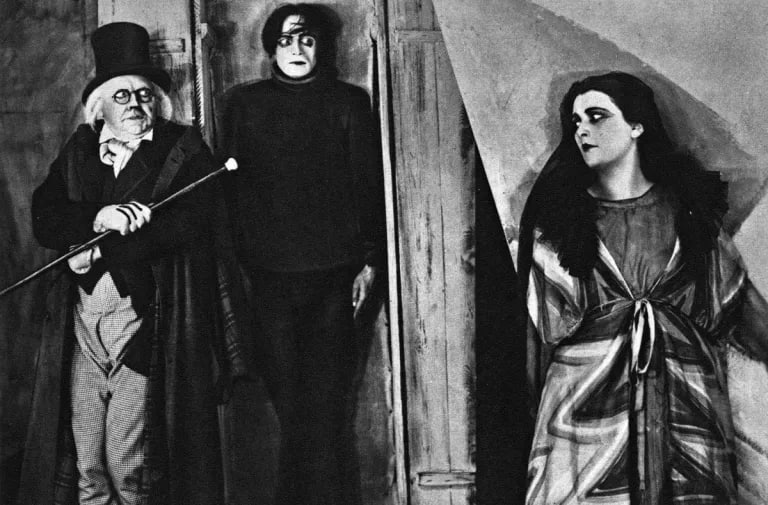
Cinema, thanks to its visual form and the camera functioning like a probing subjective eye, was a uniquely suited medium for this. Expressionist cinema of the 1920s not only dealt with themes such as the unconscious, dreams and nightmares, delusion, and psychosis, but through its chiaroscuro lighting, fractured perspectives, distorted images, steep set angles, and exaggerated spaces (and, naturally, the silence that matched the dream’s muteness) could become the direct visual and formal counterpart of the unconscious space. Thus, Expressionist films, beyond their thematic resemblance to psychoanalytic concerns, created in themselves a psychoanalytic stage—not merely depicting such themes but actually bringing the uncanny space of the unconscious to the screen.
Among these works, The Cabinet of Dr. Caligari (1920) is a quintessential example of this capability (the term “cabinet” in the title refers less to the doctor’s office than to the container in which the somnambulist is kept). The film opens with Francis narrating a horrifying story about a series of murders; his telling, framed through a “story-within-a-story” device, makes up the bulk of the film. He recounts the tale of a man named Caligari who, with the help of a somnambulist named Cesare—modeled on an Italian mystic of the same name—commits several murders, including that of Francis’s friend Alan. The story ends with Caligari’s identity being revealed; he is arrested and imprisoned in a cell-like chamber, never to be released. However, when the film returns to the present, Francis and his listener walk into the very asylum of his story, and everything changes: we suddenly realize that we have been watching the tale of a madman who is himself a patient. In the asylum courtyard, we see the man Francis had cast as Cesare, and the “fiancée” from his story as another patient. The Caligari of Francis’s tale is in fact the asylum director, who ends the film by saying, “Now I understand Francis’s delusion—he thinks I am the mystic Caligari. Now I know how to cure him.”
Such a degree of narrative-psychological sophistication for a film in 1920 is striking. The viewer discovers that much of the film has been the hallucinatory delusion of a mentally ill narrator. Yet there is more. First, Francis does not invent every element of his hallucinatory tale—some derive (as the final asylum scenes suggest) from the real environment of the institution. This recalls Freud’s insight that dreams are built from “day residues” and real elements from across one’s life: “Dreams may draw upon any part of the dreamer’s life, provided that a chain of thought links impressions from the day of the dream (‘recent’ impressions) with older experiences” (Freud, 1900, p. 169). More importantly, Francis’s narrative is not meaningless babble; it follows the mechanisms of the unconscious and compensatory processes seen in dreams. While the film does not show Francis’s actual dreams, his waking narrative, freed from much of the conscious mind’s rational censorship, allows unconscious elements to emerge—more so than in Freud’s slips of the tongue or everyday lapses, and more akin to an artist creating from the depths of madness. Thus, the story of the madman in waking life resembles the dream of a sane person.
Assuming Francis had perhaps heard of a real Caligari, his fear and hatred of the asylum director (possibly due to strict treatment) transform the latter into a sinister villain in his story. A quiet, withdrawn, sleepy man becomes Cesare the somnambulist. Alongside these negative projections, the narrative also reveals positive wish-fulfillment (in Freud’s sense of repressed or thwarted desires). The girl he knows in the asylum becomes his fiancée Jane; his timid self, especially in front of the director, becomes a powerful, clever hero who aids the police and exposes Caligari’s secret. If dreams are wish-fulfillment, Francis’s story follows the same logic—anticipating, in a sense, Lynch’s Mulholland Drive (dream as wish-fulfillment) and Lost Highway (unconscious fantasy in waking narrative).
There is, however, a complicating detail: in the real asylum courtyard at the end, Alan is absent. The film gives no direct clue as to why or how Francis creates Alan in his story—despite portraying deep friendship and no romantic rivalry between them. If Francis’s tale is not mere incoherence, Alan’s presence in the fantasy and absence in reality must have meaning. One possibility is that Alan was a past friend or even brother whom Francis lost (through estrangement, death, or perhaps a murder Francis committed and repressed). Another is that Alan was a fellow patient who died (possibly due to medical negligence or harmful treatment), reimagined in the delusion as a victim of Caligari’s somnambulist (symbolizing the institution’s staff or systemic control). The intensity of Francis’s grief supports the idea of a real loss; the director’s final close-up, with a sinister tone, could even imply silencing Francis as a witness to wrongdoing rather than curing him.
A third reading is that Alan never existed—he is another facet of Francis himself, perhaps representing his “good” or “human” side before madness. In this view, Alan’s death in the story is a mourning for that lost part of the self, destroyed by the asylum’s authority figure. The final scene, in which Francis is confined to the same cell he earlier imagined for Caligari, confirms Alan’s symbolic death and Francis’s subjugation; the director’s talk of “treatment” suggests even the memory of Alan will be erased. Such speculations, themselves a little delirious, are less an attempt at definitive explanation than a methodological way of addressing the film’s evident idea: Francis’s insistence that Caligari and the director are one, the suppression and confinement of madness, and the Expressionist focus on the primacy of inner mental space all point to a sharp critique of psychiatry as an institution and of the absolute power of the medical-disciplinary system—recalling Foucault’s History of Madness. Psychiatry and the asylum, as modern disciplinary structures, suppress free, creative existence, turn the subject into an object of surveillance, and strip away their unique language. The director’s authoritarian figure at the end—threatening, paternal, sadistic—allows no deviation from social or psychological norms; every free narrative is suppressed.
In fact, the ending does not so much discredit Francis’s account as leave the viewer with a doubt about Caligari’s malevolence—enough to make us trust the madman’s revelations. R.D. Laing, the Scottish psychiatrist aligned with the anti-psychiatry movement, in The Divided Self (1960), warns of psychiatry’s own harms:
“Psychiatry can quite easily become a technique of brainwashing, of inducing behavior by means of (preferably) non-damaging torture… Our normal, adjusted state is often no more than the abdication of ecstasy and the betrayal of our true potential; most of us have been far too successful in acquiring a false self to adapt to false realities.” (Laing, 1990, p. 12)
The psychiatric language that defines psychosis as a “failure of adaptation” unrelated to reality and devoid of insight is, in Laing’s view, a “derogatory” and unethical attempt to avoid thinking in terms of freedom, choice, and responsibility—enforcing a fixed model of “being human” (ibid., p. 27).
This reading parallels Kracauer’s political interpretation in From Caligari to Hitler (1947), where Expressionist cinema—Caligari in particular—reflects the German collective unconscious. Caligari embodies the tyrant who commands will-less masses (“Cesare the somnambulist”) to feed his lust for power. Cesare, acting merely as a tool, is less a guilty killer than an innocent victim—symbolizing the ordinary citizen compelled by state and military service to kill and be killed. For Kracauer, the film eerily anticipates Hitler, who, like Caligari, imposes his will through hypnosis—brainwashing and manipulating the soul.
Yet Kracauer laments that Wiene diluted the revolutionary thrust of the original script (by Hans Janowitz and Carl Mayer), which exposed the “madness inherent in authority.” By framing the tale as the delusion of a madman, the film, in his view, aligns with Caligari—condemning dissent as insanity. Thus, an originally revolutionary story becomes conservative, fostering the German spirit’s withdrawal from political responsibility and its turn toward a dictatorial leader. Still, certain aspects temper Kracauer’s critique, suggesting Wiene extended the film beyond a period-bound political manifesto into deeper psychoanalytic territory. Expressionist cinema’s structural focus on the unconscious, hallucinations, ghosts, and nightmares resists reduction to political symbolism; it must be read in its own context. Moreover, Wiene’s broader oeuvre shows sustained interest in psychological depth. The hidden meanings in Francis’s hallucinatory narrative suggest that the film’s “truth” lies less with Caligari than within the delusion itself—revealing both the mechanisms of a psyche marked by the longings of a nation in loss and the forces of repression.
Madness, here, is the language of suppressed truth—truth disclosed not by reason, but by madness itself. Freud recognized this revelatory power; Foucault and Laing saw it as a vital challenge to sterile rationality:
“Our civilization not only represses instincts and sexuality, but every form of transcendence and surpassing. Among one-dimensional men, it is no wonder if someone with persistent experience of other dimensions… faces the danger of either being destroyed by others or betraying what they know.” (Laing, 1990, p. 11) The final doubtful image of Caligari and his last line remind us that what is called “treatment” can be a pretext for suppressing the inner human world—a world born mad and free, yet everywhere bound by reason.