



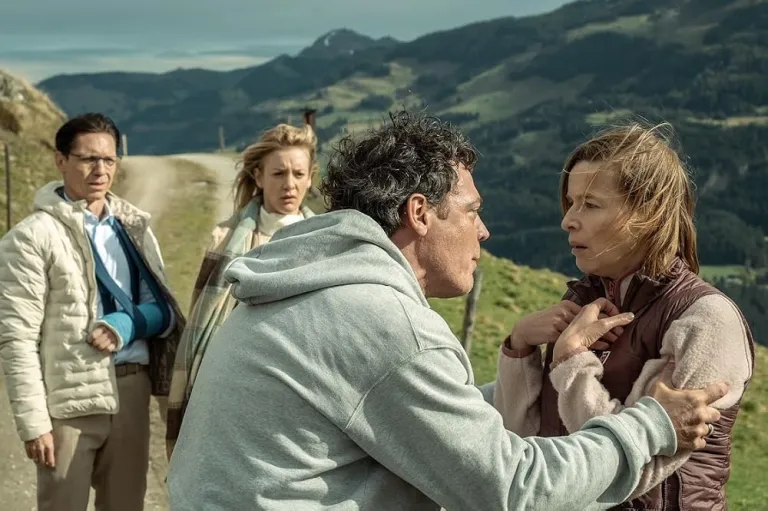
Mike van Diem is one of those filmmakers for whom an incident is not the end of the story, but its beginning: an event that shatters the calm surface of everyday life and forces people to confront a truth about themselves and their closest relationships that they had previously preferred not to see. The Dutch filmmaker, who rose to international prominence with his feature debut Character in 1997 and won the Academy Award for Best Foreign Language Film, returns to this familiar territory in Our Girls: the place where people, confronted with power, pressure, and choice, lose control of the image they have constructed of themselves. The difference this time is that there is no external force at work. The enemy is within the family, and the instinct to protect one’s child puts the boundaries of morality under strain. Our Girls is a film about an accident that leaves two teenage girls suspended between life and death, but it soon becomes clear that the accident is only the beginning. What gradually collapses is trust, friendship, marriage, and ultimately the image these people have constructed of themselves as moral human beings.
Van Diem based the film on We’ll Do Whatever We Can, a novel by Lize Spit. But his adaptation is more than simply transferring a story from literature to cinema. He reworks the novel’s setting and relocates it to the Austrian Alps. Two Dutch families who have spent years vacationing together now find themselves surrounded by the mountainous landscape of Tyrol—a setting that is both majestic and peaceful, yet also isolates them from their ordinary lives. This change of location has a strong dramatic function: the vast, indifferent landscape stands in stark contrast to a crisis that has become the entire world for these four adults. Outside the house, the mountains remain unchanged; inside, the image these two families have constructed of their lives slowly begins to fall apart.
At first, everything looks like an ideal life. Anouk and Danny, and Gwen and Erik, have been friends for years, while their daughters, Madeline and Elise, have grown up together. The two families are so close that there seems to be no boundary between them. Yet van Diem observes this intimacy with a subtle distance from the outset, as if he understands that such closeness may be less a sign of strength than the product of years of habit and routines that have never truly been tested. The accident involving the two girls is precisely that test: the moment when habit, friendship, and the calm appearance of everyday life can no longer serve as a hiding place.
At the center of the accident is the relationship between the two girls. Madeline lives in Elise’s shadow. She feels that Elise is more visible, receives more attention, and occupies a more prominent place in other people’s lives. What leads to the accident, then, is not simply carelessness but Madeline’s desire to be seen. For once, she wants to be the center of attention; she wants to experience a position she feels has always belonged to Elise. This motivation may initially seem small, even childish, but it becomes crucial to the film’s logic because it shows that catastrophe can begin with something deeply human and familiar: the desire to be seen. But once that desire is combined with jealousy and a bad decision, its consequences become far greater than Madeline could have imagined. An accident occurs that changes both girls’ lives: Elise falls into a coma, while Madeline needs a heart transplant to survive. From this moment on, the film shifts from an accident drama into a moral dilemma: if Elise’s heart could save Madeline, would Elise’s parents consent to the donation? And if they knew the truth about what had happened, would that decision change?
One of the most intelligent elements of the narrative is the unequal distribution of knowledge among the characters. Danny happens to witness Madeline’s role in the accident on the very day it occurs, meaning that from the beginning he knows a truth that the others do not. Anouk, by contrast, only discovers the truth near the end. This difference separates the two characters: Danny has to live with the truth, while Anouk suddenly has to accept a truth that directly conflicts with her love for her daughter. This is where Our Girls moves beyond being a film about truth and becomes a film about what people do after they learn the truth. Once Anouk discovers Madeline’s role in the accident, she finds herself in a position where she wants to reshape the story in a way that will persuade Gwen and Erik to consent to Elise’s heart donation. As a mother, she can no longer remain merely a moral observer. Her daughter’s life is at stake. And this is where the film poses one of its most difficult questions: Can love for one’s child justify a lie? If the truth stands in the way of saving your child, should you still remain faithful to it?
Van Diem avoids offering a definitive answer here, and he does not reduce Anouk to a deceptive mother. Her motivation is entirely understandable: she wants her daughter to survive. Yet this comprehensible desire leads her to a point where she must decide where to draw the line between love and selfishness. Morality is easy to define when we have nothing to lose. The real test begins when one of the people we love most is in danger.
Alongside this crisis, the film gradually reveals that the adults’ relationships are not nearly as solid as they initially appeared. The relationship between Gwen and Erik is one of the most revealing examples. At first, they seem like a successful and harmonious couple, but it gradually becomes clear that Elise is not merely their daughter; she is also the bond holding them together. Gwen has remained in the marriage largely because of her daughter, while Erik does not experience the possible loss of Elise simply as the loss of his child. He is also afraid of losing the very thing that has kept his marriage intact. If Elise is gone, what will keep Gwen in this life?
The situation becomes even more complicated through Gwen’s relationship with Danny. The two had a relationship in the past, and it resumes after Elise falls into a coma. The girls’ crisis, therefore, is not simply an external event that intrudes upon the adults’ lives. It also brings to the surface things that had already existed within their relationships. What initially appeared to be an old friendship and two stable marriages is revealed as a network of dependencies, resentments, and secrets that the accident has brought into the open.
In this atmosphere, the film’s black humor becomes particularly important. Van Diem refuses to let the collapse of these families turn into straightforward melodrama. Moments of black comedy run through the darker scenes, and rather than diminishing the tragedy, they highlight the contradictions in the characters’ behavior. In this respect, the film recalls the cinema of Ruben Östlund, particularly Force Majeure, in which an incident disrupts the seemingly civilized and controlled image people have of themselves and exposes the instincts and selfishness beneath the social surface. Our Girls draws on a similar tension, but moves it from Östlund’s social sphere into the family. Here, the question is no longer simply how a person behaves in a moment of danger, but how much of their morality they are willing to abandon when their child’s life is at stake.
Another strength of the film is that it does not confine its moral crisis to ethical discussions. It translates the crisis into the characters’ behavior and everyday relationships. Even a decision intended to calm the situation gradually becomes an occasion for exposing the hidden layers of those relationships. A gathering held for Madeline’s birthday, attended by the parents but without the girls, is ostensibly an attempt to restore some sense of reason to a situation that has spiraled out of control. Yet instead of bringing the group toward reconciliation, the film uses the gathering to reveal the depth of the divisions between them. Truths that had previously remained on the margins now enter the conversation, and the seemingly civilized and controlled atmosphere gradually begins to collapse.
What makes this section important is that the film’s moral crisis is no longer merely about the two girls. The secret surrounding the accident, the question of the heart, and the hidden emotional relationships all converge, leaving the characters with nowhere left to hide. Anouk, too, approaches a point of psychological collapse. The mother who initially believes she can save her daughter’s life through determination and careful manipulation eventually realizes that nothing is under her control anymore.
Anouk’s breakdown results from her simultaneous confrontation with the truth of the accident and the truth of relationships that had previously remained concealed beneath the appearance of a shared life. Madeline’s birthday gathering, with the two girls absent and the parents forced to contemplate their fate, initially appears to be an attempt to restore calm. Instead, it becomes a scene in which the apparent order of the group can no longer sustain itself. Rather than using revelations merely to move the plot forward, van Diem constructs the collapse through staging and behavior itself: distances, glances, and changes in tone reveal more than any revelation could that these families are no longer the families they were at the beginning of the film. Anouk stands at the center of this collapse—not as a villain, but as a mother whose attempt to preserve her daughter’s life gradually takes her further and further away from the person she believed herself to be.
In this way, the accident involving Madeline and Elise becomes a pretext for the film to move beyond the boundaries of family drama and become a study of the fragility of human bonds. Our Girls suggests that a family appears to be a safe structure only as long as a crisis has not placed its members’ hidden interests and fears in opposition to one another. Madeline emerges from Elise’s shadow through her desire to be seen, but unintentionally binds both their fates together. The adults, meanwhile, confronted with the catastrophe, can no longer maintain a distance between the roles they have constructed for themselves and their actual desires. Perhaps the film’s deepest bitterness lies in the fact that no one is confronted with a choice that is entirely innocent or entirely evil. Every decision saves something while destroying something else. The film’s title takes on a double meaning in this context: Our Girls initially suggests a shared bond, but the crisis reveals how long this “our” can survive against the instinct to protect “my girl.”
Through black humor, Mike van Diem maintains a distance between tragedy and the sometimes absurd situations of everyday life, refusing to reduce the film to a melodrama about victims and villains. As in Character, his early breakthrough film, his gaze remains fixed on the moment when pressure exposes people’s true character. But this time, the pressure does not come from an external structure; it emerges from the closest and most emotionally charged relationship imaginable. Our Girls is not ultimately about what the truth is. It is about the moment when the truth can no longer be contained and people are forced to live with the face that has been revealed to them. At the intersection of morality and instinct, love and selfishness, and the person we believe ourselves to be versus the person we become in a moment of crisis, van Diem pursues one of cinema’s oldest questions in a more intimate and mercilessly familial form: When everything falls apart, what remains of us?
© 2026. Phoenix Review