



The distinguished novelist and literary critic E. M. Forster famously used an example to explain the difference between a story and a plot—an example you have probably heard before. In the first case, we say: “The king died, and then the queen died.” In the second, we say: “The king died, and then the queen died of grief.” The difference lies in the causal relationship between events. The second death does not merely occur after the first; it occurs because of it.
When I first read the news of Marjane Satrapi’s untimely death, Forster’s example immediately came to mind. How strange. It was as if someone had enacted that very narrative logic in real life. Not long after the death of her husband came the news of her own passing—following the same tragic, causal pattern of a classical plot. Even in death, Satrapi seemed to offer an example as evocative and dreamlike as the world she created in her beautiful animated film, Persepolis.
Some people still mistakenly write her name as “Marjaneh.” The final “e” in the Latin spelling of her name was added simply to ensure that the “n” would be pronounced correctly in French. In a way, that small orthographic detail traces the contours of her life: migration, displacement, and existence between languages. This condition later became one of the defining themes of her work. She was neither entirely Iranian in the sense of remaining within Iran, nor entirely French; neither wholly belonging to her country of origin nor fully absorbed into her adopted one. It was precisely this liminal condition—this perpetual suspension between two worlds—that gave many of her works their energy and credibility.
Many criticisms have been directed at Persepolis, her most celebrated film. Critics argued that it simply assembled a familiar collection of signs associated with life under the Islamic Republic for the benefit of Western audiences: compulsory veiling, propaganda, one-sided education, social restrictions, limitations on sexual relationships, bans on alcohol, the shrinking of personal horizons and future possibilities, and the perpetual anxieties of the secular middle class that survived the Pahlavi era. According to these critics, these were precisely the images Western audiences already expected from Iran, and the film merely delivered that familiar package.
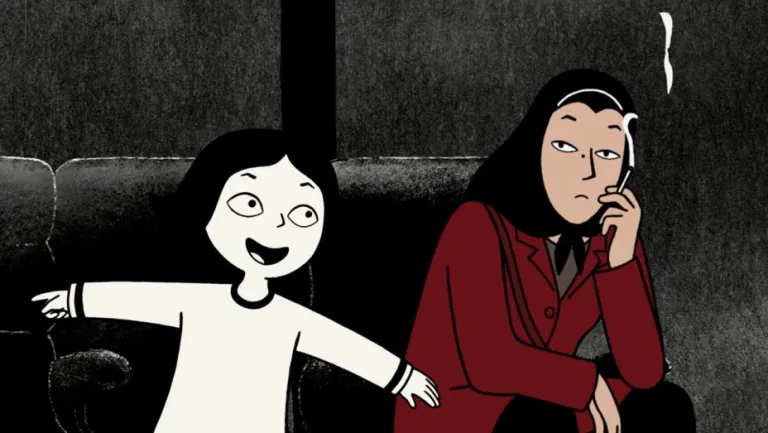
In my view, however, Persepolis is more than that. In adapting her own graphic memoir to the screen, Satrapi sacrificed neither humor nor formal sophistication. The film bears little resemblance to the hurried and superficial approaches found in many similar productions. From its opening moments, it succeeds in maintaining a fragile balance between tragedy and comedy. The child narrator’s perspective—necessarily shaped by the autobiographical nature of the source material—never entirely loses its vitality, even when confronted with death, repression, and war. This is what elevates the film beyond a purely political account and transforms it into a deeply human experience.
The film’s ending is among its greatest strengths. It leaves Marjane’s uncertain future unresolved while simultaneously turning the figure of her grandmother—whom the heartbroken young woman will never see again—into a symbol of a secular, modern Iran that is slipping away. Yet our task remains to examine what the filmmaker chooses to emphasize and what she leaves at the margins. Significantly, the film presents the freest period of the Islamic Republic’s first four decades as the moment when Marjane decides to leave Iran forever: the beginning of the reformist era under the presidency of Mohammad Khatami. This is not a detail that can easily be ignored. Whether consciously or unconsciously, the filmmaker insists that even at a moment when many people believed change was possible, ordinary life remained fundamentally unattainable. Both the older generation of political idealists and the younger generation coming of age appear trapped in disappointment.
Yet in a film of this quality, such choices become topics for meaningful discussion rather than evidence of artistic failure. This distinguishes Persepolis from less successful and more recent examples that merely reproduce worn-out visual clichés, such as Reading Lolita in Tehran, directed by Eran Riklis, a film that, in my view, lacks subtlety, complexity, and cinematic power.
From a stricter perspective, one might argue that the choice to make a film so deeply rooted in historical experience in the French language is somewhat questionable. Overall, the film can also appear excessively pessimistic, to the point where even the wise and compassionate advice of Marjane’s grandmother cannot soften its accumulated melancholy. The performances, the voices of actresses such as Danielle Darrieux, Catherine Deneuve, and Chiara Mastroianni, the mournful color palette, and the film’s brisk pacing all contribute to a pervasive sense of existential deadlock. It often feels as though Satrapi deliberately chose to keep hope at the margins of the narrative.
Nevertheless, her willingness to address the psychological costs of migration remains undeniable. Many films about exile portray the West as a land of salvation, but for Satrapi the equation is far more complicated. Failure to return to Iran, feelings of alienation in Austria, loneliness, depression, and identity confusion all become central elements of the protagonist’s experience. The intrusive expectations of relatives upon her return home, the habitual interference of those around her, and, conversely, her inability to feel fully at home in the new world all contribute to the sense of self-imposed exile that eventually defines her life.
There is a particularly memorable scene in which Marjane’s father recalls walking hand in hand with her mother through the streets of Tehran when they were fifteen years old. For many of us who have experienced the anxieties associated with life under the Islamic Republic, such a moment may appear ordinary. Yet it also demonstrates how an artist can approach the edge of one-sidedness without losing control of the work. In moments like these, the film moves beyond slogans and illuminates the fault lines of human emotion.
Still, the reality is that Persepolis is far from a flawless work. Part of that distance stems from its persistent focus on personal suffering. Satrapi repeatedly emphasizes what has been lost while showing less interest in acknowledging existing possibilities. One example is the remarkable openness of her parents. When she returns from Vienna, they honor their promise not to interrogate her about her experiences. Later, at the airport, before her final departure, they candidly tell her that what remains of Iran is no place for her and that she should understand there may never be a return. One could even read this as a tragic foreshadowing of Marjane’s destiny.
Similarly, when Satrapi depicts the end of the Iran–Iraq War, she offers an image in which Saddam Hussein appears to be bombing Tehran with the intention of erasing the city from the earth. While rooted in genuine lived experience, such moments occasionally verge on exaggeration. Some of the controversy surrounding the film may originate precisely from this tendency.
To be honest, I never connected with Satrapi’s later films. Although each contains interesting ideas—Chicken with Plums, The Voices, Radioactive, and Dear Paris—she remained, for me, essentially a one-film filmmaker. It was as though all her imagination, experience, and creative energy had been concentrated in Persepolis, while her subsequent works never achieved the same level of coherence.
Beyond filmmaking and her visual art—which, unfortunately, I have not seen extensively—her political engagement was equally significant. On the first anniversary of the “Woman, Life, Freedom” movement, she published a booklet that suffered from numerous problems in terms of factual accuracy, writing, and editorial quality. There were clear signs of haste and insufficient preparation. Yet even so, her solidarity with the Iranian people was valuable, particularly at a time when many prominent figures chose silence or accommodation with power.
Whatever one ultimately thinks of Marjane Satrapi—whatever one thinks of her political positions or the artistic value of her work—it is difficult to deny that, during an era in which opportunism often became the prevailing currency and many public figures ignored or normalized the suffering of millions of Iranians, she remained a distinctive and persistent voice. One may criticize certain aspects of her activism or question parts of her artistic legacy, but it is difficult to deny that for many years she was among the most recognizable voices of the Iranian diaspora in the world: a voice that spoke of exile and repression, of memory and displacement, and of a wound that will likely remain part of our collective conversation for a long time to come.
© 2020-2026. Phoenix Review