



War has always been one of cinema’s most enduring subjects. Since the earliest years of filmmaking, directors have sought to portray its many dimensions—from bloody battles and military heroics to civilian suffering and the devastating consequences of armed conflict. Among these works is a distinct category of films centered on the idea of the ceasefire: moments when enemies temporarily or permanently lay down their weapons, creating an opportunity for dialogue, empathy, and the restoration of humanity.
These films generally place less emphasis on military victory than on the value of peace and the shared experiences that unite human beings. Indeed, war and peace have long occupied a central place in cinematic storytelling. While many war films focus on combat, heroism, and triumph, films dealing with ceasefires explore those rare moments when the cycle of violence is interrupted and the possibility of reconciliation emerges.
From a sociological perspective, the representation of ceasefires is more than the depiction of a military event; it reflects broader social values, ideologies, and attitudes toward war, power, and humanity. In this context, a ceasefire is never a neutral occurrence. Its meaning is shaped by the filmmaker’s narrative, visual, and ideological choices.
When a film portrays a ceasefire, it is often redefining the very concept of the “enemy.” In conventional war narratives, the enemy is presented as a threatening and dehumanized figure. In films centered on ceasefires, however, this image is transformed. The enemy becomes someone fundamentally similar to “us.” This shift in representation constitutes one of cinema’s most important social functions in fostering a culture of peace.
Ceasefire: More Than a Military Agreement
In military terms, a ceasefire refers to an agreement between opposing parties to temporarily or permanently halt hostilities. In cinema, however, the concept acquires a deeper significance. It often becomes a symbol of hope, forgiveness, and the possibility of communication between people who might otherwise never understand one another.
Films about ceasefires tend to focus not on battlefield heroes but on ordinary individuals: exhausted soldiers, families devastated by conflict, and people searching for a path toward peace amid hatred and violence.
One of the key concepts in the sociology of war is the construction of boundaries between the “in-group” and the “other.” During wartime, governments and political institutions frequently mobilize public opinion by creating negative images of the enemy, and media often participate in reproducing these narratives.
Yet despite their positive potential, cinematic representations of ceasefires are not without challenges. Some critics argue that such films occasionally oversimplify the political and historical complexities of war. In certain cases, an excessive emphasis on shared humanity may obscure the role of power structures, economic interests, or ideological forces that sustain conflicts.
Moreover, some films portray ceasefires in a highly romanticized or idealistic manner that bears little resemblance to the harsh realities of political struggles. Sociological analysis must therefore address both the human and structural dimensions of war.
From this perspective, a ceasefire is not merely a temporary suspension of military operations but a symbolic moment in which identity boundaries, enemy stereotypes, and the logic of violence are challenged. By emphasizing shared humanity, collective suffering, and the possibility of dialogue, films about ceasefires strengthen the discourse of peace in opposition to the discourse of war.
These works remind us that war is not only fought on battlefields; it is also reproduced within culture and systems of meaning. Cinema can therefore function not only as a medium for depicting war but also as a vehicle for promoting peace and rethinking the concept of the “enemy.” In this sense, films about ceasefires can be viewed as part of a broader cultural effort to move beyond violence and toward coexistence and mutual understanding. The following films offer notable examples of this theme.
Joyeux Noël: The Most Famous Film About a Ceasefire
One of the best-known cinematic works dealing with a ceasefire is Joyeux Noël (2005). Based on a true story from the First World War, the film recounts the famous Christmas Truce of 1914, when German, French, and British soldiers stationed in opposing trenches spontaneously agreed to suspend hostilities.
The film depicts soldiers cautiously emerging from their trenches, gradually speaking with one another, exchanging gifts, and even organizing a football match. This brief truce demonstrates that many of those facing one another on the battlefield are not genuine enemies but victims of political circumstances and decisions made by distant leaders.
The film’s central message is that humanity can find a way to survive even under the harshest conditions. It powerfully illustrates how fragile national and political divisions can be when confronted with shared human emotions.
No Man’s Land: A Bitter Satire on the Futility of War
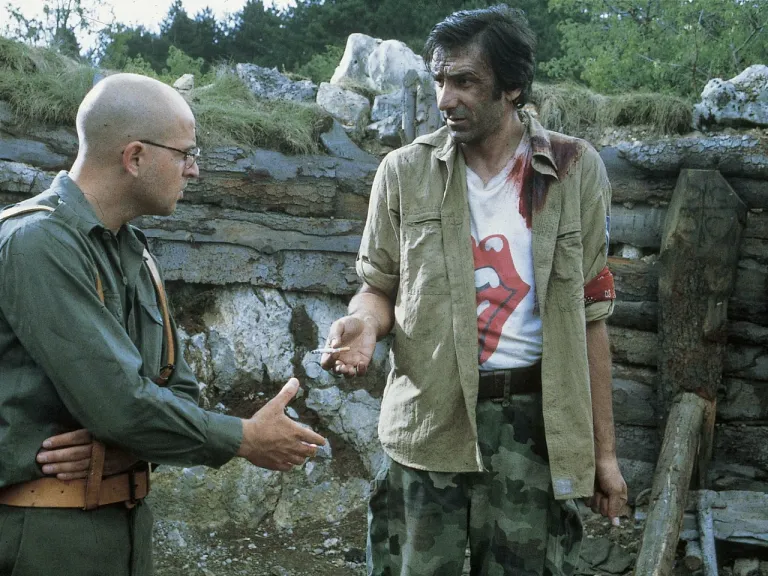
No Man’s Land (2001), which won the Academy Award for Best Foreign Language Film, is another significant work related to the idea of a ceasefire. Set during the Bosnian War, the story follows two soldiers from opposing sides who become trapped between the front lines.
As both factions attempt to manage the situation, United Nations forces become involved. Yet political and military complications render any straightforward solution impossible. Through a mixture of dark humor and tragedy, the film exposes the inefficiency of international institutions and the absurdity of many military conflicts. Here, a ceasefire is presented not as a grand achievement but as a basic necessity for preserving human life. The film encourages viewers to question the true meaning of enmity and the role of politics in perpetuating war.
The Burmese Harp: Music in the Service of Peace
The Burmese Harp is widely regarded as one of cinema’s great anti-war classics. Set in the final days of the Second World War following Japan’s surrender, it follows a group of Japanese soldiers attempting to persuade their comrades to accept that the war has ended and lay down their arms.
The film’s protagonist, a harp player, undergoes a profound spiritual transformation after witnessing the devastating consequences of war and ultimately dedicates his life to helping its victims. Although the story is not directly about a ceasefire agreement, it centers on accepting the end of conflict and embracing peace. The film suggests that the most difficult aspect of war is often not its beginning or continuation, but the willingness to accept its end and reconcile oneself with a new reality.
Merry Christmas, Mr. Lawrence: Friendship Amid Hostility
Released in 1983, Merry Christmas, Mr. Lawrence tells the story of Allied prisoners of war held in a Japanese camp during the Second World War. While the film does not depict a formal ceasefire, it presents an emotional and moral truce through the evolving relationships between prisoners and guards.
As the story unfolds, the characters come to recognize that beneath their cultural and national differences lie shared concerns and emotions. This mutual understanding gradually allows empathy to replace hostility.
The film reminds us that peace is not forged solely on battlefields; it is also created within the hearts and minds of individuals.
The Silent Mountain: Love in the Shadow of War
The Silent Mountain is a romantic drama set against the backdrop of the First World War. The film follows a love story between two individuals from different national backgrounds during a period when their countries are at war.
As the narrative progresses, viewers are confronted with the reality that political hostilities do not necessarily reflect the feelings of ordinary people. In this context, the ceasefire functions less as a military arrangement than as the dismantling of psychological and cultural barriers. The film demonstrates how human relationships can create the foundations for peace and mutual understanding even in the most difficult circumstances.
Conclusion
Many films dealing with ceasefires belong to the broader tradition of anti-war cinema. Rather than celebrating the victory of one side over another, these works seek to reveal the human costs of war. In such films, the ceasefire becomes a symbol of the return of reason and humanity.
Anti-war cinema emphasizes that every conflict, regardless of the reasons behind its outbreak, leaves profound scars. Loss of life, the destruction of families, ruined cities, and long-lasting psychological trauma are among its consequences. As a result, a ceasefire is portrayed not merely as a political decision but as a humane effort to prevent further suffering.
Films centered on ceasefires often have a powerful emotional impact because they preserve hope in the darkest circumstances. Whereas many war films focus on violence and combat, these works emphasize the possibility of change and reconciliation.
Viewers witness moments when people choose conversation over killing. Such scenes rank among the most moving in cinematic history because they demonstrate that even at the height of hostility, an alternative path remains possible.
Ultimately, films about ceasefires stand among cinema’s most compelling expressions of the desire for peace. They remind us that behind every military uniform stands a human being with dreams, loved ones, and emotions much like our own. Their shared message is simple yet profound: peace begins when people see one another not as enemies, but as fellow human beings.
In these films, a ceasefire is not merely the cessation of gunfire. It is an opportunity to rediscover human values and imagine a better future. For that reason, such works continue to inspire audiences around the world and retain their enduring relevance.