



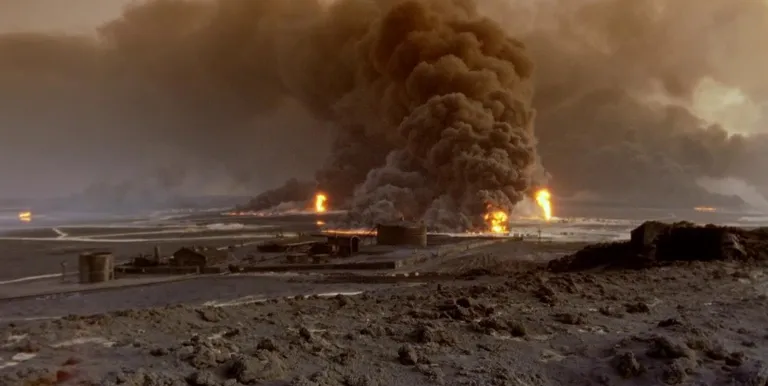
In 1992, Werner Herzog made Lessons of Darkness, a documentary about the aftermath of the Gulf War and the burning oil fields of Kuwait—a film about a scorched landscape consumed by uncontrollable fires, where water has given way to black oil, and where human suffering is both unmistakable and overwhelming. Yet Herzog’s approach bears little resemblance to conventional documentaries or journalistic accounts of war. Rather than presenting the catastrophe as straightforward reportage, he frames it through imagery drawn from religious theology and science fiction. The film opens with a quotation attributed to Blaise Pascal: “The collapse of the stellar universe will occur—as did its creation—in overwhelming splendor.” The attribution, however, is false. Herzog himself wrote the narration.
Herzog’s documentaries are, in many respects, forms of docu-fiction, in which fictional impulses often outweigh purely documentary concerns. He has long argued that this approach allows him to arrive at a deeper truth than one can achieve simply by pointing a camera at objective reality. By freeing documentary from the constraints of factual detail and supplementing reality with his own interpretation, Herzog expands individual events into something far more universal.
He has often remarked that he prefers to make films “with his knees and thighs” rather than with his head—with instinct and courage rather than intellect alone. This is, after all, the filmmaker who, when asked what his ideal film school would look like, famously replied that it would consist of nothing more than a boxing ring. Consequently, his documentaries operate on a far more emotional register than most. Rather than functioning as reports on reality, they possess an operatic quality, inviting powerful emotional responses without ever manipulating or coercing the viewer into feeling them.
The film is divided into thirteen principal chapters, introduced by intertitles: A Capital, The War, After the Battle, Findings from Torture Chambers, Satan’s National Park, Childhood, And a Smoke Arose Like the Smoke from a Furnace, Pilgrimage, Feast of the Dinosaur, Protuberances, The Drying Up of the Wells, Life Without Fire, and I Am So Tired of Sighing; O Lord, Let the Night Come.
Lessons of Darkness contains very little conventional narration or explanatory commentary. Instead, it focuses almost exclusively on the consequences of the First Gulf War—particularly the burning Kuwaiti oil fields—while deliberately withholding specific political or geographical information.
The destruction of Kuwait’s oil wells remains one of the greatest environmental and economic disasters in modern history. During their retreat from Kuwait, Iraqi forces set fire to more than seven hundred oil wells and petroleum facilities. The infernos burned for months, creating one of the most devastating catastrophes of the twentieth century. Herzog, however, sought to estrange viewers from images they had already grown accustomed to through relentless television coverage. As he himself explained, he wanted to go “deeper than CNN could ever penetrate.”
Using telephoto lenses, moving shots—many filmed from trucks—static compositions of workers laboring beside burning wells, and extensive aerial footage of Kuwait’s devastated landscape, Herzog avoids establishing shots almost entirely, constructing instead a vision of the apocalypse. As he once observed, “There is not a single frame in this film that can be recognized as our planet, and yet we know it was filmed here.”
His sparse narration detaches the images from their documentary context and relocates them within the realm of myth and fiction. The opening words read: “A planet in our solar system. Vast mountain ranges. Clouds. A land shrouded in mist.”
The narration is detached, almost awestruck. Herzog makes no attempt to explain the political causes of the disaster. Instead, he presents it as an epic tragedy, accompanied by Wagner’s monumental music. The workers are described almost as alien beings, driven by madness and an irresistible impulse toward endless destruction. In one of the film’s most haunting moments, shortly after the fires have been extinguished and the flow of oil restored, Herzog asks: “Has life without fire become unbearable for them?”
When Lessons of Darkness premiered at the Berlin International Film Festival, many audience members reacted angrily, accusing Herzog of aestheticizing the horrors of war. Herzog answered bluntly: “You’re all wrong!” He went on to argue that artists such as Hieronymus Bosch and Francisco Goya had approached catastrophe in much the same way.
Despite the controversy, the film received the Grand Prix at the Melbourne International Film Festival. In its survey of the best films of 1992, the Los Angeles Times called it “the year’s most memorable documentary,” describing it as “Herzog’s apocalyptic—and ultimately ironic—vision of the Gulf War.” Janet Maslin wrote that Herzog “uses his gift for eloquent abstraction to create images that are both shocking and disturbingly beautiful, portraying a natural world that has slipped beyond human control.” J. Hoberman described it as “the culmination of Herzog’s romantic apocalyptic worldview.” Rachel Jones Turbett found the film simultaneously “astonishingly beautiful” and “profoundly ambiguous,” arguing that its deliberate omission of geopolitical context leaves its intentions intriguingly unresolved.
Lessons of Darkness is not merely about humanity’s cruelty toward other human beings. It is equally about humanity’s hostility toward the world it inhabits. A primordial rage, an ancient wrath, is inscribed upon the screen with terrifying force, accompanied by echoes of Christian theology, legends of Atlantis’s final days, and music by Verdi, Schubert, Wagner, and Mahler.
The devastation portrayed in the film is so immense and all-encompassing that it compels viewers to question the very meaning of existence itself. How can human beings become so merciless toward the Earth, toward nature, and toward one another? Forget humanity. Forget love. Forget dignity. Death, destruction, lifelessness—and above all, terror—govern everything. We are living, and in living we seem to be descending toward the deepest floor of an immeasurably dark sea.
The film introduces us to two women. The first has lost the ability to speak after being forced to witness the torture and murder of both her adult sons. The second recounts how black liquid seeped from every opening in her son’s head before a soldier crushed his skull beneath his boot. She, too, has fallen silent. Herzog never tells us who these women are or identifies those responsible for their suffering. They are simply victims of an unspeakable war.
Even the American firefighters appear less like rescuers than arsonists—or perhaps extraterrestrial beings. They construct elaborate machines seemingly designed to extinguish the fires. Yet, with a mixture of horror and fascination, we watch them deliberately reignite the flames, launching fireballs into erupting oil fountains because, in Herzog’s vision, they—and by extension we ourselves—appear incapable of living without fire, destruction, and war. Lessons of Darkness is not only about Kuwait. It is about an entire world addicted to oil and to wars fought over oil. What Herzog records is nothing less than an image of our own decline.
One cannot watch Lessons of Darkness and merely conclude, “Yes, the Gulf War was a tragedy.” The film demands something more unsettling: that we ask what role we ourselves have played in bringing about such wars and such catastrophes. Millions of planets drift through the cold emptiness of space, dark and lifeless, or consumed by fire, bearing no trace of life. Perhaps such a future awaits our own planet. Lessons of Darkness is ultimately about that terrifying possibility. In this sense, it remains an astonishingly prophetic—and profoundly cautionary—film.
© 2026. Phoenix Review