



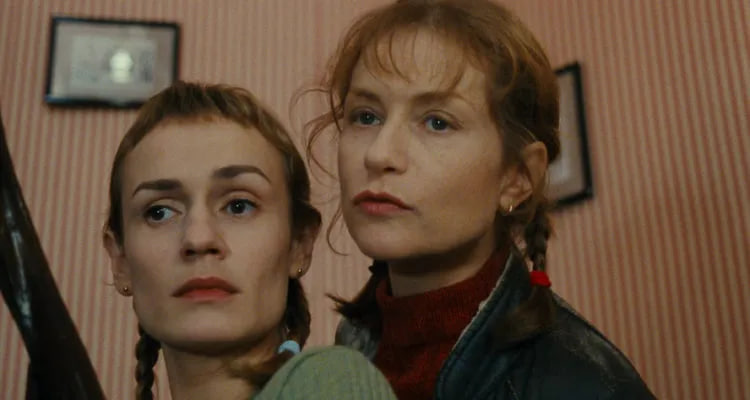
La Cérémonie is a meticulous drama centered on a realistic crime rooted in class conflict and the suppressed complexes of two women, culminating in a shocking orchestration of a mass murder of a wealthy family—making the title La Cérémonie (The Ceremony) a clever choice for this intelligent work. Claude Chabrol, a prominent French writer, director, and actor, was one of the founders of the French New Wave cinema and a well-known critic for the prestigious magazine Cahiers du Cinéma. His entrance into cinema was not through formal education but rather hands-on experience, working on film sets and writing critiques.
Over sixty years, he transitioned from producing others’ works to filmmaking, becoming one of France’s most prolific filmmakers, known for his distinct critical and theoretical perspectives that are traceable throughout his films. Coming from the bourgeois class, Chabrol believed he had a naïve childhood but developed a sharp gaze focused on the unseen aspects of human relationships within French society, emphasizing social status. The result was a body of work marked by critical, crime, suspenseful, pathological, and somewhat psychoanalytic themes about the consequences of living in such a social class.
The French New Wave filmmakers’ admiration for auteurs like Alfred Hitchcock, which led to the publication of a book on the master of suspense, is most apparent in Chabrol’s films, earning him the reputation as the French Hitchcock—albeit with a uniquely French style, tone, and subtlety. After four decades of filmmaking, in 1995 Chabrol adapted La Cérémonie from Ruth Rendell’s novel A Judgement in Stone (1977), which was inspired by the real-life story of two French maids, Christine and Léa Papin, who brutally murdered their employer and her daughter in Le Mans, France, in 1933.
This tragedy became a symbol of working-class struggle and exploitation, deeply influencing French intellectual society, including Jean Genet, the poet, novelist, and playwright, who created the play The Maids, staged in 1947 under Louis Jouvet’s direction. Ruth Rendell’s novel, which relocates the story to 1970s England, focuses on the class conflicts of English society and is considered one of her successful works, notable in the global crime literature for its suspense and tension. The screenplay for La Cérémonie was written by Chabrol and Caroline Eliacheff (co-writer of Abbas Kiarostami’s Certified Copy), earning them a nomination for Best Screenplay at the French César Awards.
La Cérémonie won the César Award for Best Actress for Isabelle Huppert, the Best Foreign Film Award from the Los Angeles Critics, the Volpi Cup for Best Actress at the Venice Film Festival for both Huppert and Sandrine Bonnaire, and received nominations for the Golden Lion at Venice along with other awards and recognitions from prestigious international film festivals.
The film focuses on a wealthy suburban family of four, where the lady of the house, Catherine (Jacqueline Bisset), hires a new maid, Sophie (Sandrine Bonnaire). Sophie, who is illiterate, keeps this secret from everyone. Her acquaintance with Jeanne (Isabelle Huppert), a postal clerk’s daughter, leads her into an adventurous and dangerous path.
At first glance, this quiet beginning—especially given Sophie’s introverted, calm, and reserved nature, alongside the aristocratic family’s demeanor (a mother who is an art gallery owner, a father who loves opera, a poised young daughter, and a teenage son), and the still atmosphere of the suburban villa—does not suggest it will lead to tension, anxiety, and suspense.
However, this is precisely what happens: the film gradually escalates into a full-fledged crime drama soaked in blood, transforming the initial coldness, stillness, and stagnation into a burning heat beneath the surface. This heat arises from a deeply rooted desire for revenge in the two young women, Sophie and Jeanne, who navigate a fine line between their personal and social dramatic needs as members of their class. This characteristic turns their trajectory into that of two cold-blooded killers—surprising and unexpected but not unbelievable.
The filmmaker has crafted reasons behind the initial hatred Sophie and Jeanne feel toward the aristocratic family and given a questionable past to explain their violent tendencies, but stops short of giving absolute certainty, preserving the ambiguity that shadows their downfall until their shocking final act.
Thus, the gradual friendship between the two women, grounded in shared wounds and especially Jeanne’s influence on Sophie, opens a path to intimacy and secrets—a dramatic and believable progression. Their interaction begins with conversation, fun, and mischief but quickly escalates like an unstoppable flood that obliterates anything in their way.
This transformative descent especially affects Sophie, who, akin to a passivity before the television screen, dissolves into Jeanne’s ideas and gradually shirks her responsibilities as a maid, becoming Jeanne’s calculating accomplice, intoxicated by revenge without regard for consequences.
Their downward spiral results not only from their interactions with the aristocratic family throughout the film but also from the calculated subtext reflecting their degraded status as members of the lower class, which Chabrol succinctly yet effectively portrays.
A prime example of this subtle marking is a seemingly simple dinner table conversation among the wealthy family members about the new maid’s arrival. Despite the elegance and dignity of their speech, an undercurrent of violence and hidden contempt flows beneath their casual jokes, turning this scene—though Sophie is absent—into a planting of the seed for the final violence, witnessed only by the audience.
In the lengthy murder sequence that unfolds according to the formal rituals of the aristocratic family’s nightly routine, all previous setups pay off. From the gun on the wall to the opera music, every element gains dramatic function, enhancing the shocking intensity of the violent climax.
This grotesque situation extends the playful rebellion of the two women into a real revenge, leaving behind a bloody trace of their repressed grievances and social class in a gripping drama—marked by cruelty and cold-bloodedness.