



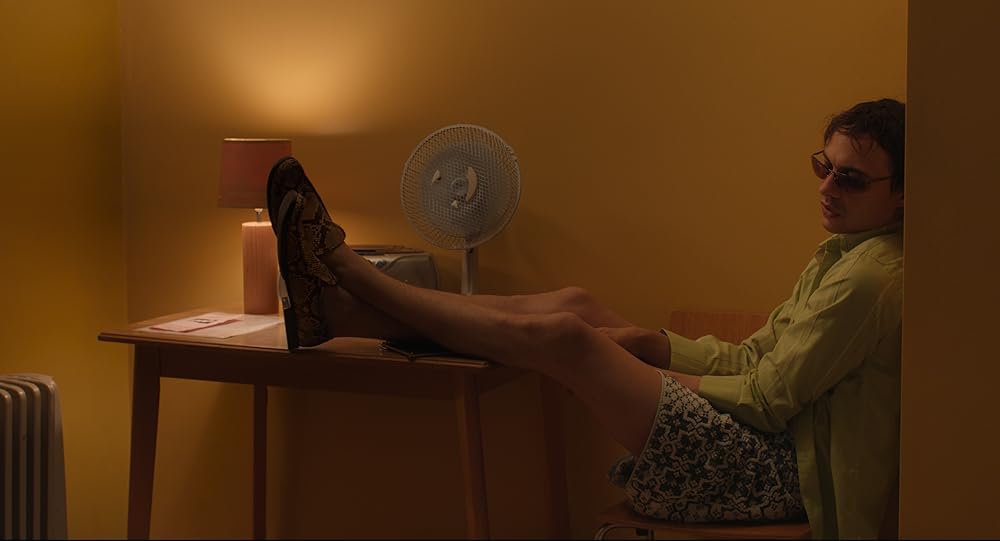
Harris Dickinson’s directorial debut Urchin, which premiered in the Un Certain Regard section at Cannes 2025, is not just a film about homelessness—it is a lyrical, unsettling meditation on what it means to be caught in cycles of trauma, recovery, and relapse. Centered on Mike (played with raw vulnerability by Frank Dillane), a young man struggling to survive on the streets of London, the film moves beyond mere social realism to explore the psychological terrain of alienation, memory, and fractured selfhood.
Urchin opens with moments of quiet desperation: Mike scavenging for food, navigating the blurred moral codes of survival, and ultimately falling into incarceration after an impulsive act of theft. Upon release, a tentative path to reintegration emerges—he takes a job, attends therapy, even meditates. But as Dickinson’s narrative structure reveals, trauma is not linear. The past returns in unpredictable waves, destabilizing every fragile step forward.
The film, Dickinson has said, was inspired by his work with grassroots homeless initiatives in London, particularly Project Parker and Under One Sky. These experiences lend the film a deep sense of immediacy and ethical engagement. But Urchin is not a documentary; nor does it fall into the trap of miserabilist social cinema. Instead, Dickinson draws on both British realist traditions (Mike Leigh, Shane Meadows, Ken Loach) and the poetic ruptures of filmmakers like Agnès Varda and Leos Carax, infusing the film with surreal, almost hallucinatory passages that mimic the psychological distortions of trauma. Nature scenes, dreamlike flashbacks, and fractured monologues punctuate the realism with moments of metaphysical disorientation.
From a philosophical standpoint, Urchin is a compelling case study in Adam Smith’s theory of sympathy. Smith, in The Theory of Moral Sentiments, posited that moral understanding arises from the spectator’s capacity to imaginatively “enter into” the feelings of another. Dickinson’s camera, often lingering on the quiet minutiae of Mike’s daily existence, invites us into this space of feeling-with—of sympathy as a mode of moral attention. But Urchin also troubles this very notion: can we truly feel with Mike? Or are we simply watching him from the safety of aesthetic distance?
Dickinson is acutely aware of this tension. As he notes in interviews, he deliberately stripped away Mike’s backstory in the final script, not to obscure meaning but to keep the focus on present action, on the “unraveling in the moment.” This dramaturgical choice challenges the viewer to understand Mike not as a case study or victim, but as a human being in flux. We are not given easy causal explanations; instead, we are asked to sit with discomfort, ambiguity, and contradiction.
Frank Dillane’s performance is at the heart of this strategy. There is a charm, even a flicker of seduction, in Mike’s presence—an echo, perhaps, of what Dickinson observed in those living rough: a charisma born of necessity, of needing to negotiate the world without shelter. But Dillane also reveals the fragility behind that charm, the exhaustion beneath every grin. The result is a character we do not always like, but cannot easily forget.
And yet, as much as Urchin seeks to elicit empathy, it also provokes critical reflection on the limitations of spectatorship. What does it mean to “care” about homelessness through cinema? Dickinson does not offer solutions. Rather, he exposes the fragility of well-meaning interventions, the difficulty of rehabilitation when trauma is not addressed, and the instability of sympathy that lacks structural support. Adam Smith imagined an “impartial spectator” who could feel justly; Urchin asks whether such spectatorship is ever truly possible—or even desirable—in a world so defined by inequality.
In its closing scenes, the film resists closure. There is no redemption, only a return to the street, to the loop.
In doing so, Urchin quietly subverts narrative expectations and affirms Dickinson’s voice as one not only of cinematic promise but of moral seriousness. This is not a film that resolves; it reverberates.