



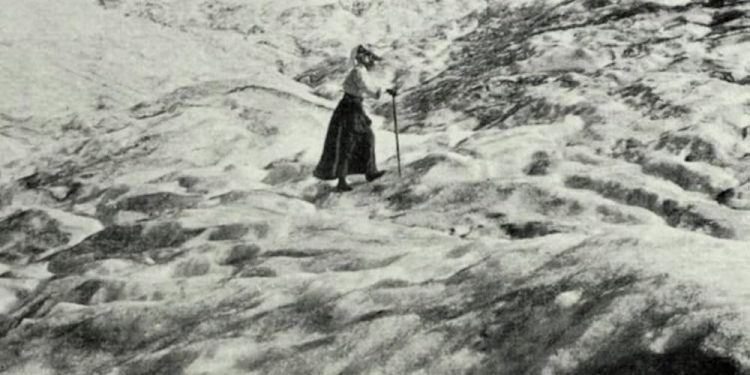
A slow vertical pressure works through Louise Hémon’s The Girl In The Snow, premiering at this year’s Director’s Fortnight at Cannes. Aimee (Galatea Bellugi), a young French woman, arrives at Soudain, a remote mountain town in 1899, to tutor the village children. She’s not exactly welcome, immediately butting up against the locals desire to preserve their customs and language (down to the sound a cow makes: “broo! broo!”)
Hémon and cinematographer Marine Atlan repeatedly capture the somewhat steep walk from where Aimee’s staying down into the village. They pull out to show the snow covered mountain and the shrinking inhabitants climbing and descending. In the dark and in the light, the mountains strain against gravity, mirroring the push and pull between Aimee and the people she’s supposed to teach.
Aimee reads Descartes at night. She absorbs the lofty ideas about the meaning of our existence but also runs her fingers across the unintentionally alluring lines of the book’s illustrations. Early on she forces a bath on a couple of her young students. The local women object after the fact, insisting that she removed a protective layer of crust from the top of their skulls. From Descarte’s pineal gland to this scalp crust, everything is pushing down from the top.
The tension between Aimee and the village heightens well, with both sides’ perspectives given weight. An avalanche is coming. Aimee has sex with a young man who goes missing. The search is on, but the village is kind of stoic about it. Bellugi plays the part of Aimee with a restrained fieriness, her eyes blazing, thoughts churning constantly. She represents reason and the logical embrace of the future, but the emotional outbursts are mostly hers. In one scene, she storms off at night. She abandons her native language to mockingly yell “broo! broo!” at a house full of villagers. She gets mad at the arbitrary nature of language. She has seemingly good intentions but has to balance imposing her ideas of a proper education with desires and a need for survival that are universal.
The history of French colonialism is ever present in the film, those that know better. We see in today’s news how those in power can promise a better future to excuse pain inflicted today. Someone might say they are going to colonize Mars and make sentient artificial intelligence and save human civilization as a massive con job or sincere self delusion. It is usually just an excuse to justify holding as much power as possible. At one point, Aimee asks her pupils to imagine life in the year 2000. They rightfully answer that all of them will be dead by then.
I felt some similarities to The Wicker Man(1973) in a good way. Although a little less out there than the Christopher Lee classic, Soudain works as a winterized counterpart to Summerisle. And opposite to the devoutly christian Sergeant Howie, it is Aimee who seems to introduce sexuality into the bundled up, snowed in world of Soudain. The rest of the cast portraying the village locals, from the children to the old folks, do very well. Their ways can be strange, but they almost wrestle the point of view from Aimee. It’s the story of an outsider, but all perspectives are shown and felt sincerely.
The score intensifies the suspense by magnifying the isolation, eeriness and frigidity. It foreshadow’s Aimee’s own fate, which will echo through the mountains. It all helps the movie build masterfully and come to a conclusion that is both satisfying and open-ended. The snow has melted from the mountains and we see a man eat a truly gigantic hunk of cheese. A final arresting image from a very good film. Who knows what sound the animal made who gave that cheese?