



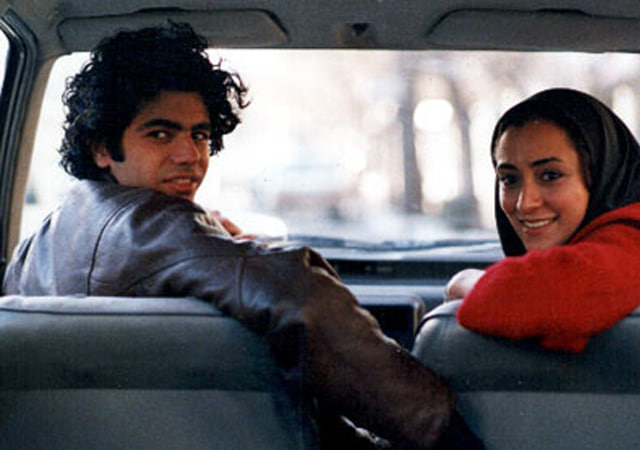
The film Deep Breath is a modern drama centered on the aimless wanderings of two young individuals disillusioned with existence, paralleling life and death, who express their protest in a quietly defiant manner. Even love offers no salvation, and rescue lies dormant in the grave.
Parviz Shahbazi, a screenwriter and director, began his cinematic journey in the 1990s with films like Traveler from the South and Whisper, which focused on children and adolescents. These early works, recorded with a sense of curiosity, gained attention at both domestic and international festivals.
Having previously entered cinema through short films and the initial story outline of Jafar Panahi’s The White Balloon, Shahbazi from the start emphasized the importance of the screenplay in his works, making it a core strength and a distinguishing feature of his films.
In 2002, Shahbazi directed his third feature film, Deep Breath, based on his own screenplay. The film became a major highlight at the 21st Fajr Film Festival, winning the Crystal Simorgh for Best Screenplay and receiving nominations for Best Director, Best Film, Best Art & Experience Film, and Best Actress (Maryam Palizban).
Internationally, Deep Breath received the FIPRESCI Prize at the Busan Film Festival, the Special Jury Prize at the Turin International Film Festival, the Golden Prize at the Hamburg International Film Festival, and a nomination at Cannes. It was also Iran’s official submission to the 76th Academy Awards (2003).
Although the film drew attention from critics and discerning audiences at its premiere at the Fajr Festival, it did not achieve widespread success during its general release in October 2003. Nevertheless, it became a subject of analysis, critique, and study from cinematic, artistic, sociological, and behavioral perspectives, ultimately becoming a cult and exemplary film in Iranian cinema, cherished by cinephiles.
Even after 23 years, Deep Breath remains worthy of viewing and examination due to its innovative approach to drama and character development, the alignment of form and content, its reflection of contemporary society, and its resonance with the historical disillusionment of multiple generations—qualities that keep it vibrant and relevant.
The film presents a linear narrative following the gradual and accidental companionship of three lost young people with a realistic perspective. Through its fluid form, it blends the flow of consciousness, dreams, and nightmares. In the end, the audience is left to interpret the fates of the characters through subtle cues and carefully planted narrative elements.
In such a drama, even on paper, the story arises from realism in everyday life, portraying people we pass by every day. By casting fresh actors and non-professionals, the filmmaker adds an unpredictability that makes what appears on screen truly authentic, unlike repetitive characters and films of that era.
The narrative structure plays a key role in expanding the film’s universe from a static, limited drama to a slow-moving exploration in width and depth. This aspect elevates Deep Breath from a purely social protest film to a modern, innovative, and unpredictable work, capable of expanding according to the audience’s mindset.
The film begins and ends with two similar sequences that act as narrative anchors. These sequences—featuring a car plunging into a lake, the drowning of two unidentified youths, and a road—are meaningfully interconnected.
In the opening sequence, these elements are presented in scattered dramatic cues and linked visually to the introduction of the two main characters, Kamran (Saeed Amini) and Mansour (Mansour Shahbazi), forming the central portion of the film.
In the middle section, these cues are developed through the depiction of the daily, aimless lives of the two young men, eventually culminating in a conclusion in the final sequence, completing the film’s circular narrative.
Between these sequences, the drama unfolds alongside Kamran and Mansour’s stagnant daily lives. The two disillusioned, wandering characters seem like two sides of the same generational coin, complementing each other despite differences in background, social class, and temperament.
Their silent friendship and mutual understanding drive anarchic actions such as breaking a car side mirror, vandalizing a phone booth, scratching a luxury car, and stealing a mobile phone—without these acts actually improving their emotional state.
In this swamp of hopelessness, Kamran appears several steps ahead of Mansour, but the introduction of a third character, Ayda (Maryam Palizban), brings a brief breath of life to Mansour, the audience, and the film, offering love as a balm to incurable wounds.
Yet in the world Shahbazi has created—like a mirror reflecting the unspoken challenges of youth—there is no path to salvation. Even love fades, unable to satisfy the simplest desires, such as admiring Ayda’s hair. In this condition, Mansour and Ayda choose to embrace the final moments of life with the remnants of love, embarking on the same fateful path as the two drowned characters from the opening sequence.
While Deep Breath focuses its drama on three central characters from Iran’s 1990s youth generation, Shahbazi skillfully constructs a dark, hopeless world without resorting to unnecessary exposition. In this narrative space, any disillusioned generation, from any time or place, can find itself represented. Hence, beyond the film’s individual characters, the drama can reflect the condition of any shattered generation—even after 23 years.