



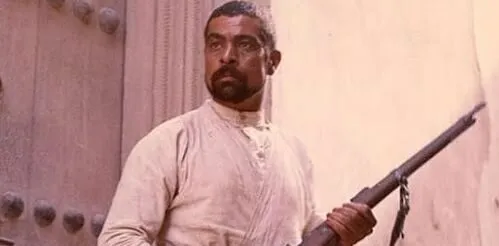
The film Tangsir is a straightforward revenge drama that follows its protagonist, Zarmemd, through a challenging journey of justice, depicting his personal transformation and culminating in a symbolic finale of taking the plunge.
Amir Naderi, a self-taught filmmaker and experimental director of Iran’s New Wave, entered cinema in the 1960s through photography. In 1971, he made his directorial debut with Goodbye Friend, marking the beginning of his intense and passionate relationship with filmmaking.
In 1973, Naderi produced three significant films spanning different genres: the children’s film Sazdehni, the urban drama Tangeh, and the literary adaptation Tangsir, which portrayed the struggle for justice in a local community.
Sadegh Chubak, one of the pioneers of modern Iranian storytelling, was a realist writer with a critical eye on society and its people, exploring themes of religion, superstition, ignorance, and passivity. Author of plays, short stories, novels, and translations, Chubak wrote Tangsir in 1963, later translated into 18 languages. The story, based on real events and names, is set in the Tangsestan region, whose inhabitants are called Tangsiri or Tangestani.
Ten years after the novel’s publication, Naderi decided to adapt it into a film, writing the screenplay himself. To expand the story into his own cinematic vision, he conducted field research and interviews with surviving witnesses, ensuring fidelity to Chubak’s novel while incorporating his personal interpretation of the events. Notably, Naderi once mentioned in a screening session that his father had seen Zarmemd with a gun in their neighborhood during his childhood.
The film, with cinematography by Nemat Haghighi, editing by Mehdi Rajaian, music by Loris Tjeknavorian, and produced by Ali Abbasi, achieved critical acclaim domestically and internationally. Naderi won Best Director at the Sixth Sepas Film Festival (1974), and Behrouz Vossoughi received Best Actor at the Delhi Film Festival.
Tangsir presents a linear, clear narrative of everyday life among local people, following Zarmemd (Behrouz Vossoughi), whose hard-earned capital has been seized by local authorities. Early provocations, such as an incident involving Sakineh (Mehri Vdadian) and a rebellious cow, trigger Zarmemd’s transition from dialogue and negotiation to decisive, personal action.
Symbolically marked by his use of an old gun and axe, Zarmemd leaves his wife, Shahro (Nouri Kasra’i), and children to pursue a personal, violent revenge. Throughout the story, he undergoes a moral and psychological transformation, taking actions that defy the law and initially appear reckless or insane.
Gradually, the audience understands the inevitability of Zarmemd’s chosen path, and the surrounding villagers shift from initial criticism to support, recognizing his struggle as a pursuit of justice. Zarmemd eventually completes his mission, escapes authorities, and symbolically passes his responsibilities to a younger generation by entrusting a gun to a local youth.
Through this approach, Tangsir delivers a compelling, accessible, and authentic narrative grounded in timeless concepts such as justice, courage, revenge, resilience, and family. Naderi’s realist and experimental cinematic style, combined with the presence of prominent actors, makes the film a notable and thought-provoking work in the careers of all involved.