



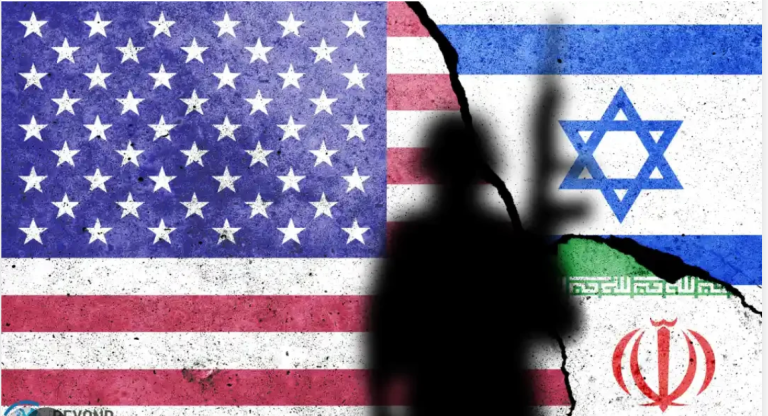
In the early hours of February 28, 2026, the Middle East—and Iran in particular—entered one of the most complex, devastating, and historically decisive phases in its modern history. A military coalition led by the United States and Israel launched an unprecedented wave of coordinated attacks against the Islamic Republic of Iran. The stated objectives of the campaign were regime change, the destruction of Iran’s nuclear and missile infrastructure, and the end of decades of regional proxy warfare and geopolitical confrontation.
Within the first twelve hours of the operation—codenamed Epic Fury by the Pentagon and Operation Roaring Lion by the Israeli military—nearly 900 strikes targeted strategic locations across Iran, including Tehran, Isfahan, Karaj, and Kermanshah.
The most shocking moment came almost immediately: the killing of Ali Khamenei inside his security compound in Tehran, alongside several of the regime’s highest-ranking military and security officials, including Mohammad Pakpour, Aziz Nasirzadeh, and Ali Shamkhani. When Iranian state media officially confirmed Khamenei’s death on March 1 and declared forty days of national mourning, reactions inside and outside Iran became sharply polarized.
For many Iranians—both within the country and across the diaspora in cities such as Los Angeles—the event was celebrated as a historic moment of liberation and the symbolic end of decades of religious authoritarianism. Anti-regime demonstrations erupted almost immediately. At the same time, supporters of the Islamic Republic and its regional allies organized mourning ceremonies and vowed severe retaliation.
Yet the brutal reality of war revealed itself far sooner than many expected. A missile strike on the Shajareh Tayyebeh elementary school in the city of Minab, located near a Revolutionary Guard military base, killed more than 165 children and civilians. Images of the massacre spread rapidly across social media and became a defining emotional and political turning point in public discourse surrounding the war.
Out of this tragedy emerged a distinct political and intellectual current within parts of the Iranian opposition—what may be described as a “third way” position or a doctrine of absolute pacifism at any cost.
This movement adopts a stance that appears morally principled yet is deeply contradictory. On the one hand, its supporters are fiercely opposed to the Islamic Republic and openly welcomed the death of Iran’s Supreme Leader. Many of them personally experienced or were traumatized by the regime’s brutal crackdowns, especially the mass killings during the protests of late 2025 and January 2026, which have been described as the deadliest state repression since 1979.
On the other hand, they are equally hostile toward American and Israeli military intervention, viewing both powers as imperialist aggressors devoid of moral legitimacy. Pointing directly to atrocities such as the Minab school bombing, they argue that the war must be stopped immediately and unconditionally in order to prevent further civilian deaths. Their commitment is not to either side of the conflict, but to the immediate cessation of violence itself. In this framework, peace becomes the supreme ethical principle, detached from questions about who ultimately holds power in Iran after the war ends. According to this logic, the future political order of the country is secondary; ending the machinery of destruction is the only absolute priority.
This analytical essay seeks to examine that position through the lens of political philosophy, international relations theory, and the intellectual history of pacifism, particularly as debated during the First and Second World Wars. The central question is why the doctrine of “peace at any cost,” despite its humanitarian intentions, often collapses into severe moral and strategic contradictions when confronted with a totalitarian or fascistic regime.
The aim is not to dismiss the ethical horror of war or minimize civilian suffering. Rather, the goal is to interrogate whether an unconditional commitment to peace can itself become ideological—so absolute that it loses the ability to distinguish between different forms of violence, different political outcomes, and different historical consequences.
This essay argues that neutrality toward the future political structure of Iran is neither morally sustainable nor politically coherent. In some historical circumstances, supporting a war aimed at dismantling a greater systemic evil may itself become the more defensible ethical position—even for those genuinely committed to peace.
The following sections therefore first outline the geopolitical and military dimensions of the current conflict, before turning to the intellectual roots of pacifism and finally evaluating the structural weaknesses of absolute anti-war politics in the context of contemporary Iran.
Part One: The Geopolitical Earthquake — War, Regime Collapse, and the End of the Status Quo
Any meaningful critique of political positions regarding an ongoing war must begin with a clear understanding of the war itself: its scale, objectives, and consequences. The tension between strategic goals—such as dismantling authoritarian infrastructure—and catastrophic civilian casualties, such as the Minab school tragedy, lies at the center of the pacifist argument.
1.1 The Scale and Intensity of the Coalition Operation
The military campaign known as Epic Fury marked a dramatic departure from previous limited deterrence operations in the region. Rather than merely containing Iran, the coalition openly pursued systematic regime destabilization and structural military collapse.
Donald Trump described the operation as a decisive campaign intended to eliminate long-standing threats to American security while giving the Iranian people what he called “a historic opportunity” to reclaim control over their country.
This represented a fundamental shift from diplomacy—negotiations that had reportedly continued until only days before the attack—to direct military confrontation, signaling the breakdown of traditional containment strategies.
Beyond the assassination of senior leadership figures, the strikes targeted large portions of Iran’s air defense systems, ballistic missile facilities, drone-launch infrastructure, and military airports. The campaign was not designed as symbolic retaliation, but as a comprehensive attempt to dismantle the operational foundations of the Islamic Republic’s military power.
1.2 Reactions and Human Casualties
In response to the attacks, the Islamic Republic launched hundreds of missiles and drones toward American bases in Iraq, Kuwait, Qatar, Bahrain, the UAE, and Jordan, as well as targets inside Israel. The exchange caused numerous military casualties, including the deaths of at least three American soldiers and dozens killed or wounded in Israel.
Yet what affected public opinion most profoundly was the scale of civilian suffering inside Iran itself. Alongside reports of more than 200 deaths on the first day alone, the massacre at the elementary school in Minab—where over 165 children lost their lives—quickly became the defining symbol of anti-war sentiment. Images of dead schoolchildren circulated across social media and transformed the tragedy into an emotional and moral rallying point for those arguing that no political transformation, regardless of its goals, could justify such a price in innocent blood.
1.3 The Split Within the Opposition: The Emergence of the “Third Way”
These developments created a deep ideological fracture within the Iranian opposition.
On one side stood monarchists and supporters of Reza Pahlavi, along with parts of the diaspora community, who openly described the attacks as a “liberation campaign.” Demonstrations in cities such as Los Angeles celebrated the intervention and called for the overthrow of the Islamic Republic by any means necessary.
On the opposite side, organizations such as the National Iranian American Council strongly condemned the U.S. and Israeli attacks, warning that the war could lead not to democracy but to state collapse, civil war, and catastrophic bloodshed.
Meanwhile, groups such as the People’s Mujahedin Organization of Iran and the National Council of Resistance of Iran claimed that they alone represented a legitimate “third way”: a democratic alternative capable of achieving regime change internally, without dependence on foreign bombing campaigns.
At the same time, left-wing feminists and activists associated with the “Woman, Life, Freedom” movement attempted to articulate a different position altogether. While emphasizing the regime’s long history of repression and violence, they also condemned Israeli military intervention and sought to defend a political path opposed both to domestic authoritarianism and foreign imperialism.
It is precisely this final current that this essay seeks to examine critically: a political tendency that, largely indifferent to the balance of power or the eventual political outcome, focuses almost exclusively on one immediate demand—the silencing of the bombs.
Part Two: The Genealogy of Pacifism — From Romantic Idealism to Political Realism
To properly understand and critique the Iranian current advocating “peace at any cost,” it is necessary to revisit the philosophical and historical foundations of pacifism within modern political thought. Should one always remain pacifist under all conditions? The essential question is deceptively simple: Should one oppose war absolutely?
This question typically emerges at the precise moment when ordinary life collapses and war becomes unavoidable. As Herodotus famously observed: “No one is foolish enough to prefer war to peace.” The preference for peace is almost instinctive; human flourishing is only truly possible under conditions of stability, and no one genuinely desires death on a battlefield.
But such a broad and abstract definition is ultimately insufficient. The real question emerges once war has already begun and has been imposed upon a society. At that point, what exactly does “being pacifist” mean? If the outbreak of war is no longer within our control, what ethical lessons follow from that reality? Does preferring peace require refusing all resistance and passively accepting the violence imposed by others? Throughout modern intellectual history, these questions have produced two radically different traditions of thought.
2.1 Absolute and Abstract Pacifism
The first tradition defends a form of total and uncompromising pacifism—anti-militarist, anti-nationalist, and grounded in the belief that one must never “add another war to war.” Its most famous representatives include Leo Tolstoy and Mahatma Gandhi.
Tolstoy, deeply shaped by the horrors of the Napoleonic Wars depicted in War and Peace, rooted his philosophy in a universal Christian ethic of love and nonviolence. In 1897, he argued that genuine peace depended on a simple moral realization: that killing could never be justified. His ideas profoundly influenced Gandhi, to whom he wrote in 1909 that both of them were engaged in the same struggle—“the struggle of gentleness against violence, of love against arrogance.” On the eve of the Second World War, however, some intellectuals pushed this logic toward far more troubling conclusions.
Jean Giono, traumatized by the First World War, declared that he opposed all wars under every circumstance and at any price. Even if Hitler, Mussolini, and the Pope occupied France and Russia, he insisted, war would still be unjustifiable because nothing was worth the death of a human being. After the Munich Agreement of 1938, he famously proclaimed: “I am ashamed of all wars, never of peace.” Similarly, Nobel Prize-winning writer Roger Martin du Gard argued in 1936 that “everything is preferable to war—even fascism in France. Hitler is better than war.”
This logic closely resembles the position adopted by sections of the contemporary Iranian anti-war movement. Faced with the horrifying images from Minab, many have reached the conclusion that the survival of the Islamic Republic is preferable to continued bombing—that literally anything is better than war itself.
Yet, as Jean-Paul Sartre argued in War Diaries: Notebooks from a Phoney War, this position often becomes a form of radical but ultimately ineffective moral theater. Sartre observed that even if an individual refuses to fight, hides, or escapes, they cannot escape the condition of being in a world at war. War transforms the entire structure of political existence whether one personally consents to it or not.
The 2026 war against the strategic infrastructure of the Islamic Republic fundamentally altered Iran’s political reality. Moral refusal alone cannot erase the existence of war or the historical conditions that produced it—whether nuclear ambitions, regional proxy violence, or decades of internal repression.
From this perspective, absolute pacifism risks becoming politically dangerous precisely because it refuses to identify oppressive power as an enemy. By collapsing all forms of violence into a single moral category, it may unintentionally weaken forces seeking liberation while enabling authoritarian structures to survive under the banner of “peace.”
2.2 Realist Pacifism
In contrast to absolute and idealistic pacifism, there exists a second approach—one that requires abandoning the comfort of abstraction and accepting a degree of political realism. This form of pacifism does not seek peace through surrender to oppressive violence; rather, it understands that preserving peace may at times require the legitimate use of force and the right of self-defense in order to protect higher values such as freedom and justice.
Realist pacifists, especially those shaped by major historical conflicts, have learned to balance the ideal of peace with the painful necessity of resistance—even when that resistance involves reciprocal violence. From this perspective, a peace built upon tyranny and repression is not genuine peace at all, but merely a temporary ceasefire or a concealed form of war that will inevitably produce even bloodier conflicts in the future.
Part Three: The Structural Weaknesses and Dangers of the “Peace at Any Cost” Position in the Iranian Context
The political current that claims to oppose both the United States and Israel on one side and the Islamic Republic on the other—while simultaneously celebrating the death of Ali Khamenei yet demanding an immediate end to the war because of civilian casualties such as the Minab school bombing—contains a series of profound contradictions and conceptual weaknesses when examined through the lenses of political philosophy, sociology, and historical realism.
3.1 The Illusion of “Peace” Under Tyranny: When Peace Itself Becomes a Hidden War
The most fundamental weakness in this position lies in its highly reductionist understanding of the word peace. Can a society genuinely be described as “peaceful” when it is ruled by a totalitarian state that systematically and brutally represses its own citizens on a daily basis? What kind of peace is this, exactly?
If peace simply means the absence of foreign bombing while a regime continues to torture, imprison, execute, and terrorize its population, can it still meaningfully be called peace at all? And if such a “peace” destroys the very human flourishing that peace is supposed to protect, does it not merely become another form of organized violence? More importantly, does a peace founded on oppression not inevitably prepare the ground for future wars and future massacres?
This is precisely why the well-known activist slogan “No justice, no peace” becomes deeply relevant in the Iranian context. A central distinction in peace studies—developed by thinkers such as Johan Galtung and rooted partly in the political theology of Augustine of Hippo—is the difference between negative peace and positive peace.
Negative peace refers merely to the absence of open warfare or foreign military conflict, while structural violence, authoritarianism, and systemic injustice continue internally. Positive peace, by contrast, requires the existence of freedom, justice, dignity, and fundamental human rights.
The Iranian pacifist current discussed here, by focusing almost exclusively on stopping external military operations, effectively advocates a return to negative peace: a condition in which bombs no longer fall from the sky, yet the domestic machinery of repression resumes functioning at full force. Genuine positive peace would require dismantling the structures of oppression themselves—an outcome that historically is not always achievable without a major external rupture or destabilizing shock.
Over decades of rule, and especially during the brutal suppression of the “Woman, Life, Freedom” movement in 2022 and the nationwide crackdowns of late 2025 and January 2026, the Islamic Republic demonstrated that it has effectively been waging a continuous one-sided war against its own population. These crackdowns—accompanied by nationwide internet shutdowns and mass killings—have already been described as the deadliest repression in Iran since 1979.
To demand an end to the external war while the regime’s repressive structures remain intact effectively means returning an unarmed population to the mercy of a wounded, humiliated, and increasingly paranoid authoritarian state. In this sense, radical pacifism risks functioning as a form of moral blindness: a refusal to recognize that the “peace” it seeks to preserve may itself already constitute a permanent condition of violence.
Critics of this position often point out that abstract pacifism is easier to defend from socially protected positions—particularly among groups less exposed to the regime’s direct violence. The moral purity of refusing conflict can itself become a privilege sustained by distance from the realities of repression.
3.2 Indifference Toward the Future: Objective Complicity with Oppression
(Orwell and Mill’s Critique)
A growing segment of this “third way” discourse openly insists that it has no allegiance to either side in the conflict and therefore remains indifferent toward the future political structure of Iran itself. Its sole demand is the immediate cessation of bloodshed. Yet this posture of political neutrality is, ethically speaking, deeply problematic.
In 1941, George Orwell sharply criticized similar attitudes in his essay No, Not One. Orwell argued that because pacifists enjoy greater freedom of expression in partially democratic societies, pacifism can end up functioning more effectively against democracy than against authoritarianism itself. His famous conclusion was blunt: “Objectively, the pacifist is pro-Nazi.”
Applied to the Iranian context, one could argue that a person demanding the immediate cessation of military operations while the infrastructure of a totalitarian regime is actively being dismantled—its Revolutionary Guard bases, intelligence centers, cyber-security apparatus, and mechanisms of repression—objectively contributes to the survival of that regime, regardless of their personal hatred for the clerical establishment or even their satisfaction at the death of its leaders.
John Stuart Mill offers an even harsher criticism of this kind of passivity in Principles of Political Economy (1848). Mill writes that war is indeed terrible, but that an even uglier condition is the moral decay that believes nothing is worth fighting for. A society unwilling to risk sacrifice for freedom, dignity, or justice ultimately becomes incapable of liberating itself except through the courage and struggle of others.
When this political current argues that the war must stop because innocent people are dying in places like Minab—and that the future political order of Iran is secondary—it effectively declares that immediate physical security matters more than the long-term liberation of an entire society from authoritarian domination.
Such indifference toward the future structure of power risks enabling the very machinery of repression to regenerate itself once the external pressure disappears.
Jean-Paul Sartre similarly argued that anyone living within a state of war necessarily bears responsibility for its political consequences unless they completely remove themselves from the situation altogether. One cannot hide behind the language of neutrality while simultaneously escaping responsibility for the future of one’s society.
Political indifference, in moments of historical rupture, is rarely neutral in practice. More often, it functions as passive alignment with whichever structure of power is already strongest and most deeply entrenched.
3.3 Power Vacuum, the Risk of Anarchy, and the “Libya Syndrome”
Another major strategic weakness in this position is its lack of a realistic alternative strategy and its disregard for the realities of power politics. Suppose that tomorrow morning, in accordance with the demands of these pacifists, the United States and Israel halted all military operations and withdrew from the region. What would happen next?
With the death of Ali Khamenei—the central pillar of the Islamic Republic—and the elimination of numerous senior military and security commanders, the regime has already entered an unprecedented state of institutional shock and political instability, even if reports suggest that a temporary leadership council has been formed.
In such volatile conditions, indifference toward Iran’s political future could easily push the country toward a post-Gaddafi Libya scenario. Sanam Vakil has warned that “decapitating a regime without a managed political transition” can lead to uncontrolled institutional collapse and violent competition among armed factions.
Without sustained pressure capable of completely disabling the regime’s machinery of repression, surviving elements of the Islamic Revolutionary Guard Corps would almost certainly respond by imposing an even more radical and violent form of authoritarian control in order to preserve themselves. In this sense, absolute pacifism does not necessarily lead to peace; it may instead pave the way for prolonged civil war, social fragmentation, and a bloodier form of chaos that could ultimately claim the lives of hundreds of thousands more civilians and children.
Part Four: The Minab Tragedy and the Ethical Dilemma — War as a Painful Surgery
One of the strongest emotional and political arguments advanced by the anti-war camp is the killing of civilians, especially the tragic Israeli airstrike on the girls’ elementary school in Minab that left more than 165 people dead and dozens wounded. The horrifying images of torn schoolbags and murdered children deeply shocked public consciousness and were immediately exploited by officials of the Islamic Republic—including Foreign Minister Abbas Araghchi—to portray the regime as the victim of foreign aggression on the international stage.
Yet the essential philosophical and political question remains: does the existence of such tragedies—however horrific and morally devastating—constitute sufficient reason to halt the destruction of what many regard as a greater systemic evil?
4.1 The Concept of “War in the Service of Peace”
Classical thinkers such as Aristotle and Christian theorists such as Augustine of Hippo argued that war can, under certain circumstances, be waged for the sake of peace. Augustine believed that war should ultimately be conducted with a peace-oriented spirit and for the benefit of humanity, with the aim of ending unjust conditions that make genuine peace impossible.
From this perspective, the legitimacy of a “just war” lies in its capacity to produce a lasting and just peace after the conflict ends—a war undertaken to dismantle institutionalized injustice. The deaths of civilians in Minab or in working-class districts of Tehran are inseparable from two brutal realities: first, the regime’s systematic use of civilian infrastructure as human shields—such as placing military installations adjacent to schools—and second, the inherently destructive and error-prone nature of modern technological warfare itself.
Albert Camus observed in The Rebel that the logic of conventional war inevitably produces moral blindness: everything becomes militarized, and human beings are reduced to numbers within equations of power. Camus himself evolved from pacifism toward participation in the French Resistance, later admitting that this contradiction made him intellectually humbler.
Nevertheless, confronting the Minab tragedy requires a broader historical and utilitarian calculation. If the current war ends prematurely and the Islamic Republic is allowed to rebuild what remains of its repressive apparatus, how many thousands of future victims—children, women, protesters, dissidents—will die over the coming decades in prisons, streets, and torture chambers?
Accepting the continuation of war for the destruction of a greater evil does not imply indifference toward civilian suffering or approval of massacres like Minab. Rather, it means acknowledging a tragic but recurring reality of history: sometimes, removing a malignant cancer threatening the survival of an entire organism requires cutting through healthy tissue as well. To stop the operation halfway through because of the horror of bloodshed may ultimately condemn the patient to a slower and far more certain death.
4.2 The Contradiction of Pacifism and the Failure of Deterrent Diplomacy
Another pacifist approach attempts to prevent war entirely through diplomacy before conflict erupts. Yet history repeatedly shows—as in the Munich crisis before the Second World War—that excessive reluctance to confront aggression can embolden authoritarian powers rather than restrain them.
Jean Jaurès, one of the most important socialist pacifists of the twentieth century, argued that genuine pacifism must be accompanied by what he called a “harsh realism.” Although fundamentally opposed to war, Jaurès remained deeply interested in military strategy and developed the theory of “comprehensive defensive resistance” in The New Army. He believed that a nation wishing for peace must nevertheless remain fully prepared to defend itself through uncompromising resistance.
For Jaurès, peace at any cost was never a viable solution. Similarly, Montesquieu argued in The Spirit of the Laws that the natural right of self-preservation can sometimes justify preventive war in order to avoid future annihilation.
If Iranian pacifists genuinely seek the fall of authoritarian rule while rejecting all military force, they must answer a fundamental paradox: how exactly can an ideologically driven regime—armed with regional proxy militias, extensive security institutions, and nuclear ambitions—be persuaded to surrender power solely through diplomacy or peaceful protest, especially when peaceful demonstrations themselves are repeatedly crushed with live ammunition?
By insisting that tragedies like Minab prove war must immediately end, these pacifists effectively send a dangerous signal to the regime’s hardliners: that by hiding behind civilians, placing military infrastructure near schools, and weaponizing humanitarian suffering diplomatically, they can shield themselves indefinitely from meaningful international pressure and secure their survival indefinitely.
Part Five: Beyond a Temporary Ceasefire Toward Kant’s “Perpetual Peace”
Immanuel Kant, in his landmark 1795 essay Perpetual Peace (Projet de paix perpétuelle), offered a far more ambitious and forward-looking conception of peace. For Kant, peace could not simply mean the temporary absence of war—a fragile ceasefire destined to collapse. Human history, he argued, is filled with so-called “periods of peace” in which political leaders merely preserve hidden motives and strategic conditions for future conflicts. Beneath the surface of peace, the seeds of future wars continue to grow.
True and lasting peace, according to Kant, requires accountable republican governments and a global political order grounded in international law. The Islamic Republic, because of its expansionist ideology, its doctrine of exporting revolution, its systematic support for proxy militias such as Hezbollah, and its structural antagonism toward the liberal international order, represents precisely the kind of political system that makes Kantian “perpetual peace” impossible—both within Iran and across the broader Middle East.
If one sincerely believes in peace as an ethical ideal, as Kant and later thinkers such as Max Scheler argued, then one cannot simultaneously defend the survival of a political order whose very foundation rests upon the production, distribution, and institutionalization of violence. In other words, defending “peace at any cost” in the present Iranian crisis may ultimately amount to betraying the possibility of a genuine and durable peace in the future.
If this pacifist current celebrates the death of Ali Khamenei, then intellectual honesty requires acknowledging that this historic event did not occur through democratic reform, elections, or peaceful persuasion, but through a brutal and highly coordinated military-intelligence operation. To celebrate the outcome while condemning the only mechanism that made it possible reveals a profound moral and cognitive contradiction.
They desire the fruits of liberation while recoiling from the violent uprooting of the decaying structure preventing that liberation from emerging. Carl Schmitt warned in The Concept of the Political (1932) that radical pacifism can sometimes transform into a “war against war”—an ideological crusade so absolute that it strips opponents of their humanity and paradoxically contributes to even deadlier conflicts.
The goal should not be apocalyptic or endless war. But peace itself requires difficult political labor, endurance, and at times the limited use of force in order to establish democratic institutions capable of sustaining justice. As Georges Bernanos wrote: “Dying is easy… living and preserving peace require steadfastness and great love.”
Part Six: Fundamental Questions for Reassessing the “Third Way”
To expose the blind spots, strategic contradictions, and ethical weaknesses of the “peace at any cost” position—particularly among those who simultaneously claim to oppose the Islamic Republic—it is necessary to confront this political current with a number of direct and uncomfortable questions.
1. The Question of Succession and Power Vacuum
If, according to your demands, the United States and Israel immediately halt all military operations tomorrow in response to tragedies such as Minab, what political force exactly is supposed to fill the enormous power vacuum created by the deaths of Khamenei and senior Revolutionary Guard commanders?
Would stopping the war halfway through not simply empower the most radical, vengeful, and violent surviving factions of the Islamic Revolutionary Guard Corps to consolidate total control over an already traumatized and defenseless society?
2. The Historical Cost–Benefit Calculation of Violence
Have you seriously calculated—through a utilitarian or historical lens—the difference between the civilian casualties caused by the current war, however tragic and morally devastating, and the potentially hundreds of thousands who may be imprisoned, tortured, executed, or shot in future uprisings if the Islamic Republic survives and rebuilds its machinery of repression?
If future generations are massacred because the regime remains intact, does moral responsibility fall partly upon those who, in the name of pacifism, demanded the suspension of efforts to dismantle it?
3. The Ethics of Objective Complicity with Fascism
Does demanding the immediate cessation of military operations aimed at systematically dismantling the regime’s infrastructure of repression not place you dangerously close to the position criticized by George Orwell when he argued that “objectively, the pacifist is pro-Nazi”?
How can one claim neutrality when stopping the war directly prolongs the life of the very regime one professes to despise?
4. Perpetual Peace versus Temporary Ceasefire
Do you genuinely believe that Iran can ever achieve democracy or what peace theorists call “positive peace” without dismantling the economic, military, nuclear, and ideological structures of the current regime?
Or is what you truly seek merely a return to the previous condition—a silent and exhausting state of low-intensity repression—simply because images of bombings disturb your moral comfort? And if so, does this not risk becoming a form of ethical selfishness disguised as humanitarianism?
Conclusion: Accepting the Bitter Reality — War as the End of an Endless Hidden War
The position adopted by those Iranians who claim that they are “neither aligned with Western interventionists nor with the religious regime; who celebrate the dictator’s death while simultaneously demanding peace at any cost because of innocent civilian casualties” is, on an emotional and humanitarian level, deeply understandable and deserving of empathy and respect.
The horrifying tragedy of the Minab school bombing and the deaths of innocent civilians remain an enduring stain on the conscience of any war. It confirms Albert Camus’s observation that within the logic of modern warfare, human beings are reduced to “numbers, coordinates, and targets” in the eyes of military machinery. No morally healthy person can rejoice in the deaths of children.
Yet from the standpoint of political philosophy, historical sociology, and geopolitical realism, this position ultimately proves fragile, contradictory, and objectively favorable to the continuation of authoritarianism.
History repeatedly demonstrates—and thinkers such as John Stuart Mill, George Orwell, and Immanuel Kant all argued in different ways—that reducing political virtue to pure passivity and the avoidance of physical confrontation ultimately means surrendering the field to the most ruthless and violent forces within society. Neutrality in a struggle between an oppressor and those attempting to dismantle oppression is never truly neutral; in practice, it favors the oppressor.
The Islamic Republic has repeatedly demonstrated that its survival is inseparable from permanent conflict—whether against its own citizens or against neighboring states—as well as systematic repression and perpetual crisis production. Peace with such a structure, or a desire to return to the situation that existed before February 28, 2026, would not constitute genuine peace. It would merely mean accepting a quieter form of subjugation: the slow, suffocating, and gradual death of an entire society.
Indifference toward Iran’s political future in the name of pacifism risks paving the way for chaos while simultaneously granting the regime’s surviving repressive institutions the opportunity to rebuild themselves.
Ultimately, just as Simone Weil initially embraced anti-war pacifism in 1933 but later joined the French Resistance after recognizing the existential danger of Nazism, genuine Iranian pacifists may eventually need to confront a similarly painful truth: lasting peace is not a gift that descends from the sky through moral appeals or peaceful demonstrations alone.
At times, reaching the horizon of Kantian peace and building a democratic society requires passing through what might be called the Augustinian hell of war.
If one sincerely seeks the complete dismantling of a regime that has been the principal source of suffering, repression, exile, and devastation for Iranians over the past four decades, then one must also possess the courage to face the costs of that historical transition and the painful surgery required to achieve it.
To prioritize the temporary security created by stopping the war over the possibility of enduring freedom may ultimately become a catastrophic and self-deceptive miscalculation—one whose price will be paid not only by the present generation, but by generations yet to come.