



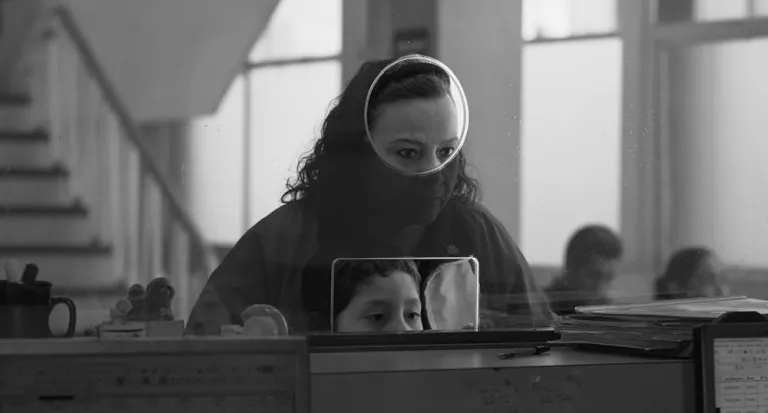
Fernando Eimbcke’s Flies explores the possibility of human transformation through an encounter with another person’s suffering. In this film, Eimbcke moves away from the familiar trope of “the grumpy, lonely old woman who becomes kinder after encountering a child” and creates a more humane, though also more bitter, situation: three lives marked by failure become intertwined, without any of them having sought it, and each takes something from the others while also giving something in return.
At the beginning of the film, Olga is a middle-aged woman who is lonely, irritable, and seemingly indifferent to the world around her. She lives in an apartment where other people are more of a nuisance than fellow human beings. Even when Tulio enters her life to rent a room, their relationship is based less on empathy than on an economic arrangement. Olga needs money, and Tulio needs a roof over his head. Yet this simple transaction gradually develops into a relationship that transforms Olga’s fundamental outlook on the world.
Olga’s character, of course, risks falling into a familiar cinematic cliché: the grumpy, withdrawn person who rediscovers a forgotten part of her humanity through an encounter with an innocent child. Cinema offers plenty of examples of this formula. What makes Flies compelling is that Eimbcke does not render Olga’s transformation sudden or sentimental. She is not supposed to become a different person overnight. Instead, what happens is a gradual erosion of her defensive walls. The child, the father’s suffering, and the mother’s illness force her to see something she had previously overlooked: other people’s lives, even when they have no connection to our own, can enter our private sphere and change its meaning.
In this respect, Christian, Tulio’s nine-year-old son, may be the film’s most compelling element. He is not merely the story’s “innocent child” but an active character in his own right. His predicament is simple yet painful: he wants to see his sick mother, but the hospital has become a formidable, almost insurmountable obstacle. His attempts to find a way inside turn the film from a family drama into a small-scale, deeply human adventure.
What matters here is that, for Christian, the hospital marks the boundary between “having a mother” and “losing a mother.” He cannot yet fully comprehend illness and death, but he understands his mother’s absence. His attempts to enter the hospital are therefore more than childish escapades; they amount to a form of resistance against a reality the adults have already accepted. His father, despite all his helplessness, is trapped by economic hardship and illness, while the child still wants to change that reality.
Tulio, too, belongs to this same world of the underprivileged and vulnerable. He is neither a hero nor an absolute victim. His wife is struggling with a serious illness, he is financially destitute and homeless, and he must also take care of his child. Secretly bringing Christian into Olga’s home violates his agreement with her, on the one hand, but on the other, it is an unavoidable response to circumstances that have severely limited his choices.
It is here that the film moves beyond a family story to offer a portrait of a society in which illness, poverty, housing, and loneliness are interconnected. The hospital becomes part of a social structure that people on the outside, despite their physical proximity to it, are effectively unable to enter.
The film’s title, however, Flies, provides its most important interpretive key. At first, a fly is a trivial, irritating nuisance, something whose presence is hardly worth taking seriously. At the beginning of the film, Olga views life in much the same way. People, relationships, and their problems seem to her like nuisances to be rid of. By the end, however, the fly takes on a different meaning. This same tiny, seemingly insignificant creature remains by Olga’s side, as if to suggest that life, with all its disorder, filth, suffering, and irritations, is not something one can simply escape.
From this perspective, Olga’s transformation is not merely a matter of “a woman’s heart softening” but a kind of detachment from her former self. By the end, she is not necessarily happier. What matters is that she no longer rejects the world in order to protect herself. She accepts the presence of another. Perhaps this is precisely where the film reaches its maturity: human redemption does not come through the elimination of suffering but becomes possible through the acceptance of another person’s suffering.
Flies is a film about people who were never meant to save one another. Christian does not save Olga, Olga does not save Tulio’s family, and Tulio cannot stop his wife’s illness. What emerges between them is something subtler: a form of empathy and shared vulnerability. For a brief period, the lives of these three people become intertwined, and this encounter changes them.
In this sense, the fly at the end of the film may be a metaphor for life itself: small, persistent, irritating, inescapable, and yet alive. What Olga wanted to drive away at the beginning of the film is beside her at the end. The difference, however, lies not in the fly itself but in Olga’s perspective. The world has not changed; her way of looking at it has. Perhaps this is the film’s most humane insight: sometimes redemption comes not from changing the course of fate, but from changing ourselves in response to the fate of others.
© 2026. Phoenix Review