



Emin Alper’s cinema has consistently operated at the intersection of politics, collective psychology, history, and structures of repression. A PhD in modern Turkish history, Alper is a remarkably perceptive, if highly selective, filmmaker whose films are separated by considerable intervals. This is partly due to the demands of a commercial sensibility that does not align with his approach, and partly to his own artistic elitism. What is striking is that Alper analyzes Turkish society, and the Middle East more broadly, not through transient behaviors or the political slogans of the day, but by probing the deepest psychological, ideological, and historical layers of collective life. His fifth feature film, Salvation, marks the return of a distinctive filmmaker. Following the disappointing A Tale of Three Sisters (2019) and a film that has largely faded from memory, Burning Days, Alper is back on track with a merciless, harrowing, multilayered, and intelligent dissection of ideological fundamentalism and its devastating effects on individual psychology and collective relations.
More than anything else, this film recalls his most distinctive, coherent, and acclaimed work, Frenzy (2015). There, through an emotionally charged and tension-filled form, Alper depicted the psychological disintegration of a society consumed by suspicion, paranoia, authoritarian anxiety, and structural repression. Fortunately, Salvation is likewise infused with that same uncontainable energy, visceral intensity, and unflinching confrontation with the darkness within human beings.
At the heart of the film lies a direct, fearless, and radical assault on the very foundations that sustain fundamentalism—not as a simple form of religious extremism or a temporary political maneuver, but as a comprehensive system of repression, a contagious psychological structure, and a destructive machine that annihilates thought, reason, will, and human conscience. Alper turns his attention to the movements, institutions, and beliefs that nourish dogmatic and repressive tendencies. By infiltrating the intricate capillaries of society, fundamentalism poisons public morality, family relationships, individual life, and even the most private dimensions of human existence, paving the way for the complete disintegration of a civilization, a culture, or a moral community.
An important aspect of the film’s production is the difficult circumstances, pressures, and severe constraints under which it was made. It is hardly news that independent and dissenting cinema in the Middle East has long faced severe censorship, numerous red lines, both covert and overt pressure from centers of power, and an acute shortage of financial resources and support. Alper, however, has managed to transform these structural, political, and material limitations into creative aesthetic possibilities. The limited number of shooting locations, the reduced cast, and the avoidance of financial—and, consequently, technical—extravagance do not leave the film looking impoverished or lacking in vitality. Instead, they lend its narrative structure greater compression, intensify its sense of suffocation, and create an extraordinarily claustrophobic world. Out of these very constraints and pressures, the filmmaker constructs an enclosed, stifling environment from which escape seems impossible for the characters.
One of Alper’s most effective narrative devices is the continual blending of fantasy, nightmare, and reality. As a result, the boundary between events in the external world and those unfolding in the characters’ fractured, fragile, and wounded minds becomes almost entirely indistinguishable. Throughout the film, viewers are repeatedly shuttled between individual nightmares and realities that are even more bitter and horrifying than the nightmares themselves. This formal and narrative strategy can be understood as a reflection of what it means to live under the oppressive, destructive shadow of fundamentalism.
When a repressive, dogmatic ideology comes to dominate every aspect of human psychology and existence, it is only natural that objective reality itself should give way to a continuous, multilayered nightmare, while the human mind generates new nightmares in an attempt to escape reality. This disorienting psychological progression sustains a sense of insecurity, suspense, helplessness, and anxiety throughout the film.
In my view, Alper’s boldest move comes when, in a film built around classical storytelling, he leaves the narrative unresolved. There is no conventional denouement here, as though the director were insisting that no ending to fundamentalism can be imagined.
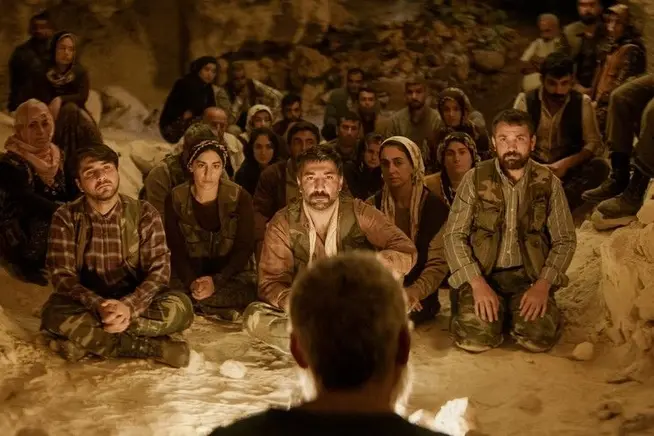
It would also be remiss not to mention the film’s masterful framing and the filmmaker’s persistent use of low-key lighting in constructing this self-contained, stranded world. Shadows are not decorative elements here, nor merely components of a visual identity; they acquire a distinct cinematic presence and function. Patches of absolute darkness in the corners of the frame, deep shadows in the background, and weak, faint, narrow beams of light that illuminate only parts of faces or fragments of the densely packed surroundings give tangible form to the sinister shadow cast by ideology and repression over every aspect of life. This dim, dark visual structure not only harmonizes perfectly with the story’s psychological atmosphere and the characters’ protracted nightmares, but also conveys a sense of suffocation, isolation, despair, and entrapment. In most scenes, light sources are faint and localized; the characters’ faces are often half-hidden in shadow, or only partially illuminated. This visual strategy suggests divided identities, concealment, deeply ingrained fear, and a lack of transparency in the world of the story. In the same vein, long, dark shadows stretching across walls create the impression of an invisible yet threatening presence.
What is particularly striking is how far the film’s political, social, and critical dimensions extend beyond Turkey’s geographical borders to encompass life across the contemporary Middle East. Alper directs his critical gaze at the roots, structures, ideologies, and governments that have turned fundamentalism into a principal instrument of domination, repression, warmongering, and self-preservation. This transregional perspective, direct and fearless, lifts the film beyond the confines of a local story and transforms it into a sweeping humanist statement against obscurantism, repression, and darkness.
It is worth noting, too, that Alper, like many filmmakers, refuses to follow passing trends or retreat into complacency. He does not settle for superficial, cost-free gestures toward regional crises or the plight of the Palestinian people—gestures that amount to little more than a safe bet—or seek the fleeting applause and cheers of Western film festivals. His mention of Iran during the closing ceremony of this year’s Berlinale, as he received the festival’s Special Jury Prize, was entirely in keeping with the making of such a cautionary film. It was a message to the Iranian people: “You are not alone!” This was all the more striking given that Wim Wenders, the celebrated president of the Competition jury, had poured cold water on such expectations on the very first day, declaring the festival to be an entirely cinematic, nonpolitical event.
Fortunately, in Salvation, overt political pronouncements give way to formal intensity, psychological complexity, and a nightmarish structure. The film seeks to uncover how dogmatic ideologies can take possession of human minds and turn people into unquestioning agents of violence. Fundamentalism is presented in this process as a misguided defense mechanism against existential anxiety, poverty, a loss of identity, and historical disillusionment. Dogmatism grants the powerless a false sense of power and belonging to an absolute truth. The price they pay for this counterfeit identity, however, is the complete destruction of critical thought, the distortion of conscience, and the unconditional acceptance of repression.
The filmmaker shows how fundamentalist relations first take shape within society’s smallest institutions, such as families and local communities, before spreading to society at large. The language of extremism is saturated with threats, the sanctification of violence, and the rejection of the other. The film emphasizes that fundamentalism needs a “permanent enemy” to survive. If no enemy exists in reality, the ideological machinery manufactures one in the minds of its followers. Paranoia, therefore, is an inseparable component of the way fundamentalist systems operate.
Salvation demonstrates that fundamentalism is neither an abstract phenomenon nor an isolated set of ideas. It is a complex network of ideology, power, wealth, and organized repression that crosses borders and drives diverse societies toward destruction. By targeting these underlying structures, Alper establishes himself as a filmmaker committed to genuine humanism, one who values truth and informed analysis far more highly than comfort, conservatism, or the approval of fashionable cultural circles.
Emin Alper’s remarkable film offers a radical, revelatory, interpretively rich, and coherent text—the work of a filmmaker who skillfully weaves together philosophy, history, and the language of cinema, further cementing his position as one of the most important and courageous auteurs in Middle Eastern cinema. We are already eager to see what he makes next.
© 2026. Phoenix Review