



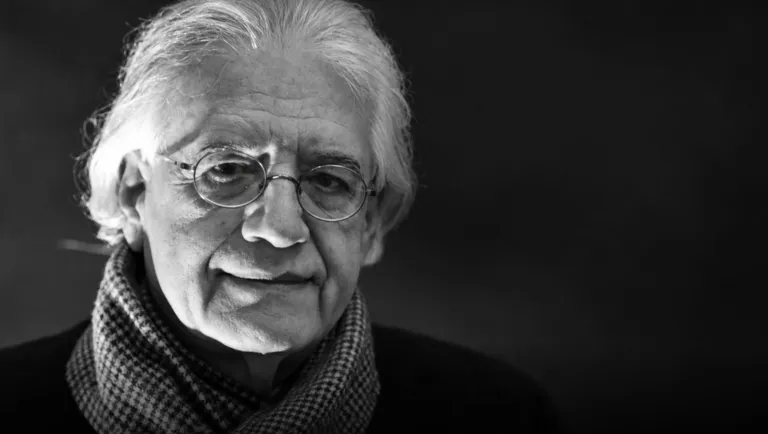
The death of Patricio Guzmán, the great Chilean documentary filmmaker, at the age of 85 marked the end of the life of a filmmaker who spent more than half a century using his camera to chronicle Chile’s contemporary history and the painful and tragic experiences of his homeland. Guzmán was not only one of the most important filmmakers of political documentary cinema in Latin America, but also one of the most distinguished examples of the convergence of historical testimony, poetic reflection, and “essay film” in contemporary world cinema.
From his first feature-length film, The First Year (1971), about Salvador Allende’s first year as president, Guzmán became deeply engaged with politics and Chile’s contemporary history. Yet this engagement evolved into an immense cinematic and historical project in The Battle of Chile. He once said that he became involved in politics with his very first film and could never again distance himself from Chile and its tragic history—from a country he first forgot and then, gradually, remembered. For him, memory was both the central subject of his work and a creative limitation as well as a creative privilege.
This approach is what distinguishes documentary filmmaking from the mere recording of events. In Guzmán’s cinema, film is not simply a memory of the past, but a means of remembering and continually returning to it—a return that reveals a new layer of violence, silence, responsibility, and loss each time. History in his films resembles a buried body that must be excavated once again: sometimes in the archives, sometimes in the faces of witnesses, sometimes in a landscape, and sometimes in a small, seemingly insignificant object, such as the pearl button belonging to an Indigenous man in The Pearl Button (2015).
For Guzmán, documentary film was not an immediate and neutral representation of reality, but a web of connections between history, memory, nature, the body, politics, and the image.
Guzmán’s three-part The Battle of Chile, made between 1975 and 1979, is regarded as one of the most important works in the history of political documentary cinema. The series follows and examines the collapse of Salvador Allende’s government, Chile’s socialist president, following the military coup of September 11, 1973. The significance of the film lies not only in the fact that Guzmán’s camera directly witnessed the days leading up to the coup, but also in the way it records the political and economic crisis through the voices and bodies of ordinary people.
In The Battle of Chile, history is not narrated from above. The camera takes to the streets, moving among workers, students, factory owners, women, soldiers, opponents of Allende, and his supporters. Through street interviews and direct observation, Guzmán portrays a society on the brink of collapse that is still engaged in dialogue, argument, and imagining the future. In the classical sense, the film is not an impartial report on Chile and the American-backed coup led by General Pinochet against Allende’s government. It has an unmistakable political position and makes no attempt to pretend that it stands outside history. Guzmán understands that the camera exists within relations of power. Through the selection of shots, temporal continuity, the juxtaposition of conflicting voices, and the recording of scattered moments, the film becomes a living documentary analysis of a society in turmoil and on the verge of collapse. In this sense, The Battle of Chile can be situated within the traditions of cinéma vérité, observational cinema, and the Third Cinema movement in Latin America—forms of cinema that regarded film not as a commodity for entertainment, but as a tool for political consciousness and intervention in history. For this reason, The Battle of Chile trilogy became one of the foundational works of political documentary and Latin American cinema.
Yet Guzmán did not stop at documenting the moment of the coup. In his subsequent works, he repeatedly returned to that moment, showing that the coup was not a completed historical event, but an old wound that continues into the present and is repeatedly reopened through the recollection and revisiting of traumatic memories of the past. In Chile: Obstinate Memory (1997), after years of absence and living in exile, he returned to Chile and, through the method of “cinema verité,” screened his earlier film, The Battle of Chile, for generations who had not experienced the coup themselves. In this film, the act of watching the film itself becomes the subject of the film. A new generation looks at images from the past and responds to them. This approach to documentary filmmaking constitutes a form of historical and emotional education. The film does not merely show the past; it asks its audience what they are going to do with that past in the present. In this sense, Guzmán’s work can, in a way, be placed within the category of “educational cinema”—a cinema that refuses to separate knowledge from emotion.
One of the most important characteristics of Guzmán’s later cinema is that it does not examine the violence of Pinochet’s dictatorship and the repressive system of his regime in a historical vacuum. He seeks to trace the deeper roots of violence in the history of colonialism, the formation of the modern Chilean state, and the destruction of Indigenous communities. In The Pearl Button, the sea and water become central elements of the narrative. The film begins with the geography of southern Chile and the maritime peoples of Patagonia, and then connects the history of Indigenous communities such as the Kawésqar, Yaghan, Selk’nam, Aónikenk, and Haush to the history of political repression in the twentieth century. These communities, whose lives and cultures were deeply intertwined with waterways, islands, and the sea, were gradually suppressed, displaced, and destroyed following the arrival of Spanish colonizers.
In this film, Guzmán challenges the grand colonial narratives surrounding “civilization.” The colonizers saw themselves as bearers of civilization, yet their treatment of Indigenous peoples—from human hunting and systematic massacres to the suppression of culture and language—revealed a deeply barbaric face. The film’s title, The Pearl Button, is taken from the shirt button of one of Pinochet’s victims, while also alluding to Jimmy Button, a young Indigenous man from Patagonia. In 1830, Robert FitzRoy, the English naval officer and naturalist, took Jimmy captive and brought him to England, giving him the name Jimmy Button. He taught him English and Christianity before sending him back to Chile as a missionary. Jimmy Button, an Indigenous man, had been transformed into an instrument of colonialism and a commodity for public display; after returning to Chile, he no longer had a place in his own homeland.
Yet Guzmán does not view the history of colonialism separately from the history of dictatorship, violence, torture, and massacre. He shows how camps, islands, and places of isolation and extermination acquired similar functions at different moments in Chilean history. Dawson Island, which during the colonial period and the activities of religious missions had been the site of the killing of hundreds of Indigenous people, was later transformed into a political prison camp for supporters of Allende. In this way, the film speaks of a history of violence and killing that has continued for centuries, taking a new form in each period. This connection, however, does not mean equating the two historical experiences in their entirety. The genocide and destruction of Indigenous cultures are historically very different from the repression of political opponents under Pinochet. Guzmán’s achievement lies instead in establishing a structural relationship between them—a relationship between the appropriation of land, the elimination of the Other, the control of bodies, the silencing of voices, and the erasure of memory.
In his later works, Guzmán’s cinema moves away from the direct, stark, and tense depiction of violence and repression found in The Battle of Chile, turning instead toward a slower, contemplative, and poetic rhythm. But this shift in cinematic language does not mean that politics has been abandoned. In these films, politics moves beyond the forms of speechmaking and reportage and becomes sedimented in nature, sound, matter, and time.
Guzmán is one of the most important contemporary filmmakers in the development of the “essay film” form. His films are neither linear, closed narratives in the tradition of classical documentary nor simply collections of interviews and archival materials. They are constellations of questions, associations, and free connections that move, in the course of their journey, from science toward politics, from nature toward the body, from history toward memory, and from the image toward philosophical reflection. In the essay film, the filmmaker does not usually remove himself from the work. He is not merely a collector of information or a supposedly neutral observer, but an active narrator and thinking subject. In Guzmán’s films, this presence is most clearly manifested through the voice-over narration. His calm and personal voice, with its poetic and at times nostalgic tone, gives direction to the images. It does not claim to possess the final truth; instead, it invites the viewer into a shared search. Yet Guzmán’s narrator is not neutral. His voice chooses, compares, establishes connections, and asks the viewer to assign political meaning to a particular landscape or object. This calm and seemingly modest form of narration nevertheless guides the viewer’s emotions and interpretation. The narrator’s voice in Guzmán’s films is therefore not a voice outside history, but the voice of an exiled subject, a witness, and someone deeply entangled with politics and history.

In The Pearl Button, this voice moves from an observation of water toward the history of colonialism and then toward the crimes of Pinochet’s regime. A pearl button, which at first appears to be a small and insignificant object, becomes the link between two histories: the history of Jimmy Button and the history of prisoners who were thrown into the sea. Thus, montage in Guzmán’s cinema is not simply a matter of joining and juxtaposing images; it is a dialectical narration of history. The narrator does not attempt to fill the void left by the dead, either. He does not speak on behalf of the victims; rather, he makes their absence visible. Photographs, faces, names, skeletal remains, and small objects are, in his films, incomplete signs. The film’s task is not to make absence whole; its task is to prevent absence from becoming oblivion.
Guzmán’s importance cannot be measured solely by the number of awards he received or the festival recognition his films garnered. His stature derives from the fact that he was able to transform a specific national experience into a universal cinematic language without erasing its historical and cultural particularities. He demonstrated that political documentary can be precise, emotional, and poetic at the same time; that it can remain faithful to history and the historical archive while drawing upon cinematic and poetic imagination; and that it can take a stand against forgetting without succumbing to a simplistic reconstruction of history and the past. In Guzmán’s films, history is not a museum-like collection of settled events, but a living field of contestation.
One of Patricio Guzmán’s major achievements lies in the way he uses place and geography in his films. Geography in his cinema is not merely the setting in which historical events occur; geography itself becomes a narrator, an archive, a witness, and a repository of historical memory. This process reverses the traditional relationship between geography (nature) and history. We usually conceive of history as a human event and nature as a voiceless backdrop. Guzmán, however, shows that nature also participates in history, and that human violence leaves traces within it.
The places in Guzmán’s films do not function as memorials or tourist sites. No monument in the Atacama Desert, the waterways of Patagonia, or the slopes of the Andes necessarily explains the history of the victims. It is the filmmaker who must uncover the hidden layers of these places, and Guzmán rises to this difficult task remarkably well in his films. Thus, in Guzmán’s cinema, nature is not the backdrop to history; nature itself becomes a witness to history. The desert, water, and mountains are tangible and visible natural elements, yet at the same time they articulate the psychological and historical condition of a nation and become repositories of its historical memories—memories that, unlike official institutions, can preserve part of what those in power seek to destroy.
In Guzmán’s late trilogy—Nostalgia for the Light, The Pearl Button, and The Cordillera of Dreams—three fundamental elements of Chilean territory—the desert, water, and mountains—evoke political violence and repression, colonialism, and loss in three different ways. These three films are, in effect, a kind of personal map of Chile drawn by Guzmán, a map in which the vast geography of the country is intertwined with the memory of Allende’s government, Pinochet’s coup, and its aftermath. It is a psychological map that reflects the state of mind of a wounded nation. Nature, in fact, becomes a metaphor for the social trauma left by the coup.
In these films, Guzmán removes history from the human spaces of cities and official institutions and searches for it in nature, stone, water, soil, and light. The result is a kind of natural history of violence and repression—a history that has not survived only in documents and testimonies, but has also become sedimented in Chile’s landscapes themselves. In Nostalgia for the Light, the Atacama Desert is simultaneously a site of astronomical activity, archaeological research, and the search conducted by women looking for the remains of their disappeared loved ones. Telescopes gaze toward the sky while the women stare at the ground. Astronomers search for the cosmic past, while Chilean women search for the political past of their homeland. The light of the stars has traveled for millions of years, just as the political past, despite the government’s efforts to bury it, continues to exist in the present. The narrator’s voice connects geography to a personal experience of exile. He does not simply speak about a place; he speaks from the temporal and emotional distance that separates him from it. This distance is not a simple form of nostalgia. In Guzmán’s work, nostalgia is always accompanied by a political question: What remains of the past? What has been destroyed? And who has the right to tell its story?
His narrator moves between different scales—from atoms and stars to human bones, from a button to colonialism, from a glacier to the body of a prisoner, and from a mountain range to the fate of an entire nation. This shifting of scale lies at the heart of Guzmán’s essay film. He does not proceed through dry historical argument; instead, through association, juxtaposition, and metaphor, he reveals connections that official narratives have kept separate. In Nostalgia for the Light, he transforms a poetic metaphor into a political structure. Sky and earth, the most distant past and the most immediate suffering, science and mourning, are placed side by side. For Guzmán, the Atacama Desert is not merely a beautiful landscape or a site of scientific research, but a natural archive that preserves bones, camps, and traces of military violence, embodying silence, absence, and the effort to uncover what has been hidden.
In Nostalgia for the Light, the Atacama Desert possesses a dual character. On the one hand, because of its aridity and clear skies, it is home to observatories where astronomers search for an understanding of the cosmic past. On the other, women search the same soil for the remains of their disappeared loved ones. This juxtaposition forms the basis of the film’s narrative and intellectual structure. Astronomers look toward the sky to see the past of the universe; the women gaze at the earth in an attempt to recover the past of their families and nation. Two forms of searching thus converge within a single geography: science searches for the past in starlight, while mourners find it in buried bones, and cinema acts as the mediator between them. In this film, cinema assumes the role of an excavator. Rather than merely presenting a beautiful image of the desert, Guzmán’s camera asks the desert to speak. Camera movement, montage, the narrator’s voice, music, and extended pauses allow natural elements to function as historical documents.
The desert’s dryness, in effect, functions like a forensic archive, preventing the complete destruction of traces of crime, while the soil, unlike the state’s official memory, preserves the traces of the victims. The Atacama Desert therefore becomes, in Guzmán’s film, an archive that simultaneously contains the prehistoric past and contemporary history. Yet this archive is incomplete. What is found in the desert is often a fragment of bone, a piece of clothing, or an ambiguous trace, and Guzmán expresses the nature of historical trauma through precisely this ambiguity and incompleteness. Memory cannot bring the dead back, but it can resist the denial of their deaths and the erasure of their names.
If the desert in Nostalgia for the Light is a dry and buried memory, water in The Pearl Button is a fluid and mobile memory. In this film, water is the source of life, a means of communication, an element of Indigenous culture, and, at the same time, an instrument of destruction.
Like Nostalgia for the Light, The Pearl Button deals with Chilean history and the victims of colonialism and dictatorship, a history narrated from the perspective of the defeated rather than the victors. Here, too, Guzmán does not address the Pinochet era directly. Instead, through a geopolitical approach, he poetically and symbolically uses water and the sea—and their relationship to the lives of the Indigenous peoples inhabiting the Chilean archipelago of Tierra del Fuego, followed by the arrival of European colonizers—to connect nineteenth-century Chilean history with the bloody history of the 1970s and the victims of Pinochet’s coup.
The film rereads Chilean history through the shores, rivers, glaciers, and waterways of Patagonia. Water in the film is both a source of life and freedom and a cemetery for the victims. The sound of dripping water, the movement of rivers, glaciers, and the sea create a kind of quiet music; yet these same waters also conceal the bodies of drowned political prisoners. The film moves from the beauty of nature toward historical violence and then returns to nature. In Guzmán’s work, beauty is never innocent or neutral; it always contains a shadow of loss.
The Indigenous communities of southern Chile organized their lives around the sea and movement across the water. But colonialism, by appropriating this geography, did not merely take their land from them; it also destroyed their way of life, language, memory, and relationship with the world. This same water would later become the place where political prisoners were thrown during the Pinochet era. The military regime that emerged from the coup sought to conceal its crimes from public view by throwing bodies into the sea. Yet within the logic of Guzmán’s cinema, water is not a site of forgetting; like the desert, it is a repository of a nation’s historical memory. The movement of water, against the wishes of those in power, does not completely erase the bodies or the memories.
This is why the film’s title, The Pearl Button, points to this relationship between the object, water, and history. A small button made of marine material connects the displacement and destruction of Indigenous peoples to the political crimes of the twentieth century. The object takes on the role of a witness in place of an official document. Here, history is read through a fragment of shell and the sound of water. Guzmán shows that even when history is erased from books and official archives, it will remain in the memory of nature, the earth, and the sky.
In The Cordillera of Dreams, the mountains embody apparent stability, isolation, and the petrification of history. Guzmán reaches the Andes, the mountain range that runs along Chile and geographically separates the country from Argentina and the world beyond. These mountains are simultaneously Chile’s backbone and protective wall: they shape the country’s geography and protect it, while also isolating it. In this film, the mountains are more than a national metaphor. Guzmán connects them to Chile’s social and economic history—to mining, the sale of natural resources, the transformation of the landscape, and the dominance of foreign capital. In his view, the land and natural resources of the country are like the body of a nation; when these resources are sold off, it is not only the economy that suffers, but collective memory and identity also undergo erosion.
The Andes are also the mountains that the exiled Guzmán looks upon from a distance. He lived outside Chile for many years, and this distance gave his gaze a dual character. His perspective is both that of an outsider and that of a filmmaker who emerged from within Chilean society and its bloody history. His later films express precisely this dual condition. He returns to his homeland, but he can no longer see it as he once did. In this film, figures such as Pablo Salas, the archival cameraman, serve as intermediaries between the mountains and memory. Throughout the years of dictatorship and afterward, Salas continuously filmed reality, producing images that, like an endless personal diary, recorded changes in society and political repression. In an interview, Guzmán describes him as a kind of mirror of himself. Both filmed and documented the bloody reality of Chile, but Guzmán went into exile while Salas remained in the country.
In his documentaries, Patricio Guzmán searches through Chilean history and uncovers hidden truths, inviting us, with a poetic mind and voice, to contemplate his discoveries. In each of his films, he bore witness to a historical truth—a truth buried beneath tons of earth in the dry and scorching deserts of Chile, or hidden in the depths of its seas and oceans. In Nostalgia for the Light, unlike the astronomers of Chile’s Atacama Desert, who directed their telescopes toward the sky and the galaxies, he turned his camera toward the earth and the depths of the Chilean desert, joining the families of Pinochet’s victims in excavating the nameless graves of their loved ones. In The Pearl Button, too, instead of searching for pearls and shells in the sea, he went in search of the buttons from the shirts of hundreds of victims of Chile’s bloody coup—people whose bodies were thrown into the depths of the sea by Pinochet’s forces from helicopters. Taken together, Guzmán’s films constitute an indictment of the historical crimes of colonialism in Chile and the coup led by General Pinochet and supported by the United States. His legacy lies in the fact that he did not reduce the Chilean coup to a static image of defeat. He showed that the coup and its tragic and bloody aftermath remain alive in the minds and memories of survivors, in archival images, in places, and in the natural landscapes of Chile. In Guzmán’s cinema, film is not merely a witness to violence; it is also a space in which the victims return to history. He asks us to look, to remember, and to respond.
© 2026. Phoenix Review