



Years ago, Kaveh Golestan, the renowned Iranian photographer known for his distinctive style, published a haunting series of photographs of female sex workers in Tehran’s Shahr-e No district. Speaking about his photographs, he once said: “I want to show you scenes that hit you in the face like a slap, that disturb your sense of security and put it at risk. You can choose not to look. You can switch it off. You can hide your identity, like murderers. But you cannot stop the truth. No one can.”
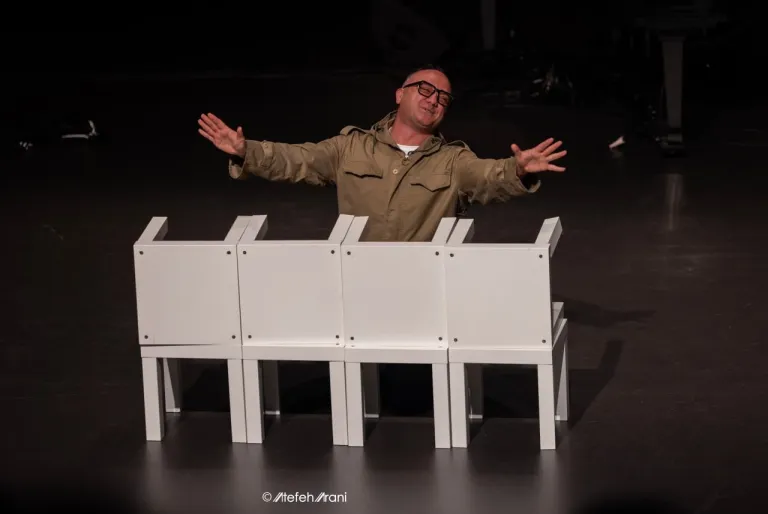
I believe that the play Talangor, by Borzo Arjmand and Ehsan Karami, does much the same to its audience. The two prominent Iranian theatre artists bring six stark accounts of six different deaths to the stage, each more disturbing than the last. It is as though dying in Iran has become more painful and more terrifying with each passing year. The play lands like a hard slap, reminding you that tragedy cannot simply be left behind. No matter how much time passes, your mind remains caught up in it. Your body and soul remain trapped inside it, and its trauma continues to live with you and within you.
A short while ago, Talangor, co-written and co-directed by Borzo Arjmand and Ehsan Karami, had its seventh performance in Washington, D.C., the capital of the United States. The play consists of six separate episodes, set in different periods, and narrated alternately by the two performers. Arjmand performs three episodes and Karami the other three. At the beginning, between each episode, and at the end, the acclaimed Iranian singer Rana Mansour, who is based in Los Angeles, performs a series of songs with remarkable power and beauty.
All six characters are dead. After their deaths—or after being killed—their spirits are summoned onto the stage to recount what happened to them. I spoke with Borzo Arjmand and asked him: Why spirits? Why death?
“Whenever I want to write a text, I first choose a few words for myself. Ehsan and I used the same method when we made Puzzle. We chose several words and concepts for the piece, such as border, nostalgia, Iran. We used the same method for Talangor, and death has always been particularly important to me.”
The very first episode begins with the narrator saying, “I am dead,” a sentence repeated at the beginning of all six stories. Dead narrators are hardly uncommon in world literature. In our own literature, Sadegh Hedayat famously begins The Blind Owl with the words: “There are wounds in life that, like termites, slowly consume and gnaw away at the soul in solitude.” Hedayat wrote the novel in 1936, and its manuscript was first published in India. Although Hedayat never explicitly identifies his narrator as dead, the melancholic structure of the narrative and its prose suggests a spirit recounting the story of its own life. Indeed, the narrative moves so insistently along the borders of death, shadow, bodily disintegration, the grave, and nothingness that the narrator can be understood as a kind of voice emerging from the world of the dead.
The first episode of Talangor likewise features an elderly narrator: a man named Omar ibn Ibrahim Khayyami of Nishapur, who, like the celebrated Iranian poet Omar Khayyam, lived in Nishapur in the fifth and sixth centuries of the Islamic calendar. The episode is based on Khayyami or Khayyam, a book by Mohit Tabatabaei, the contemporary Iranian scholar, researcher, and literary figure.
In the book, Tabatabaei argues that the poems attributed to Omar Khayyam—and known throughout the world as Khayyam’s poetry—were actually written by a man named Ibrahim Khayyami, who lived in Nishapur at the same time as Omar Khayyam. According to Tabatabaei, Omar Khayyam was primarily a philosopher, mathematician, and astronomer, and it would have been unlikely for a religious man who preached from the mosque pulpit to have written poems that denied an afterlife and advocated living in the present.
In one sense, this episode is a reminder that the history written by historians can be full of distortions and falsehoods. Although Mohit Tabatabaei’s theory remains no more than a possibility and has never been conclusively proven, there is little doubt that the history of Iran, like the history of any other country, is vulnerable to inaccurate information, false statistics, distortion, and fabrication.
I asked Arjmand about choosing this particular theory by an Iranian literary scholar concerning one of Iran’s greatest poets:
“That part of Iranian history was suggested by Ehsan Karami, and he had researched it thoroughly. This episode is trying to ask why we should not simply believe everything we hear. We believe nothing should be accepted too easily; we should investigate. Judgment is not necessarily the right thing either. The word ‘judgment’ and its meaning were also among the things we chose at the beginning.”
With the second episode, the narrative returns to contemporary Iran. Performed by Borzo Arjmand, it tells the story of a father who is killed while trying to retrieve his teenage daughter’s friend’s mobile phone from thieves. The episode speaks to an atmosphere of social insecurity, economic hardship, and, above all, the suffocating presence of gender stereotypes in contemporary Iran. It is a story of financial poverty, family disorder, the absence of protective laws and support mechanisms for victims of crime under the Islamic Republic, and finally of misplaced male pride and honor, alongside the traditional patriarchal attitudes embedded in Iranian culture. Each of these factors alone can put a human life at risk; together, they lead to a fifty-five-year-old man losing his life over nothing more than an insignificant mobile phone.
The third episode tells the story of Peter, a young Armenian man in love who is forcibly sent to the Iran-Iraq War and eventually killed by a bullet after the ceasefire is announced. Peter is a character who stays with the audience long after Talangor is over: a quiet, kind, dignified, romantic, hopeful young man, full of life. And then, at the moment the bullet strikes Peter in the heart, something suddenly drops out from under the audience. The play’s black humor becomes even darker, and you realize you have to prepare yourself for what is still to come.
Ehsan Karami delivers one of his finest performances in this episode. With irony, patience, meticulous attention to detail, and remarkable control over his facial expressions and body, he gives the character every particle of his being. That is why Peter’s impact on the audience’s heart and soul becomes all the more powerful.
The fourth episode tells the story of a poor but educated young man in the 1980s who is run over and killed by his romantic rival. It is a story of queues, ration coupons, deprivation, and the severe control imposed over streets and people by a dictatorial regime. The dark decade of the 1980s: secret romances, furtive glances, and freedoms that were not quite so secret after all.
And because Borzo Arjmand himself came of age during that decade, he is particularly well suited to the role. His full range as an actor, however, is revealed in the play’s final episode, in which he plays a young man killed on Ahmadabad Boulevard in Mashhad on January 8.
The final two episodes unfold around executions and street massacres. These are the episodes that not only leave the audience breathless, but seem to push the actors themselves to the edge of the world in their attempt to create an apocalyptic scene. The physical and psychological pressure on them is so intense that, at moments, you fear they might collapse onstage, suffer a heart attack, or simply stop breathing.
But how could you play the role of a young political prisoner in Iran, an innocent man who is nevertheless led to the gallows, without going all the way into the role? How could you play a young man who has merely come into the street to make a peaceful protest, only to find himself facing a machine gun, without losing your mind?
The sound of crying fills the theatre. Men and women are sobbing uncontrollably. Tears cover Borzo Arjmand’s face. His eyes are bloodshot. Even from the middle rows, you can hear him gasping for breath. There seems to be no way out.
At a certain point in the final episode, the actor throws his hat to the ground, takes off his shirt, and cries out that he is Borzo Arjmand, an actor, and that he can no longer continue playing this role.
And this is the moment when the “fourth wall” is broken: the imaginary wall between actors and audience.
The technique, famously associated with the twentieth-century German playwright, poet, and theatre director Bertolt Brecht, was intended to prevent audiences from becoming completely immersed in emotion and to preserve a space for thought. Through his technique of Verfremdungseffekt, or alienation effect, Brecht did not want spectators to become so absorbed in a story that they forgot the characters and events and were reduced to mere emotional responses. He wanted them to maintain a certain distance from the work so that they could think about and judge what they were seeing.
And that is precisely what happens at the height of the emotional despair in Talangor. The actor tells his audience: Look, I am an actor, and this is a stage. So remain conscious, and think about the atrocities that have taken place.
When I asked Borzo Arjmand how the two actors manage to withstand such enormous physical and psychological pressure, he said:
“The final two scenes not only engage my soul, they put enormous pressure on my body as well. I experienced something similar after my father passed away: an extraordinary back pain that could only have had a neurological cause. But what matters is that this pressure should lead to the right result. Judging by the reaction we have received from audiences so far, I think we are standing in the right place.”
Talangor is a document of contemporary Iranian history. It begins in ancient Iran and moves forward to events that took place only a few months ago. The play demonstrates just how fragile the contemporary history unfolding before our eyes can be, and how vulnerable it is to distortion.
Creating works of art like this can be a way of standing against distortion, lies, repression, and tyranny. Because such works target collective memory—and a nation with a strong collective memory will stand against oppression, injustice, and crime.
Finally, I want to mention Rana Mansour’s velvety voice and piano playing, and how beautifully and empathetically they accompany each story. The choice of songs is equally remarkable: each one finds its place within the story it accompanies. This is especially striking when Peter says that the Iraqi soldier’s sense of time was slightly behind theirs, and Rana performs Vigen’s immortal song:
“I went with you,
I came back without you,
From the alley where he lived, my mad heart…
I buried, beneath the ashes of sorrow,
All those dreams, my mad heart…”
And alongside Ms. Mansour’s vivid and captivating presence, there were moments when I could not help thinking about how much this stage is missing the presence of a female actor—and what a shame that is.
© 2026. Phoenix Review