



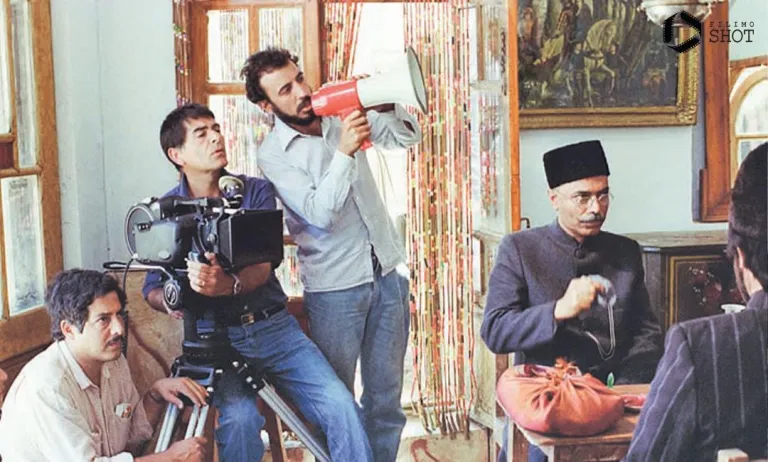
The cinema of Ali Hatami cannot be understood merely as a cinema of storytelling, poetic dialogue, or historical reconstruction. In his cinematic world, the image is as important as the word, and every object, color, costume, and piece of set design contributes to the film’s meaning. Hatami is one of the few Iranian filmmakers in whose work “Iranian-ness” exists not only in the subject matter and characters, but also in the very form and appearance of the cinematic world. Houses, bazaars, coffeehouses, costumes, carpets, dishes, mirrors, paintings, curtains, wall colors, and even the arrangement of objects within the frame all form part of an aesthetic system that can be understood as a cinematic recreation of Iran’s visual and cultural memory.
In films such as The Pigeon (Touqi), The Lovesick (Sutehdelan), Haji Washington, Kamal al-Molk, Mother, and Hezar Dastan, Hatami sought to construct a world in which the spectator would not merely witness a story, but enter a space that was at once familiar and dreamlike—a space rooted in Iranian architecture, traditional arts, literature, theater, painting, and popular culture. For this reason, the setting in Hatami’s cinema is not merely where events take place; the setting itself becomes part of the narrative.
One of the defining features of Hatami’s aesthetic is his almost obsessive attention to production design and set decoration. He was rarely interested in reconstructing a historical or social period in a purely documentary sense. Instead, he sought to create an imaginative and artistic vision of that period. In Hezar Dastan, for instance, old Tehran does not appear as a dry historical reconstruction, but as a nostalgic, mysterious, and almost mythical city. Its streets, houses, shops, signs, carriages, doors, windows, and interiors come together to create a world that is more than the reconstruction of a historical city: it is an image of “Tehran as remembered by Iranian culture.”
Here we can see one of the important differences between Hatami’s cinema and many conventional historical films. Set design in his films is not merely intended to make the story believable. The setting has a character of its own and enters into a relationship with the people who inhabit it. Old houses, with their interconnected rooms, courtyards, pools, orsi windows, curtains, carpets, and decorative objects, evoke an entire way of life. Architecture in these films is not simply a backdrop; it is a means of expressing social relationships and the inner lives of the characters. The enclosed space of the house can signify tradition and belonging, while the exterior world—the bazaar or the street—becomes the site where the character encounters a changing and increasingly modern world.
This attention to space takes on a particular form in Mother. The house in this film is not merely a location; it is the emotional heart of the narrative. Its architecture, the arrangement of its rooms, its carpets, curtains, dishes, and old belongings create a space that preserves the past and its memories. The characters do not simply meet one another in this house; they confront their own past. Objects and set design therefore acquire an emotional function in Mother, while the house itself becomes a kind of collective memory.
Another important source of Hatami’s aesthetic can be found in Iran’s traditional arts, particularly Persian painting and miniature art. His frames often present carefully arranged combinations of people and objects, an order that sometimes resembles a painting or a miniature. Characters are positioned within the frame in such a way that their costumes, architecture, and surrounding objects come together to form a complete visual composition. In such compositions, the movement of the characters can sometimes seem less important than the quality of the image itself. It is as though Hatami wants to suspend time for a few moments and create an “Iranian image.”
This quality is particularly evident in Kamal al-Molk. The film tells the story of a painter whose life is intimately connected with the history of Iranian art and with the problem of seeing and representing the world. The film therefore naturally gravitates toward painting. Yet Hatami does not merely tell the story of a painter; he turns the film itself into a visual artwork. Color, costume, architecture, and mise-en-scène work together to recreate the historical and artistic atmosphere of the period. Here, cinema enters into a dialogue with painting.
Color also occupies a special place within this aesthetic system. Hatami does not treat color as a merely decorative element. Colors, together with the textures of fabric, wood, metal, carpets, and walls, shape the emotional atmosphere of each scene. Red, lapis blue, green, turquoise, brown, gold, and cream are among the colors that contribute to the construction of an image of Iranian visual culture. Warm colors combined with aged, natural textures reinforce a sense of history and memory.
In Hatami’s cinema, color is often inseparable from materiality and texture. A red piece of fabric is never simply red; its meaning changes according to the material of the fabric, its pattern, the lighting, and the environment in which it appears. Turquoise, when placed alongside tiles, pools, pottery, or traditional architecture, activates a part of the visual memory of Iranian architecture. Gold and brown, meanwhile, can evoke aristocracy, age, or decay. Hatami’s use of color therefore tends less toward the most contemporary conventions of cinematic color design and more toward a distinctly indigenous and historical aesthetic.
Costume design is equally fundamental. In Hatami’s films, clothing is not merely a means of identifying a historical period or a character’s social class; it is part of characterization itself. The shape of a hat, the type of fabric, the color of a garment, its tailoring, vest, coat, shawl, headscarf, and other elements of dress reveal the social and cultural position of the characters. In fact, Hatami’s characters are often introduced, to some extent, through their clothes before they ever speak.
This becomes particularly important in films dealing with modern Iranian history or the Qajar and Pahlavi periods. Hatami attempts to make differences between social classes, professions, and personalities visible in the characters’ outward appearance. The clothing of a courtier, intellectual, merchant, housewife, artist, or ordinary working-class figure possesses a distinct visual language. Costume design therefore becomes deeply intertwined with production design: the characters must “belong” within their surroundings and form part of the visual composition of the scene.
Props and set objects, meanwhile, have a significance that extends far beyond decoration. The samovar, tea glass, hookah, prayer beads, walking stick, chest, mirror, pen case, old dishes, paintings, lamps, carpets, curtains, and even the small objects placed on a table all participate in constructing the world of the film. These objects carry cultural signs. They tell the spectator what period they are in, how the characters live, and what relationship they maintain with tradition and the past.
Most importantly, Hatami allows objects to produce memory. A tea glass or samovar in his cinema can be more than a functional object; it can evoke a way of life that is gradually disappearing. For this reason, objects in his films often possess a nostalgic quality. This nostalgia, however, does not always amount to an idealization of the past. At times, it resembles a form of mourning for a world that no longer exists.
This becomes even more pronounced in The Lovesick (Sutehdelan). The characters’ living environment, their clothes, the objects in their homes, and the way their surroundings are arranged evoke a traditional way of life and a particular social stratum. Rather than moving toward harsh, unadorned realism, the film creates a poetic and tragic world. Even poverty and decay acquire a visual quality within this world. Hatami frames ugliness aesthetically as well.
From this perspective, Iranian aesthetics in Ali Hatami’s cinema can be understood as the convergence of several elements: Iranian architecture, traditional arts, literature, theater, popular culture, historical memory, and the visual language of cinema. He does not reconstruct any of these elements in a pure, museum-like form. Instead, he integrates them into one another. The result is a world that, while historical, is never entirely realist, and while dreamlike, remains saturated with the tangible details of Iranian life.
Perhaps the most important feature of this approach can be summed up in the idea of “Iran as image.” Hatami seeks to portray an Iran that exists within our cultural memory: an Iran of old houses, pools and tiles, carpets and curtains, bazaars and coffeehouses, traditional clothing, old dishes, music, poetry, and conversation. His films therefore cannot be understood simply as representations of the past. He reinvents the past and gives it a visual form.
The relationship between word and image is equally important. Just as Hatami’s dialogue is not confined to everyday speech and often possesses a literary and rhythmic quality, his images generally move beyond straightforward realism. Just as his characters sometimes speak like figures from an old play or tale, their surroundings resemble the stage of an Iranian theatrical performance. In this sense, the boundaries between cinema, theater, painting, and literature become blurred in Hatami’s work.
This very quality has, of course, also been a source of criticism. Some may regard Hatami’s emphasis on visual beauty, dialogue, and aesthetic detail as a departure from cinematic realism. Yet if his cinema is examined according to its own aesthetic logic, this departure from realism should be understood as deliberate. Hatami did not want his camera merely to record what stood before it; he wanted to create an “image of Iran”—an Iran in which historical reality is intertwined with memory, imagination, and art.
From this perspective, the value of Ali Hatami’s cinema lies not only in the stories he told or the dialogue he wrote. A significant part of his legacy lies in the creation of an Iranian visual language. He demonstrated that Iran’s history and culture could be represented not only through political and social narratives, but also through color, costume, architecture, objects, light, and mise-en-scène. His cinema reminds us that cultural identity does not live exclusively in stories and characters; it can also reside in the shape of a window, the pattern of a carpet, the color of a wall, the texture of a fabric, the sound of a tea glass, and even the distance between two objects.
Ultimately, Hatami’s aesthetic can be understood as a form of visual memory-making. He does not record the past exactly as it was; he translates it into the language of cinema. The result is a world that may not always be historically identical to reality, but is profoundly Iranian in cultural and emotional terms. In his cinema, set design, costume, color, and props are not merely tools of film production; they are components of a visual culture. This is why so many images from Hatami’s films remain in the spectator’s mind long after the film has ended. More than simply making films about Iran, he sought to turn Iran itself into a cinematic image—an image woven from memory, poetry, architecture, color, and objects that preserve the past within themselves.
© 2026. Phoenix Review