



Outcry wants to talk about women’s right to sing; about women whose voices, before they can even be heard, run up against the walls of law, convention, and power. But the film’s problem begins precisely where its attempt to tell a new story once again takes refuge in the familiar language of Iranian social cinema: the violent official, the humiliated woman, interrogation, threats, the female body as an instrument of power, and a succession of calamities meant to convince the viewer of the extent of the injustice. And yet the difficulties faced by women who sing are complex and deeply human enough to have been explored from a more personal and nuanced perspective—through the difficulties of living, choosing, falling in love, staying, leaving, and the price a woman has to pay to preserve her own voice.
In Outcry, Soheil Beiraghi has chosen a serious subject. Yet at times, instead of uncovering the hidden layers of that subject, he simply intensifies the dramatic situations. A scene in which an official or officer drives a woman against a wall and backs her into a corner may be socially plausible, even entirely conceivable, but cinema does not arrive at something new simply by presenting a situation that could happen in real life. The question is whether the film can transform violence from a familiar occurrence into a personal and complex experience. In this respect, Outcry sometimes falls into the same “taste for excess and overstatement in storytelling,” as though, in order to prove that women are living under difficult conditions, the characters must constantly be subjected to yet another calamity.
But one of the film’s most harrowing episodes involves the mother, played by Leili Rashidi: an alcoholic woman who, in order to secure her daughter Seti’s release, is forced to comply with the prosecutor’s demands, record and publish the video he wants, and ultimately sleep with him. Seti, however, reproaches her mother, saying, “The dignity of prison is better than this kind of freedom.” The situation takes the film beyond the right to sing and toward questions of the body, dignity, and women’s agency. At the same time, it is one of those moments when the film comes dangerously close to exaggeration. Must every possible form of humiliation really be inflicted upon a woman at once in order to depict structural violence against her? Sometimes a smaller situation, if constructed with precision, can be far more horrifying and far more enduring.
Seti’s crime in the film is singing two songs. At one point, she says, “The country’s solved all its problems; apparently I’m the only problem left.” The line effectively conveys her anger and defiance, but it also pulls the film into the trap of familiar, repetitive storytelling—the well-worn pattern of the rebellious character who, in a single line of dialogue, comes to represent all the contradictions of society. The more Outcry tries to explain its subject, the less room it sometimes leaves for the character herself to speak.
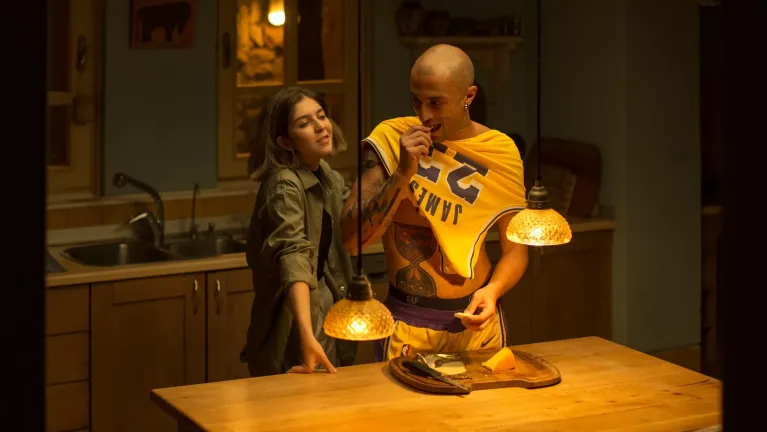
In the second half, however, particularly with the arrival of Amir Jadidi, the film begins to move away from these clichés and becomes more personal, and to some extent more distinctly its own. Seti’s relationship with “Bebin”—a man whose name the film itself avoids mentioning—is no longer simply a romantic relationship. On a metatextual level, he seems to want to function as a kind of secondary protagonist, even as another voice for society. He encourages Seti to leave the country, but when she challenges that logic, saying, “The plan can’t always be for everyone to leave. Why should I leave? Because I sing?” he ultimately accepts her position and goes along with her. Here, the film arrives at a more fundamental question: Why, in order to have an ordinary life, make one’s own choices, or even sing, must one choose the way out of the country?
When Bebin asks, “How do you understand so much?”, a seemingly simple line becomes one of the film’s keys. It is as if, in the world of Outcry, understanding itself is an unwritten crime. Once someone understands, they can no longer reconcile themselves with the existing order, and must therefore pay the price for their awareness. At this point, the film moves beyond being merely a story about women who sing and reaches a broader question of consciousness, choice, and the cost of living in a deeply tense society.
Seti’s exchange with the prosecutor is another of the film’s strongest moments: “Everyone is born with something, and I was born with singing.” The line transforms singing from an artistic activity into a fundamental part of her identity. For Seti, being forbidden to sing is not simply a ban on performing two songs; it is the negation of a part of her very self. This is precisely where the film could have moved even closer to the individual experience of a woman who sings—to the fears, desires, relationships, loneliness, and choices that exist behind the prohibition.
The scene in which Seti confronts the female officer also raises an important point. The officer tells her, “Take your clothes off,” and Seti reacts with reluctance and embarrassment. The officer responds, “How come you’re not ashamed to take them off elsewhere, but you’re ashamed here?” The violence of the exchange lies not merely in the command itself, but in the normalization of a gaze that treats the female body as something over which power has the right to decide. More importantly, the perpetrator of this violence is herself a woman. In other words, structures of power can be reproduced even by those who are themselves victims of gender discrimination.
Perhaps one of the film’s most precise and nuanced moments, however, comes after Seti is released, when she develops a stutter. A woman who has spent the entire film fighting for her voice and her right to sing now struggles even with ordinary speech. At this point, the film no longer needs to explain anything. Seti’s body and language tell the story of what violence has done to her. The stutter alone could have been one of the film’s most powerful metaphors: a voice that wanted to be heard becomes caught and broken even when it tries simply to speak.
Amir Jadidi is one of the film’s strengths, particularly in the second half, where his performance allows the film to move away from melodrama and slogans. Seti, too, becomes more convincing in those moments when she steps away from the role of the rebellious heroine. The scene in which Bebin talks to Seti as she rides her bicycle is a good example. For a moment, the characters stop being representatives of a “social issue” and simply become people talking about life, leaving, and staying.
Outcry is a film about a voice that wants to be heard. But this is also where the film’s paradox lies: it sometimes shouts too loudly itself. Beiraghi has chosen an important subject, but the more he reaches for increasingly devastating calamities in order to shock the viewer, the closer he comes to the very formulaic Iranian social cinema that he might otherwise have transcended.
Perhaps telling the suffering of women who sing does not always require an official to slam someone against a wall, a prosecutor to issue threats, a mother to sell her body, and a daughter to prefer prison to freedom. Sometimes a stutter, a silence, a glance, or a simple conversation about staying and leaving can tell the whole story of that injustice.
The subject of Outcry is serious. But cinema becomes more serious when, instead of piling more calamity onto calamity, it moves closer to the subtleties of life. And perhaps that is precisely the point: we are, after all, this worn-out.
© 2026. Phoenix Review