



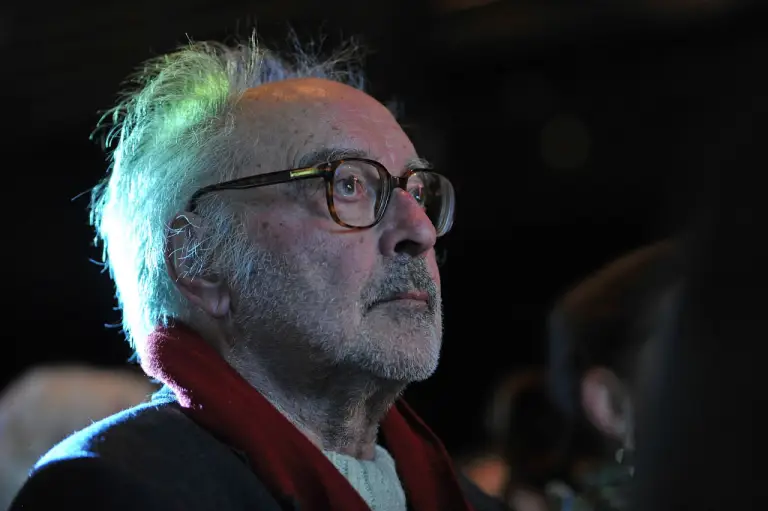
In an interview, Jean-Luc Godard once remarked: “I don’t believe in the oeuvre. There are individual works, which may be produced as separate pieces, but the oeuvre as a whole—that vast, unified legacy—holds no appeal for me. I prefer to speak of trajectories. Along my own path, there have been highs and lows, attempts… I have often yielded to circumstances. You know, the hardest thing is to tell a friend that what they have done is not very good. I cannot do that. Éric Rohmer had the courage to tell me, during the Cahiers du Cinéma years, that my review of Strangers on a Train (1951) was poor. Jacques Rivette could say such things as well, and we paid close attention to Rivette’s judgments. François Truffaut, however, never forgave me for considering his films worthless. He also suffered from the fact that, in the end, he could never find my films as worthless as I found his.”
In these few brief lines, Godard does far more than recall his relationships with Truffaut, Rivette, and Rohmer. He offers a vision of the ethics of criticism, the relationship between friendship and art, and the artist’s relationship to his own past. On the surface, the passage is about cinema. In reality, however, it addresses one of the most difficult questions of intellectual life: How can we criticize those we love, and how can we distinguish a work from its creator?
Godard begins by rejecting the idea of the oeuvre —the notion of a coherent, unified artistic legacy. At first glance, this may seem surprising, since the history of art typically judges artists through their complete body of work. We speak of Bergman’s oeuvre, Kurosawa’s filmography, Kiarostami’s cinematic universe, or Hitchcock’s legacy. Godard proposes a different perspective. Rather than speaking of a unified whole, he speaks of a trajectory—a path along which success and failure, courage and compromise, boldness and conservatism coexist.
This view constitutes a form of resistance to the mythologization of the artist. Society and history have a tendency to turn artists into monumental figures, as though everything they have created possessed equal value and each work were simply another fragment of a larger masterpiece. Godard rejects this narrative. He openly admits that he “often yielded to circumstances.” This confession is significant because, unlike the familiar image of the infallible artistic genius, he speaks candidly of his weaknesses, retreats, and compromises.
From the perspective of the sociology of art, this insight is equally significant. Pierre Bourdieu argued that the artistic field is fundamentally a field of struggle and power, and that artists never create under ideal conditions. They work under the pressures of the market, politics, censorship, capital, and professional relationships. In a single sentence—“I have often yielded to circumstances”—Godard expresses this sociological reality in deeply personal terms.
Perhaps the most important part of the passage, however, is where he says that the hardest thing is to tell a friend that what they have done is not good. Here, he exposes the ethical dilemma at the heart of criticism. Genuine criticism is not born solely from distance or detachment; sometimes it requires us to criticize someone we love, someone with whom we have shared meals, collaborated in the same magazine, or walked the same intellectual path for years.
In many societies, including our own cultural environment, criticism often assumes one of two extreme forms: either absolute praise or absolute condemnation. If someone is our friend, every one of their works is treated as a masterpiece. If they fall outside our circle, suddenly everything they have ever produced becomes worthless. Godard points toward a third possibility: that friendship and honesty can coexist.
He speaks of Éric Rohmer and Jacques Rivette with admiration because they had the courage to tell him that his review of Strangers on a Train was weak. Here, criticism is not an act of hostility but an ethical responsibility. A true critic is not someone who always agrees; sometimes the most valuable gift one can offer another is sincere disagreement.
In the age of social media, such courage has become rarer than ever. Many cultural relationships are structured around exchange: I praise you so that you will praise me in return. Admiration has become a form of social capital, while criticism carries a heavy cost. In such an environment, silence is easier than disagreement, and compliments are far less expensive than honesty.
The conflict between Godard and Truffaut begins precisely at this point. Godard says that Truffaut never forgave him because he regarded his films as worthless. The remark reminds us of an uncomfortable truth: many artists do not actually seek criticism; they seek affirmation. As long as they are admired, they celebrate criticism as a sign of freedom and dialogue. Yet when criticism is directed at their own work, they often interpret it as a personal attack.
Perhaps the most painful part of the quotation is its closing sentence, where Godard says that Truffaut suffered because he could never find Godard’s films as worthless as Godard found Truffaut’s. At this point, the issue extends beyond artistic disagreement. Pride, rivalry, jealousy, and the desire for recognition all come into play. Even among the leading figures of the French New Wave, these profoundly human emotions were very much alive.
This aspect of Godard’s reflection dispels a common illusion—that the world of intellectuals and artists is somehow pure, elevated above ordinary human rivalries. It is not. Artists, like everyone else, experience jealousy, disappointment, comparison, and the pain of judgment. The only difference is that these conflicts unfold within the realm of aesthetics.
Returning to Godard’s idea of the trajectory gives the essay a new meaning. If we understand art as a fixed and unified oeuvre, we are forced either to embrace an artist completely or to reject them entirely. But if we think of art as a trajectory, we become free to say that one work is significant while another is a failure; that one film is brilliant while another is weak; that one period is creatively fertile while another is not.
Such a perspective frees us from the temptation of idolization. No artist is always great, and no artist is always a failure. Just as no human being is defined solely by their successes.
Perhaps this is the most important lesson in Godard’s words: genuine criticism begins when we learn to separate the work from its creator, preserve friendship without sacrificing independent judgment, and replace the worship of artistic legacies with an appreciation of the winding trajectories of human lives—paths marked by mistakes, retreats, failures, courage, and perseverance. Art, before it becomes a magnificent and completed monument, is an unfinished road along which the artist repeatedly falls, repeatedly errs, and, from time to time, creates a masterpiece. Perhaps an artist’s true worth lies not in the flawless perfection of their works, but in their willingness to continue that journey.
© 2026. Phoenix Review