



If cinema is the mirror of each era’s anxieties, perhaps no concept reflects the rise and fall of modern history more vividly than paranoia. In psychiatric terms, the concept traces its origins to the work of the German psychiatrist Emil Kraepelin, before acquiring greater complexity through the psychoanalytic theories of Sigmund Freud and Jacques Lacan. Paranoia describes a psychological condition in which the individual experiences the surrounding world as a network of threats, persecution, suspicion, and conspiracy. In his celebrated analysis of the memoirs of Daniel Paul Schreber, the German judge whose case became foundational for psychoanalysis, Freud argued that paranoia is fundamentally a mechanism of projection: a process through which an individual’s internal desires or anxieties are attributed to external reality. Lacan, meanwhile, linked paranoia to the crisis of subjectivity through his theory of the Mirror Stage, demonstrating that it is not merely a psychiatric disorder but also a particular mode of experiencing reality itself.
This transition—from a purely medical and psychoanalytic understanding of paranoia toward a broader cultural and social one—ultimately paved the way for the concept’s entrance into literature, visual art, and, most significantly, cinema.
From the 1970s onward, postmodern thinkers increasingly ceased to regard paranoia as merely a psychological illness. Instead, it became a framework for understanding the contemporary world. In The Geopolitical Aesthetic: Cinema and Space in the World System (1992), Fredric Jameson argues that under late capitalism, economic, political, and media systems have become so overwhelmingly complex that individuals can no longer comprehend them as coherent totalities. Consequently, conspiracy narratives and paranoid thinking emerge as forms of cognitive mapping—desperate attempts to orient oneself within a world that has become almost impossible to understand.
Drawing upon Lacanian psychoanalysis, Slavoj Žižek similarly contends that paranoia is not simply a misreading of reality but an attempt to discover hidden order within the apparent chaos of existence. For the paranoid subject, accepting that events may be governed by chance, meaninglessness, or symbolic gaps is intolerable; there must always be an invisible hand orchestrating what appears to be random.
In Cinema 2: The Time-Image, Gilles Deleuze demonstrates how modern cinema disrupts the classical relationship between perception and action, producing characters who no longer trust the world around them and instead wander through fractured temporalities, unstable memories, and uncertain realities.
Although Michel Foucault never addressed paranoia directly, his analyses of power, surveillance, and disciplinary mechanisms in Discipline and Punish, particularly his discussion of the Panopticon, reveal how modern society transforms permanent surveillance into an ordinary condition of everyday life. The constant possibility of being watched generates suspicion as a habitual mode of existence—a phenomenon that later became central to countless paranoid films, from The Conversation to The Truman Show. According to Foucault, contemporary institutions employ technologies such as surveillance cameras, digital networks, and legal systems to construct environments resembling the Panopticon, where individuals internalize observation and become the primary agents of their own regulation.
From its earliest years, cinema had already discovered the visual language of paranoia long before it attempted to narrate paranoia as a psychological disorder. German Expressionist cinema—deeply influenced by Expressionist theatre and literature—translated the paranoid mind into visual form through distorted architecture, exaggerated shadows, deserted streets, fractured compositions, and faces that resemble nightmares more than human beings.
Robert Wiene’s The Cabinet of Dr. Caligari (1920) is not merely the story of a murder; it is the story of the spectator’s inability to distinguish truth from illusion. Its narrator is fundamentally unreliable, while the film’s universe is as distorted and unstable as his own mind. Film historians such as Lotte Eisner and Siegfried Kracauer have famously interpreted the film as a psychological prelude to the authoritarianism and fascism that would soon engulf Germany. Here, paranoia ceases to be an individual pathology and instead becomes the symptom of a society that has lost its faith in reality itself.
Across the Atlantic, the Great Depression of the 1930s introduced paranoia into American cinema in a different guise. Although Hollywood of the era is remembered primarily for its musicals and gangster pictures, beneath the surface of many of these films lies a profound anxiety about social collapse and the erosion of confidence in economic institutions.
Following the Second World War, these anxieties deepened and crystallized within the visual and narrative conventions of film noir. Returning soldiers, the devastation of Europe, widespread moral uncertainty, and the emergence of Cold War geopolitics produced a world in which certainty itself seemed impossible. The noir protagonist is typically a man who no longer knows whom he can trust, wandering through cities where every alley leads toward betrayal and every relationship threatens to become part of a larger conspiracy.
In films such as Double Indemnity, The Big Sleep, Out of the Past, and, above all, The Third Man, the city itself becomes a labyrinth of shadows, corruption, and suspicion. Noir’s signature visual style—its high-contrast lighting, diagonal compositions, Venetian blinds, barred windows, and elongated shadows—functions as the cinematic equivalent of a paranoid consciousness: a fractured mind incapable of distinguishing appearance from reality, whose perspective can never be accepted as entirely trustworthy.
With the onset of the Cold War, paranoia evolved from a psychological condition into a political paradigm. The enemy no longer possessed a recognizable face; it could be one’s neighbor, colleague, friend, or even a member of one’s own family. Fears of communist infiltration, espionage, brainwashing, and nuclear annihilation ushered American cinema into what many film historians and scholars have come to describe as the Cinema of Paranoia. At first glance, Invasion of the Body Snatchers (1956) appears to be a science-fiction film about extraterrestrial invaders. In reality, however, it functions as an allegory for American anxieties surrounding communist infiltration and the erosion of individual identity. The Manchurian Candidate (1962) carried these fears even further. Here, the individual no longer retains sovereignty over his own mind; without his knowledge, he may already have become an instrument of an invisible political apparatus. During this period, the distinction between external enemies and internal ones effectively disappeared.
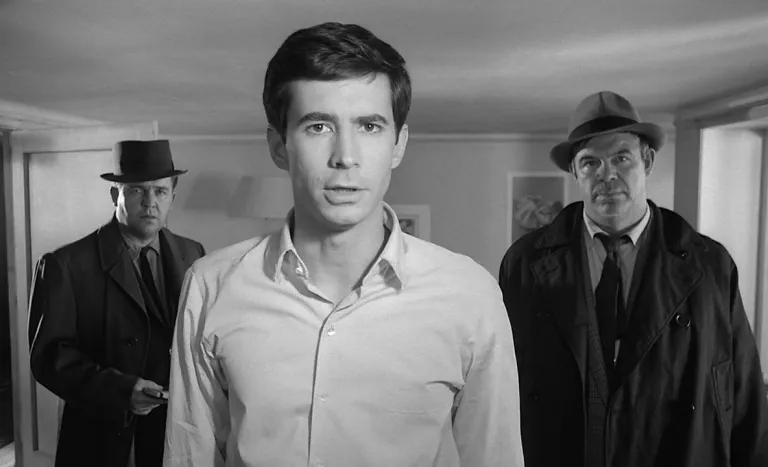
One of the most significant examples of the Cinema of Paranoia, as well as of modern alienation, is Orson Welles’s The Trial (1962), adapted from Franz Kafka’s novel. The film follows Josef K., a bank clerk who is suddenly arrested despite having no knowledge of the crime he is accused of committing. He finds himself trapped within a judicial process devoid of transparency or rationality. In this universe, power remains invisible, law ceases to provide security and instead becomes the very source of anxiety, and the individual stands powerless before an incomprehensible system.
Through monumental architecture, endless corridors, expressionistic compositions, and dreamlike mise-en-scène, Welles transforms Kafka’s universe into a cinematic representation of the paranoid mind. Here, paranoia is not the product of personal delusion but the inevitable consequence of confronting structures of power that remain unseen while permeating every aspect of existence. The Trial would become an essential precursor to many of the political thrillers and paranoid films that followed, including The Conversation, Three Days of the Condor, and All the President’s Men, all of which explore the uneasy relationship between the individual and hidden systems of authority. Within Welles’s Kafkaesque universe, the central question is no longer “Who is conspiring against me?” but rather “Is truth itself still knowable in a world where power has become invisible?”
Perhaps no filmmaker translated paranoia into cinematic language more masterfully than Alfred Hitchcock. Unlike many of his contemporaries, Hitchcock was rarely interested in grand political conspiracies. Instead, he explored how an ordinary individual can suddenly find himself at the center of suspicion and uncertainty.
In Rear Window (1954), Hitchcock demonstrates how the desire to observe gradually transforms into suspicion and obsession. Jeff, a photographer confined to his apartment with a broken leg, spends his days watching his neighbors through the lens of his camera. By chance, he believes he witnesses a murder in a neighboring apartment. As the narrative unfolds, however, both Jeff and the audience are confronted with a troubling question: has he genuinely uncovered a crime, or has prolonged isolation, voyeurism, and compulsive observation generated an entirely paranoid reality within his own mind?
With Rear Window, Hitchcock establishes one of the defining principles of paranoid cinema: truth can never be fully possessed through vision alone, and the very act of seeing may itself become the source of anxiety and suspicion.
In North by Northwest, Roger Thornhill becomes entangled in an elaborate espionage network simply because of a mistaken identity. The more desperately he attempts to prove his innocence, the more deeply he sinks into an increasingly incomprehensible conspiracy. Likewise, Torn Curtain and Topaz transform Cold War espionage into narratives where distrust itself becomes the governing principle of reality.
Through tightly controlled framing, subjective point-of-view shots, suspense generated by deliberately incomplete information, and carefully constructed architectural spaces, Hitchcock places spectators directly within the perceptual world of the paranoid protagonist—a world where every glance, every closed door, and every silence conceals the possibility of unseen danger.
The 1970s may justifiably be regarded as the golden age of the Cinema of Paranoia. America’s defeat in Vietnam, the Watergate scandal, revelations concerning the CIA’s covert activities, and the collapse of public trust created a political climate in which conspiracy theories no longer appeared as fantasies but as plausible interpretations of reality itself.
With Klute, The Parallax View, and especially All the President’s Men, Alan J. Pakula produced a remarkable trilogy in which truth is perpetually obscured beneath successive layers of institutional power. Unlike conventional political thrillers, All the President’s Men derives its suspense not from action sequences but from the painstaking process of investigative journalism, where every document and every conversation carries the potential either to expose or to deepen an unfolding conspiracy.
During the same decade, Francis Ford Coppola created one of cinema’s most penetrating portraits of paranoia in The Conversation. Harry Caul, a professional surveillance expert, embodies the paranoid subject in its purest form. Having devoted his life to secretly recording the conversations of others, he ultimately becomes the victim of the very surveillance apparatus he once served. Rather than depicting a vast conspiracy, the film demonstrates how obsessive devotion to uncovering the truth gradually destroys the possibility of certainty itself.
Its conclusion remains one of the defining images of paranoid cinema. After tearing apart his entire apartment in a futile search for a hidden listening device, Harry sits alone amid plaster and debris, quietly playing his saxophone. It is the unforgettable image of a mind that has lost the ability to distinguish reality from delusion.
Sydney Pollack’s Three Days of the Condor stands as another essential work of this period. Its protagonist, an ordinary CIA researcher, returns to discover that all of his colleagues have been murdered and that even the institution to which he has dedicated his career can no longer be trusted. The film portrays a world in which the boundaries separating government, multinational corporations, economic interests, and covert violence have collapsed entirely—a vision that would become increasingly influential in later political cinema.
That very same year, Martin Scorsese shifted paranoia from the sphere of politics into the troubled interior of the individual with Taxi Driver. Travis Bickle, a Vietnam veteran, is the direct product of America’s military defeat, urban isolation, and the disintegration of social trust. He perceives the world as irredeemably corrupt, diseased, and in desperate need of purification. Yet Scorsese deliberately refuses to reveal whether Travis’s perception accurately reflects reality or merely the projections of his deeply disturbed mind. It is precisely within this ambiguity that paranoia completes its journey—from politics back into the fractured landscape of the human psyche.
While the paranoid cinema of the 1970s was primarily preoccupied with government power, espionage, and political conspiracy, some of the greatest films in cinema history connected paranoia to crises of identity and perception. In Michelangelo Antonioni’s The Passenger (Professione: Reporter, 1975), the protagonist attempts to escape his life by assuming the identity of a dead man, yet the deeper he sinks into this new existence, the more blurred the boundary becomes between himself and the “Other.” Antonioni suggests that paranoia does not necessarily arise from the fear of external pursuit; it can also emerge from the collapse of identity and the inability to locate a stable place within the world.
The Truman Show (1998) expands this idea into the realm of media and spectacle. Truman lives in a world where everything—from his romantic relationships to the sky above his head—has been fabricated. The moment he becomes aware of this artificiality has become one of contemporary cinema’s most enduring metaphors for surveillance society, media manipulation, and the construction of truth. In Shutter Island (2010), Martin Scorsese returns once again to the problem of the unreliable narrator and the unstable mind. Through its labyrinthine structure, the film forces the audience, like its protagonist, to lose confidence in the distinction between reality, memory, hallucination, and projection. In doing so, it does not merely narrate paranoia; it reproduces the experience of paranoia itself.
If New Hollywood cinema of the 1970s spoke of governmental crisis and fears of conspiracies orchestrated by institutions such as the CIA, the cinema of David Lynch addresses something even more unsettling: the crisis of reality itself. Because Lynch’s films explore the unconscious, blur the boundary between reality and illusion, and fuse dreamlike atmospheres with everyday life, conspiracy in his universe is never fully revealed—and may not even exist at all. In Blue Velvet, Lost Highway, and Mulholland Drive, characters inhabit worlds in which identity, memory, time, and space are constantly shifting. In Lynch’s cinema, paranoia no longer stems from the activities of intelligence agencies; it arises from humanity’s inability to comprehend the world. His is a universe in which no sign possesses a stable meaning.
David Fincher offers a different reflection of paranoia, one rooted in late capitalism and technological modernity. In The Game, the protagonist discovers that his entire life may be part of an elaborate performance designed by others. In Fight Club, the principal enemy is not the state but the subject himself, who creates an alternate personality in response to the crisis of modern identity. Zodiac stands as one of cinema’s most remarkable studies of paranoia: a film in which the truth is never fully uncovered, and the very impossibility of solving the mystery traps its characters in years of obsession, suspicion, and futile investigation.
Christopher Nolan, though best known for his intricate narrative structures, also builds many of his films upon paranoid foundations. In the neo-noir Memento, memory can no longer function as a reliable criterion of truth. In Inception, dream and reality become indistinguishable. And in The Dark Knight, terrorism and total surveillance appear as two sides of the same coin: in the name of security, society accepts mechanisms of control that may themselves become threats to freedom.
After the attacks of September 11, 2001, paranoia assumed a new form. The source of anxiety was no longer the conventional army of a rival nation-state, but invisible terrorist networks operating across borders. Governments expanded the scope of digital surveillance, and concepts such as wiretapping, big data, CCTV monitoring, and internet tracking became ordinary features of daily life. Cinema responded accordingly, from Syriana and Body of Lies to Denis Villeneuve’s Enemy and Michael Haneke’s Hidden (Caché), films that reveal how the camera is no longer merely an instrument for recording images but has itself become a producer of anxiety.
In recent years, the expansion of social media, fake news, artificial intelligence, and the widespread circulation of conspiracy theories has transformed paranoia from a primarily political subject into an everyday condition. If the central question of the 1970s was “Who is hiding the truth?”, today the more fundamental question is “What is truth at all?” In a world where any image can be manipulated and any piece of information can be fabricated, cinema has increasingly turned toward narratives in which the boundary between reality, simulation, and imagination dissolves entirely.
Perhaps this is precisely why paranoia has never disappeared from cinema and never will. It is not merely a psychiatric or even political concept; it is one of the defining experiences of modernity itself. Every major historical crisis—from economic depression and the world wars to the Cold War, the Vietnam War, the Watergate scandal, the war on terror, and the age of digital surveillance—has generated a new language for expressing paranoia.
From the distorted shadows and crooked walls of The Cabinet of Dr. Caligari to the surveillance devices of The Conversation, from the urban nightmare of Taxi Driver to the media labyrinth of Zodiac and the multilayered realities of Nolan and Lynch, the history of cinema can be read as the history of the changing ways in which modern humanity projects its anxieties about power, truth, and the Other onto the silver screen.
Perhaps this is the ultimate secret behind the enduring power of the Cinema of Paranoia. These films are not, at their core, about conspiracies. They are about the fragility of certainty itself—about the moment when human beings realize that the greatest threat may not reside in the external world at all, but within the unstable landscape of their own minds.