



Karim Lakzadeh’s Twice Living and Thrice Dying, which is being presented in the ACID section of the Cannes Film Festival, is a distinctive work within contemporary Iranian cinema—a cinema currently dominated either by social melodramas or by so-called underground political films that have, in recent years, become particularly appealing to international festivals and film circles. As such, a minimalist and experimental film with thematic and stylistic characteristics that diverge from the prevailing festival-oriented trend is unlikely to find favor with the programmers of Cannes’ main sections and can only be screened in a sidebar section such as ACID, which is dedicated to experimental and avant-garde cinema. Although the film was made without official authorization in Iran due to its disregard for mandatory hijab regulations and its inclusion of female singing, and can therefore be considered an underground production, I believe that films of this kind—with their distinctive approach, freshness, and cinematic audacity—are essential for today’s stagnant and lethargic Iranian cinema, which is in desperate need of new blood.
Karim Lakzadeh is one of the young, independent filmmakers of the post-2000 generation in Iranian cinema. Unlike the dominant trend of so-called “festival-friendly” social realism, he gravitates toward a personal, minimalist, nervous, and anti-narrative form of filmmaking. His films generally focus on marginalized and alienated individuals, absurd and difficult situations, identity crises, latent violence, and estrangement. In works such as Scissors and Redhead, he often prioritizes atmosphere, psychological tension, and the creation of absurd situations over straightforward classical storytelling. A pervasive sense of anxiety, tension, and impending collapse runs beneath the surface of his images, making his films feel closer to independent European and American cinema than to the conventions of mainstream Iranian filmmaking.
One of Lakzadeh’s most significant differences from many Iranian directors is his rejection of the conventional social and moral realism that dominates Iran’s so-called social cinema. Many Iranian filmmakers—from the commercial mainstream to parts of the artistic and ostensibly independent scene—tend to portray the lower classes through a compassionate, moralistic, and somewhat poetic lens. Lakzadeh, by contrast, presents a harsh, merciless, and often nihilistic image of society. His characters are neither heroes nor pure victims; they are dysfunctional, anxious, disoriented, angry, and frequently destructive individuals. While a large portion of Iran’s festival cinema, influenced by filmmakers such as Jafar Panahi, Mohammad Rasoulof, and Asghar Farhadi, relies on social realism, political tensions, and a form of humanism, Lakzadeh moves toward a more formalist cinema filled with psychological turmoil and nervous breakdowns. His films typically feature anti-narrative structures, antisocial and unsympathetic characters, restless camerawork, and a deliberately slow rhythm.
Unlike many Iranian art-house and festival filmmakers, Lakzadeh has little interest in aestheticizing poverty or romanticizing misery. In interviews, he has criticized a kind of cinema that, in his words, “approaches poverty as a form of tourism.” This stance gives his films an aggressive and anti-sentimental quality, making them resistant to the easy empathy often expected by viewers accustomed to conventional storytelling.
Formally, Lakzadeh appears to be influenced by American independent cinema, particularly the anxious and neurotic atmosphere of New York indie films, including the work of Jim Jarmusch, Hal Hartley, and the Safdie brothers. These influences can be seen in his creation of absurd situations, his approach to directing actors, and the sense of controlled chaos that permeates his scenes. The cold minimalism, extended pauses, and aimless characters in his films also recall Jarmusch’s work, though Lakzadeh’s films contain considerably more violence and inner tension. One can also trace the influence of contemporary European art cinema, particularly the works of Leos Carax and Gaspar Noé, in his depiction of dysfunctional relationships, exhausted and damaged bodies, emotional violence, and a pervasive sense of social disintegration. His formalism is not as extreme as Noé’s, yet similarities exist in his tendency toward experimentation and the dismantling of linear, classical narratives. Consequently, Lakzadeh’s films, much like those of Shahram Mokri, Mohammad Shirvani, and Ali Ahmadzadeh, are shaped less by the social or poetic traditions of Iranian cinema than by Western independent, experimental, surrealist, and avant-garde filmmaking.
The title of Lakzadeh’s new film, Twice Living and Thrice Dying, carries both philosophical and theological connotations and may allude to Qur’anic notions of life and death. In certain Qur’anic verses—most notably verse 11 of Surah Ghafir—reference is made to two deaths and two resurrections:
“They will say, ‘Our Lord, You caused us to die twice and gave us life twice; now we confess our sins. Is there any way out?’”
This has traditionally been interpreted as referring to death before earthly existence, life in this world, death at the end of earthly life, life in the intermediate realm (barzakh), death at the end of that realm, and finally resurrection on the Day of Judgment. In Iranian philosophy and mysticism, however, it is often said that a human being dies three times. The first death occurs when the body ceases to function. The second comes when the body is buried and disappears from sight. The third takes place at some future moment when a person’s name is spoken for the last time before being completely forgotten.
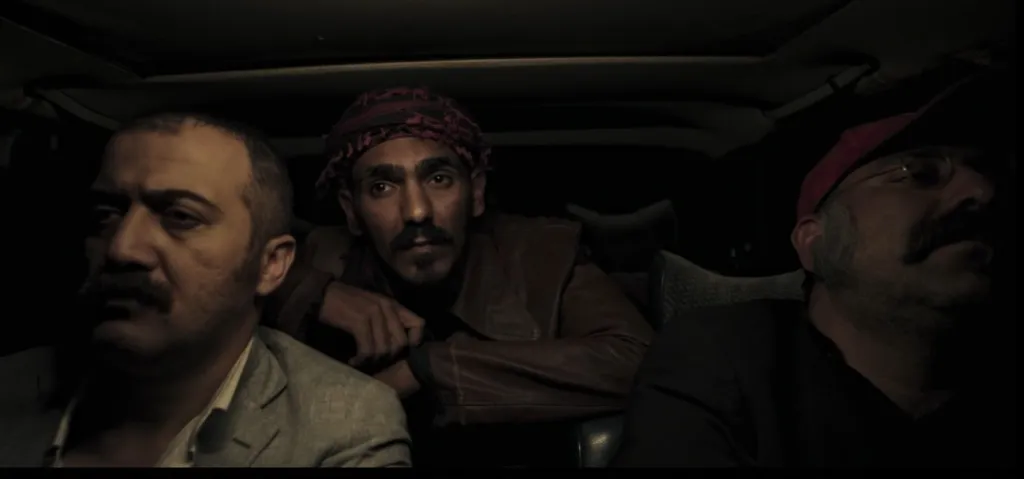
Twice Living and Thrice Dying is a dark comedy with a social and critical dimension, centered on a subject that has no real precedent in Iranian cinema. Three miners who survive a mine explosion decide to conceal the fact that they are alive and instead pass themselves off as victims of the disaster so that their families can receive compensation and blood money from the mine’s owners. Yet this premise merely serves as the starting point for the film’s social drama. Very quickly, the narrative enters strange and unsettling territories that cannot be understood through a realist framework and can only be justified within the surreal logic of Lakzadeh’s previous works and through non-realist cinematic conventions.
Notably, there is nothing overtly unusual about the film’s physical settings. Mountains, mines, hills, plains, roads outside the city, and a remote rural village form the backdrop. The snowy, freezing climate of Redhead is replaced here by a cold, foggy, and overcast atmosphere. The only truly unusual location is a café near the village whose upper floor, according to the owner, is reserved for special customers who have come from the city. Later, when Ebrahim—one of the miners—visits the café in search of his coworker Younes’s mother, we discover that these customers are young urban men and women sitting together, drinking coffee, and performing karaoke.
Like Lakzadeh’s previous works, Twice Living and Thrice Dying evokes the atmosphere of Jim Jarmusch’s films, particularly The Limits of Control and Down by Law. It shares the postmodern, minimalist, and surreal qualities characteristic of Jarmusch’s cinema: strange events, eccentric characters, darkly comic dialogue, and absurd situations in which the characters find themselves trapped. Following the explosion, Younes becomes wedged between rocks on a mountainside, while Davoud and Ebrahim set out for the village to seek help, rescue him, and notify their families. They are two unfortunate, ill-fated men who continually move from one disaster to another. The first person who offers them a ride is a health and safety inspector who grows suspicious of them and intends to hand them over to the police.
Although they are miners and members of the working class, we feel little sympathy for them because of their deeply unlikable nature, and Lakzadeh deliberately avoids encouraging any emotional identification with them. Their antipathy stems from their personality disorders and antisocial behavior. They stand in opposition to the law and to social norms. Without hesitation and with remarkable brutality, they murder the mine’s safety inspector and take his clothes. They think only of their own interests and the compensation they hope to receive, showing no concern for the rights of others. Davoud and Ebrahim abandon their colleague Younes in the cave where he is trapped among the rocks and continue pursuing their own objectives.
The film is populated with bizarre incidents and eccentric characters. Beyond Davoud, Ebrahim, and Younes themselves, there is a young dervish-like man living in the wilderness who possesses the gift of clairvoyance but is unable to start a fire; Davoud’s sister, who roams the village streets at night carrying a sickle, wearing a GoPro camera and dressed like a ninja while producing strange and frightening videos for her YouTube followers; Younes’s sister, one of the privileged patrons of the village café, who performs a French chanson in a karaoke session; and Younes’s mother, known as “Mama Lulu,” who, after hearing of her son’s death in the mining accident thirty years after leaving the area, sends her daughter to retrieve his body, only for her to discover that her brother is still alive. Even the fact that Davoud and his sister speak in the Mazandarani dialect contributes to the film’s sense of estrangement. This multilingualism and diversity of dialects appears to have been present in Lakzadeh’s earlier film Scissors as well.
The film is ultimately a story about human disappointments and unfulfilled desires. Younes’s sister tells Davoud that she dreams of becoming a famous singer. At the beginning of the film, Younes remarks that he has no one in his life who would be able to claim compensation on his behalf if he died. Davoud’s sister is greedy and wants to keep all the compensation money for herself. Ebrahim, meanwhile, has grown weary of his married life and hopes to disappear and live anonymously after the incident. When a representative of the mining company informs Davoud’s sister—who has come to claim compensation for her supposedly deceased brother—that the deaths of the missing miners must first be proven, and that compensation can only be paid once a fragment of their bodies is recovered, the miners agree to amputate parts of their own bodies and submit them as evidence of their deaths in the explosion.
Visually, Twice Living and Thrice Dying is equally rich. Lakzadeh succeeds in creating a series of inventive static and dynamic mise-en-scène compositions. One notable example is the conversation between Younes’s mother and sister: they appear side by side within a single frame, yet are in fact separated and facing one another, an effect achieved through the use of a mirror. Other memorable examples include the three miners’ composition inside the cave, their three-way conversation in a sauna-like room in Mama Lulu’s house illuminated by extraordinary lighting, and the intertwined three-shot of the miners leaning against a tree in the desert after a night of drinking. The film’s frequent extreme close-ups of the characters’ faces are effectively balanced by long shots of the surrounding landscape.
Like Lakzadeh’s earlier works, the film contains several scenes of graphic violence, from the murder of the mine safety inspector to the disturbing sequence in which Younes’s ear is cut off while he sleeps. The inclusion of old songs by Mehrpouya and Iraj Mahdian introduces another postmodern element, functioning as a reference to popular culture and non-elite forms of artistic expression. One can only hope that the film will soon find an opportunity to be screened in Iran.
I Die, Therefore I Am | A Look at Karim Lakzadeh’s Twice Living and Thrice Dying

Shares: