



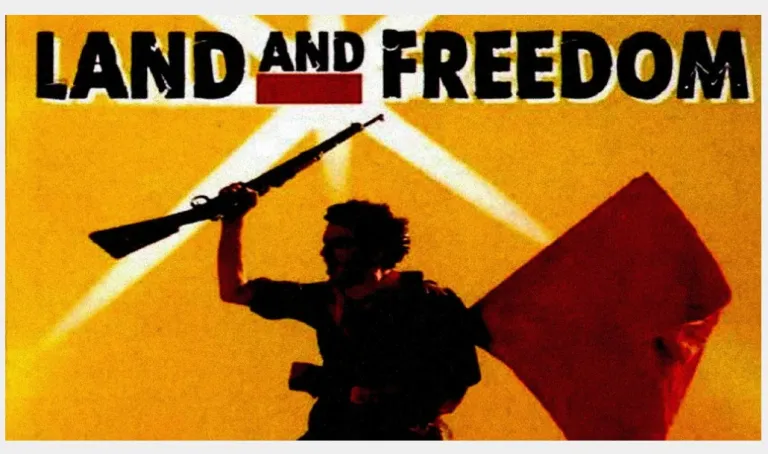
Yesterday, the newly restored 4K version of Land and Freedom (1995), directed by Ken Loach, was screened in the Cannes Classics section of the 2026 Cannes Film Festival. The film remains one of the most significant political and historical works of European cinema from the 1990s. More than a historical account of the Spanish Civil War, it transforms that conflict into a testing ground for some of the twentieth century’s most fundamental ideas: freedom, social justice, anti-fascism, and the possibility—or impossibility—of revolution. The return of the film to Cannes after many years is a reminder that its subject matter has not become outdated and does not belong solely to the past. Land and Freedom is one of those rare films that can still feel fresh and deeply affecting for contemporary audiences because, both politically and cinematically, it differs from many conventional films about the Spanish Civil War.
The film’s principal distinction lies in the fact that Loach does not treat the war merely as a historical backdrop or a national tragedy. Instead, he presents it as a battleground between emancipatory ideals, the internal divisions of the left, and the advance of fascism. Many films dealing with this period either emphasize the heroic dimension of the conflict or focus on personal melodrama. Loach, by contrast, places politics at the center of the drama and demonstrates that the failure of a struggle or a revolution is not solely the result of external forces; it can also emerge from the internal tensions and disagreements among the political groups engaged in that struggle.
Formally, Land and Freedom also differs from the lavish historical epics associated with the Spanish Civil War. Rather than relying on grandiose recreations of battle, Loach favors realism, simplicity, and a sense of lived immediacy. This choice prevents the film from becoming overly didactic and allows it to function less as a historical lesson than as a vivid human experience.
The issues addressed in Land and Freedom continue to resonate powerfully today: the rise of the far right, the fragility of political alliances, the difficulties of solidarity among progressive and left-wing movements, and the question of whether social justice is possible without organization and unity. Even reports surrounding the film’s re-screening at Cannes have emphasized that Loach himself regards these concerns as highly relevant to the present, noting that the film deals with the first major war against fascism while exposing the fractures within the left. For contemporary viewers, the film’s appeal lies not only in its historical depiction of the Spanish Civil War but also in its broader political meditation on the possibilities and failures of collective action. Its themes echo many of today’s global realities: democratic crises, the resurgence of aggressive nationalism, competing narratives of truth, and the challenge of building common fronts against fascism and authoritarianism.
The film reminds us that resisting fascism is not merely a military struggle but also one that requires political, ethical, and social cohesion. This idea feels especially relevant at a time when many protest movements—particularly those on the left—have been weakened or fragmented by internal divisions, disillusionment, political defeat, and ideological conflicts. At the same time, the film remains compelling because of its focus on themes that have long defined Loach’s work: the lives of ordinary people, friendship, love, disappointment, and political hope. Rather than resorting to slogans, it explores the real tension between idealism and reality. It is both a reflection on the historical failure of emancipatory projects and an inquiry into why progressive movements, even at moments of great hope, can become consumed by internal conflict, exhaustion, and repression.
Loach’s achievement lies in elevating the war beyond the level of national mythmaking or personal melodrama and turning it into a framework for examining anti-fascist struggle, the internal tensions of left-wing movements, and the necessity of international solidarity. Consequently, the film is not merely a story about the conflict between the Republican forces and Franco’s supporters. It is simultaneously a critique of political fragmentation, the erosion of ideals, and the internal collapse of emancipatory projects. Combined with Loach’s unadorned realist style, this perspective allows the film to remain remarkably alive and contemporary for today’s audiences.
Land and Freedom tells the story of David, a young unemployed English worker and member of the Communist Party in Liverpool. During the Spanish Civil War, he joins the Republican forces and the International Brigades in their fight against fascism. Like most of Loach’s films, the narrative is simple, classical, and linear, unfolding through an extended flashback. The film opens with David’s death in old age, and through his granddaughter’s search among his letters, newspapers, and personal documents, we gradually discover the story of his life and political involvement in Spain.
This narrative structure allows the film to do more than simply depict external events; it presents the past as a wounded and traumatic memory returning to the present. One of the film’s greatest achievements is its ability to recount major historical events through the perspective of an ordinary individual without ever turning him into the sole protagonist of history. Instead of offering a conventional heroic figure, the film presents a character who learns from and is ultimately disillusioned by political reality. This process of learning and disenchantment forms the emotional and intellectual core of the film.
David is a character who moves from idealistic simplicity toward painful political awareness. He enters the war driven by revolutionary enthusiasm, only to gradually realize that the struggle against fascism cannot succeed without political and ethical unity among progressive forces. Blanca, meanwhile, is far more than a romantic interest. She embodies a form of political and moral consciousness rooted in the lived experience of the revolution itself. The supporting characters—particularly the militia members and representatives of various left-wing factions—each embody a distinct historical position. Through them, the film demonstrates how internal divisions can slowly erode a movement from within. This approach to characterization creates what might be called a situational and social form of characterization rather than one based solely on individual psychology, perfectly serving the film’s political objectives.
In its final moments, the narrative returns to the present. We see David’s granddaughter at his funeral, reading lines from William Morris’s poem The Day Is Coming while sprinkling Spanish soil onto her grandfather’s grave:
“Join in the only battle wherein no man can fail,
For whoso falls and dies, yet his deed shall still prevail.”
These closing lines encapsulate the spirit of Loach’s film: the belief that even defeated struggles can leave behind a legacy of resistance, memory, and hope.
One of the film’s most important themes is the struggle against fascism and authoritarianism in Spain. Loach does not view the Spanish Civil War merely as a military conflict; rather, he presents it as the modern world’s first major confrontation with fascism—a confrontation in which volunteers from different countries joined the fight in the hope of defending freedom and human dignity. In this sense, the film is not simply recounting Spanish history; it is narrating a global resistance to fascism, a moment when fascism came to be understood as a transnational threat and the struggle against it likewise assumed an international character. From this perspective, Land and Freedom, while depicting the brutality of Franco’s forces, also emphasizes that authoritarianism does not advance solely through military violence. It also operates through political repression, the suppression of popular organizations, and the destruction of democratic and revolutionary possibilities.
International solidarity among progressive and left-wing forces occupies a central place in the film. David’s presence in the Republican ranks is not merely a personal choice; it symbolizes the international horizon of emancipatory politics. The film suggests that the fight against fascism is not a local struggle confined to a single nation but a shared battle among those who oppose reaction, discrimination, and militarized capitalism. This international dimension becomes particularly visible through the coexistence of volunteers, militia members, and left-wing activists from different national backgrounds, turning the film into an allegory of a united front against fascism—a coalition in which people from different countries and cultures come together in defense of a common ideal.
At the same time, the film reminds us of the historical bitterness of that solidarity’s defeat. It shows how emancipatory forces are weakened when internal divisions within the left and ideological rivalries begin to outweigh the common priority of resisting fascism.
The struggle against oppression and injustice is not confined to the film’s broader political sphere; it is also embedded in the everyday lives of its characters. Like many of the protagonists in Ken Loach’s films, David comes from the working class, and his journey to Spain can be understood as an extension of the experiences of insecurity, unemployment, and deprivation endured by workers in Britain during that period. His decision to join the struggle is therefore a response to a social order that marginalizes ordinary people. At the same time, his relationship with Blanca, a fellow revolutionary, allows the film to define freedom not merely as a political slogan but as the possibility of a genuinely human and loving relationship. Yet Loach avoids romanticizing love or mythologizing resistance. He consistently insists that political oppression ultimately damages human and emotional bonds as well.
Dramatically, the film is built upon the tension between hope and defeat. The scenes in which a village is liberated and the possibility of collective land ownership is discussed, or in which groups of fighters debate the contours of a more just future, possess tremendous dramatic force because they allow the audience to feel that history might genuinely be transformed. Yet that hope gradually gives way to anxiety and sorrow as ideological disputes and internal conflicts emerge. Consequently, the film’s tragedy is not simply the result of fascist violence; it is also the consequence of the collapse of political unity within the anti-fascist camp.
Ken Loach’s cinematic style is unmistakable throughout the film. His commitment to social realism and his avoidance of artificial spectacle create a world that often feels close to documentary filmmaking. The natural performances, the use of non-professional actors in certain roles, and his collaborative approach to the screenplay all contribute to a sense of immediacy and lived experience. As a result, historical events are not perceived as distant, museum-like reconstructions but as living and painful experiences.
Through this approach, Loach brings history down from the realm of official narratives and places it within everyday life, where politics, love, fear, and loyalty are inseparably intertwined. The rural landscapes and open spaces of Spain are more than mere backdrops; they are intimately connected to the film’s sense of possibility and freedom. The liberated land itself seems to embody the promise of emancipation. Yet these same landscapes later become symbols of the fragility of those aspirations as war and defeat take hold.
The film’s simple and unadorned mise-en-scène reinforces the material reality of its world and allows viewers to experience the political weight of events directly. Rather than maintaining an aesthetic distance, the camera often places itself within the action, increasing the audience’s sense of involvement and empathy. Ambient sounds, collective conversations, the noise of public spaces, and moments of silence all serve the demands of a realist drama rather than functioning as decorative or exaggerated effects. This restraint in the film’s sound design is entirely consistent with Loach’s broader cinematic universe—a universe in which politics cannot be separated from everyday life, and where every sound, silence, and pause can carry meaning.
Land and Freedom should ultimately be understood within the broader context of Ken Loach’s filmmaking and recurring thematic concerns. His cinema has always been defined by its commitment to the working class, its sensitivity to social injustice, and its critique of structures of power. Rather than focusing on great historical figures, Loach generally centers ordinary people—individuals who confront poverty, unemployment, humiliation, repression, and the desire for liberation within specific economic and political circumstances.
From this perspective, Land and Freedom is not an exception within Loach’s body of work but rather a concentrated expression of his worldview: a moral, political, and deeply human cinema that insists history should be viewed from below, from the perspective of those who have paid the highest price for freedom and social justice. This is precisely what makes the film enduring. It is a work that transcends the representation of a particular historical moment and becomes a reflection on the possibility of resistance and the necessity of international solidarity in the face of fascism and authoritarianism.
The screening of the restored version of Land and Freedom at Cannes 2026 is therefore more than the return of a classic film to a prestigious festival. It is an affirmation of the film’s continuing historical and political relevance for contemporary audiences and a reminder that its central questions—about fascism, international solidarity with emancipatory movements, political authoritarianism, and social justice—remain unresolved today.