



“Morality is not derived from reason, but arises from sentiment.” This famous statement belongs to David Hume, the eighteenth-century Scottish philosopher. Hume was among the first philosophers to unsettle the foundations of moral knowledge. From his perspective, reason is incapable of extracting or proving moral laws. He was the first philosopher to cast doubt on moral knowledge itself, believing that morality cannot be judged or adjudicated through reason. This skepticism toward ethics later became the theoretical foundation for many philosophers after him. From this standpoint, I would like to take a look at Jafar Panahi’s filmIt Was Just an Accident.
It Was Just an Accidentopens with a scene inside a car. A man whose face is familiar to supporters of the Islamic government is behind the wheel; his wife sits beside him, and his young daughter is in the back seat. Cheerful music is playing, and the little girl is dancing. Suddenly, an accident occurs: the man—whom we later learn is named Eghbal, also known as “Pretty Leg”—hits a dog and kills it. The joyful atmosphere inside the car turns into sorrow as the girl becomes distressed. The mother, who is also pregnant, turns to her daughter and says, “It was nothing, just a simple accident.” But this seemingly simple accident becomes the beginning of a complex chain of events.
Because of the crash, the car breaks down and stops in front of a workshop—one where Vahid, one of Eghbal’s former victims, works. Vahid is a young man who lost both his physical and mental well-being in prison at the hands of his ruthless interrogator. He has never seen his interrogator’s face; he recognizes him only by the sound of his footsteps—one leg artificial, producing a distinctive sound unlike that of a healthy, two-legged person. Vahid knows only that his interrogator lost one of his legs in the Syrian war and used this fact as a pretext for inflicting even greater cruelty on prisoners.
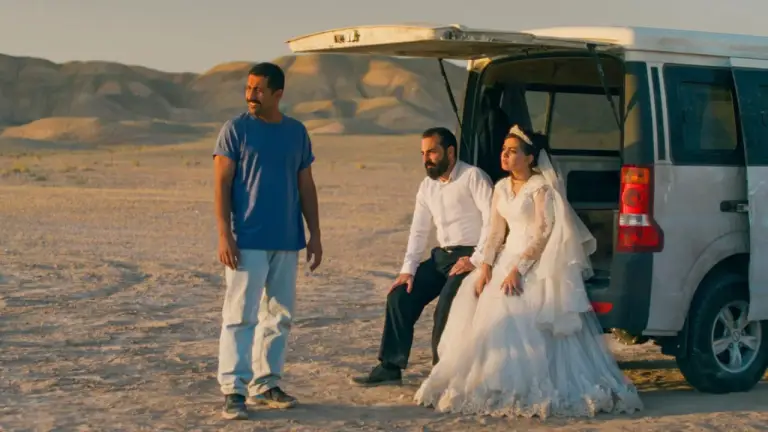
Vahid follows the man to his home, keeps watch until he finds him alone, knocks him unconscious with a blow, throws him into the back of a van—the same van meant to carry his sister’s baby supplies—and drives him into the desert to make him disappear.
Up to this point, it may seem that no real dramatic knot has yet formed. But in It Was Just an Accident, the drama truly begins when Eghbal regains consciousness and denies the identity attributed to him, claiming that he lost his leg in an accident. This is where doubt takes hold of Vahid. What if he really isn’t “Pretty Leg”? This is precisely the starting point of the film’s main narrative and its underlying layer: doubt.
This doubt and hesitation continue throughout the entire film: Salar’s doubt—another former prisoner tortured by “Pretty Leg”—as he helps Vahid identify the interrogator; Shiva’s doubt, a photographer who joins Vahid to identify the man while preparing for the wedding of another friend who was also one of the interrogator’s victims; the doubt of each former prisoner about killing the man trapped in the trunk; doubt over whether to take the unconscious man’s cellphone; doubt about whether the little girl’s crying is truly for her mother in labor or a trap to catch these former political prisoners; Hamid’s doubt about whether they should help Eghbal’s pregnant wife and take her to the hospital; Goli’s doubt about continuing alongside Vahid and Shiva to be sure that this man really is their interrogator; and finally, doubt over whether taking revenge on the interrogator is right, ethical, or just. Is killing him fair, or should he be released? And ultimately, does morality have a boundary with lived reality or not?
This is exactly where we can return to Hume’s famous statement and conclude that moral values are determined by emotions—emotions shaped by history, culture, knowledge, worldview, and beliefs of an individual or a society, rather than by logic and reasoning. Accordingly, these values may or may not align with external reality. Each character in It Was Just an Accidentconfronts events largely through their immediate emotions, and through those emotions they eventually arrive at the conclusion that the cycle of violence must end somewhere. This is also the film’s moral conclusion: violence reproduces violence, and at some point, sacrifice must prevail. Forgiveness and mercy must be what brings about change in “Eghbal Pretty Leg,” so that he, too, can end this bloody, rotten, and dark cycle.
But does that actually happen? Panahi responds to this question with the same stance of doubt and uncertainty. The film ends with a scene in which Vahid is gathering his sister’s baby supplies when, from behind, he once again hears the sound of footsteps—one artificial. Eghbal has come for him. But with what intention? This is where the film ends. An open ending that suggests even Panahi and the screenwriters do not have a definitive answer. In the face of both “yes” and “no,” there remains a great doubt and a bold question mark.
Can an interrogator like Eghbal—who withheld no form of physical or psychological torture from political prisoners and repeatedly declared that he could easily kill for the regime’s ideals—change simply by hearing that those very prisoners helped his wife safely give birth to their son? Can he become kinder? Or has the humiliation and degradation he endured made him even more bloodthirsty, now returning for revenge? Panahi leaves these questions to the audience—questions that are undoubtedly disturbing and even terrifying for many.
The film was terrifying for me from the very beginning. I, too, was familiar with the sound of footsteps made by an artificial leg—but from the opposite direction. My father lost one of his legs in childhood, and I have heard that sound since the earliest days of my life. But for me, it was the sound of truth, kindness, and purity. My father’s footsteps meant embrace and safety—steps I could trust. Here, however, the sound belongs to a man whose footsteps signify blows, beatings, insults, and humiliation; sexual and gender-based abuse; violation of both body and soul. This was the first disturbing grotesque image that formed in my mind.
If I were to point out another grotesque scene—one that reminded me of Aki Kaurismäki’s films—it would be the moment when Eghbal’s pregnant wife is laid down on the very trunk in the back of the van where her husband lies unconscious, effectively held hostage. The woman lies atop her husband, separated by a wooden partition inside a trunk shaped like a coffin—a coffin that could have been the interrogator’s. Yet on that very “coffin,” the woman is taken to the hospital so she can survive and give birth to the interrogator’s son. The fact that this group of Eghbal’s tortured victims chooses to help his pregnant wife is itself another layer of grotesque, black irony—suggesting that sometimes there is no choice but to be good and to do good, even toward a man who has destroyed everything his victims had.
It Was Just an Accidentnot only managed—for the second time in the history of Iranian cinema—to bring the Palme d’Or at the Cannes Film Festival to Panahi and to the people of Iran, but it has also been nominated for Best Drama Film, Best Director, Best Screenplay, and Best Non-English Language Film at the prestigious Golden Globe Awards. This opens the door to speculation that the film will likely be among the Oscar nominees as well. So far, It Was Just an Accidenthas received widespread international acclaim and positive reviews. Curiously, however, it has also faced a significant number of negative reviews from domestic critics—another kind of extra-textual grotesque surrounding the film. It seems that some local critics consider themselves more entitled and more knowledgeable than international critics and even the thousands of voters who have already supported—and may continue to support—this film.
Even if we consider Panahi’s film a political protest statement—something he himself does not deny—aside from a few scenes where performances feel exaggerated and dialogues somewhat overstated, the film possesses an effective cinematic structure, a convincing visual language, and a courage in both form and content that remains little more than a dream for many of those very critics. It is enough to remind ourselves of one key fact: this film was written and shot in Iran.