



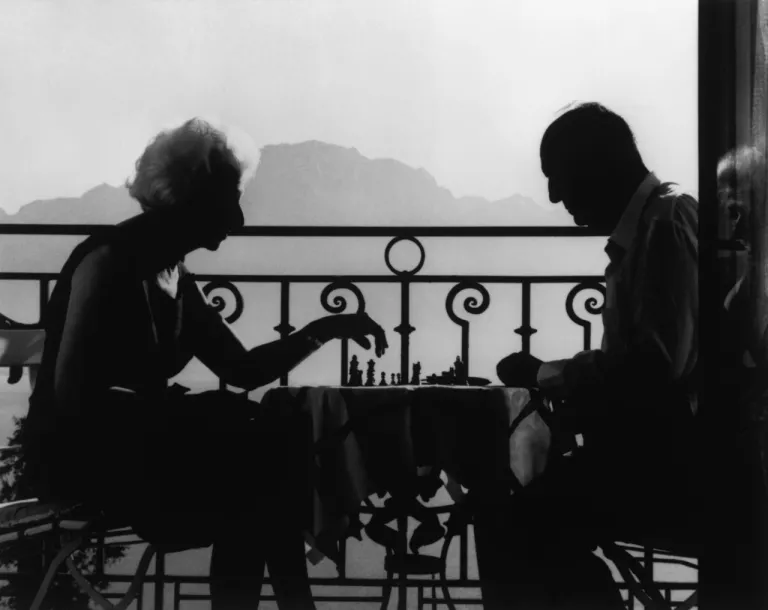
Nabokov can be regarded as the only prophet who openly disavowed any moral message for the masses. He proclaimed loudly that “art has no social value” and described himself as a pure aesthete—a “firebird,” free and unbound, a creature concerned solely with form and linguistic pleasure. In Nabokov’s creed, writers who stained their pens with moral preaching or political manifestos were, at best, boring and, at worst, vulgar.
If we were to distill Nabokov’s theology into a single principle, it would be this: “Cruelty is, above all, inattention.” In Nabokov’s world, the devil is not someone who delights in torture; the devil is someone so absorbed in himself that he does not even notice he is torturing.
Nabokov famously said, “I have no general message for the world, except that people should learn how to write well.” For him, literature meant a shiver down the spine while reading a pure description; it meant aesthetic pleasure. But if we stop at these surface declarations alone, we miss the greatest lesson of this modern prophet of literature.
At this juncture, perhaps only a sharp-eyed philosopher like Richard Rorty can peel back the delicate layers of Nabokov’s mesmerizing prose and reveal the hidden meanings beneath its linguistic glitter. Rorty argues that the mission of this literary prophet is not to preach, but to awaken us to a terrifying danger: the way beauty itself can become a vehicle for cruelty.
Rorty explains that the villainous characters in Nabokov’s novels—such as Humbert Humbert in Lolita or Charles Kinbote in Pale Fire—are not stupid or illiterate. On the contrary, they are intelligent, sensitive, cultured, and passionately devoted to beauty.
The problem is that they are completely immersed in their private worlds and fantasies, attempting to rewrite external reality according to their own desires. Their cruelty does not stem from innate wickedness, but from inattention. They are so busy constructing their beautiful inner worlds that they fail to notice how they are destroying other people’s lives—like Lolita’s. Humbert tries to freeze Lolita inside his eternal fantasy and ignores her human reality.
In Pale Fire, the narrator Kinbote goes to a barber shop in the village of “Kaspbim.” As the barber cuts his hair, he speaks painfully about the death of his son. Kinbote, a complete narcissist, pays absolutely no attention to this tragic story. He is only thinking about how much the barber’s face resembles the king of his own imaginary realm.
Rorty says: this is the height of cruelty—not physical torture, but the ignoring of another human being’s suffering in favor of one’s personal mental and aesthetic preoccupations. He concludes that novels like Nabokov’s do not teach us morality in the conventional sense (they do not say “do not steal”); rather, they help us recognize how the pursuit of beauty or personal truth can unintentionally cause others to suffer. They sharpen our sensitivity to the details of strangers’ pain. They make us understand that people like us—intelligent, well-read, sensitive individuals—can also become monsters if we lose our curiosity about other people’s worlds.
Nabokov was a man who spent half his life writing his own literary masterpieces and the other half ruthlessly criticizing the masterpieces of others. If a writer today dared to say that The Brothers Karamazov is a pile of “journalistic nonsense,” they would likely be publicly slaughtered on social media. But Nabokov, with the courage of a gladiator, not only did not fear expressing his hatred—he took pleasure in it. He knocked down the giants of world literature one by one.
Nabokov’s blacklist practically included the entire “Hall of Fame of twentieth-century literature.” He spared no one. Of Bertolt Brecht, Faulkner, and Camus, he said: “Their names are engraved on empty tombs… they mean absolutely nothing to me.” He even called Ezra Pound “a complete charlatan,” dismissing his poetry as “pompous nonsense.”
Yet perhaps no one incurred Nabokov’s aristocratic wrath more than Dostoevsky. For Iranian readers enamored of Crime and Punishment, Nabokov’s remarks may sound heretical. He wrote: “Non-Russian readers fail to understand that Dostoevsky is not an artist but a verbose journalist and a sloppy clown.” With his formalist obsession, Nabokov could not tolerate the chaos of Dostoevsky’s novels, declaring: “I loathe The Brothers Karamazov and that ridiculous affair called Crime and Punishment. His sensitive murderers and spiritual prostitutes are unbearable even for a moment.”
Nabokov’s list of “false idols” was not limited to writers. He harbored a deep contempt for Doctor Zhivago (by Pasternak) and for Sigmund Freud. Nabokov regarded Freudian psychoanalysis as a “fraud” and, with a tone blending mockery and disdain, remarked: “Why should I tolerate a complete stranger sitting at my mental bedside? I have no desire to behold the banal middle-class dreams of some odd Austrian with a shabby umbrella.”
Even Hemingway—whose short story The Killers Nabokov admired—did not escape his sharp tongue. Of Hemingway’s famous novels (such as For Whom the Bell Tolls), Nabokov said: “It was something about bells, balls, and bulls—and nauseating.” He described the mentality of Hemingway and Joseph Conrad as “disappointingly juvenile.”
Was Nabokov always right? Certainly not. Thomas Mann and Faulkner remain literary masters, whether Nabokov liked it or not. But Nabokov’s appeal lies not in the correctness of his judgments; it lies in his candor.
Nabokov teaches us an important lesson: literature is not a democracy. We do not have to respect everyone, nor do we have to swim with the current. He gives us the courage to have our own taste and to defend it. When asked what the best things in life are, he replied: “To be kind, to be proud, to be fearless.” Perhaps his insults toward other writers were not particularly “kind,” but they were certainly “proud” and “fearless.” And in today’s cautious, overly polite world, reading someone who dares to say “the emperor has no clothes” is a rare pleasure.
Ultimately, for Nabokov, a work of fiction is worthy of the name only if it can bestow upon the reader the gift of aesthetic pleasure. This pleasure is nothing less than a sense of connection to other realms of existence—where art alone reigns supreme, supported by four pillars: curiosity, refinement, kindness, and ecstasy. Perhaps this very invitation to kindness and delicacy is the greatest moral lesson of a writer who insisted that “my stories contain no moral lessons at all.”