



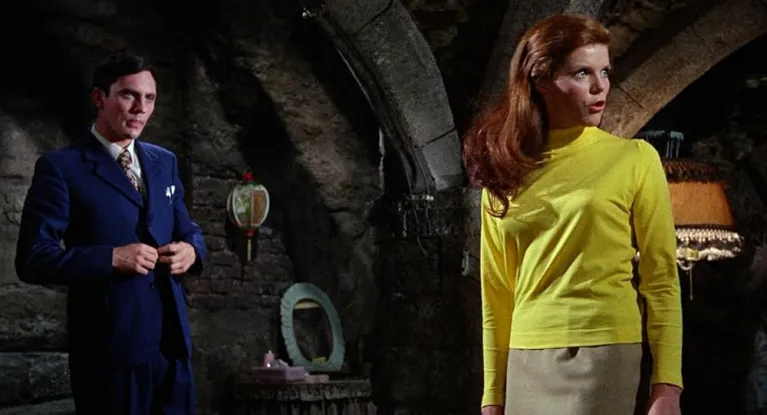
The Collector is a tense psychological drama centered on a lonely, isolated character burdened with inner knots and suppressed anguish, who seeks love and companionship through coercion. A man who, in a gradual process, reveals his dark sides and leads love to the slaughter.
William Wyler was a renowned American–German Hollywood director who shone brightly during the Golden Age of cinema. He holds the record for Academy Award nominations, with 12 in total, winning three of them.
Wyler began his career in 1926 by making silent films and, over the course of 46 years, directed celebrated works such as Wuthering Heights (1939) and Roman Holiday (1953), which garnered numerous awards and nominations at the Oscars and major international festivals.
Interestingly, in 1974 (1353 in the Iranian calendar), William Wyler traveled to Iran to be honored and to present 11 of his films at the third Tehran International FilmFestival, where he was warmly welcomed by cinema audiences and admirers of his work.
Three Academy Awards for Best Director for Mrs. Miniver (1943), The Best Years of Our Lives (1947), and Ben-Hur (1960); three nominations at the Cannes Film Festival and the Palme d’Or for Friendly Persuasion (1957); three BAFTA nominations and the Best Film award for The Best Years of Our Lives and Ben-Hur; and five Golden Globe nominations, including a win for Best Director for Ben-Hur, are among the major achievements of his career.
In 1965, Wyler directed The Collector, based on a novel by John Fowles. Published in 1964 as Fowles’s debut, the novel became a bestseller and marked the beginning of his literary career, which continued until 2005, shortly before his death.
John Kohn, Stanley Mann, and Terry Southern wrote the screenplay for this challenging adaptation—challenging due to the popularity of the source material. With Wyler’s direction, cinematography by Robert Krasker and Robert L. Surtees (both Oscar-winning cinematographers), and a score by Maurice Jarre (an Oscar-winning composer), the film was produced and nominated for three Academy Awards: Best Screenplay, Best Director, and Best Actress for Samantha Eggar.
The film also received four Golden Globe nominations, winning Best Actress (Eggar), and three nominations at the Cannes Film Festival, where it won Best Actress (Eggar) and Best Actor for Terence Stamp—among its most significant honors.
The color film The Collector opens with a male narrator, Freddie Clegg (Stamp), who gradually tells his story through step-by-step narration. The story begins with his pursuit of a beautiful young woman, Miranda Grey (Eggar), through the street, the university, a restaurant, and elsewhere, eventually leading to her abduction by Clegg.
From this point on, the film confines us to a country villa outside the city with these two characters, offering the audience a very different kind of companionship. We are accompanied by a physically present narrator who, although his voice-over compels us to follow him, leaves us unaware of the reasons behind his actions. Indeed, from the girl’s position, we share the same questions directed at the man—while knowing almost nothing about Miranda except that she is a painter.
This companionship becomes even more challenging when the drama, contrary to our conventional expectations of hostage and kidnapping scenarios, does not revolve around violence, rape, murder, blood, or gore. Instead, we are meant to witness the “terms” of this one-month forced cohabitation, grounded in a love that Freddie expects the girl to develop after getting to know him (“Could you love me?!”).
This distinctive approach highlights the psychological dimensions of the film, its drama-centered structure, and its characters, inviting the audience into a different quality of engagement—one in which the past and present of these two characters are given meaning through their actions and reactions in the present.
This psychological reading, focused on Freddie’s character, produces the film’s only flashback in black-and-white images, establishing him as a withdrawn bank clerk who is mocked by friends and colleagues—and then introduces the news of his winning a betting pool, which appears to spark a change in his lifestyle, rooted in that same humiliated self.
It is under these conditions that the character’s inner knots and complexes emerge. Instead of spending this windfall on leisure, travel, pleasure, and entertainment (as Miranda asks), Freddie uses the money to obtain the girl to whom he has paid attention for years but by whom he has never been seen.
In a brief parenthesis, one might note a comparable dramatic situation in a very different Iranian film that offers a distinct reading of the consequences of unrequited love. In What’s the Time in Your World?, this very “not being seen” by the beloved is portrayed over a long process—from childhood to adulthood, from school to university—and ultimately, the parallel worlds of the two characters intersect through the miracle of infatuation, creating an unparalleled romantic work in Iranian cinema.
In The Collector, however, this situation leads to a probing of Freddie’s character and an expansion of the reasons behind his unjustified expectation of forced interaction with Miranda. Two human beings with parallel, distant worlds who, in the tense situation of hunter and prey, captor and captive, find neither a shared language for communication nor even a common physical/sexual need to be fulfilled.
This is the dead end that Freddie’s diseased mind fails to foresee, believing coercion to be the key to achieving love and mutual understanding. Meanwhile, from the moment Miranda sees Freddie’s collection of dried butterflies, she senses the fate that awaits her (“Is this what you have planned for me too?”) and gradually loses hope of escape.
Thus, the psychological reading of the work steadily comes to the fore, guiding the audience step by step—alongside Freddie and Miranda—into the terrifying depths of the impending catastrophe and what awaits them (perhaps unintentionally).
In this context, the function of the suspenseful, tension-filled scene of water overflowing from the upstairs bathroom—simultaneously with the presence of a nosy, talkative neighbor downstairs—is amplified. Especially through the intelligent mise-en-scène and framing, which assign two sides of the image to two simultaneous, volatile events that could alter the course of the drama and the fate of the characters.
More importantly, this scene serves, in a prophetic way, to lend an inevitable meaning—consistent with the film’s worldview—to the failure of all small and large escape routes for Miranda and to the futility of her attempts to flee and be freed.
Particularly when the film’s ending, through its linkage to the repetition of kidnapping and the demand for compulsory love and affection, transforms Freddie into a psychotic serial killer with a collection of female victims—each resting in a coffin beneath a tree in the garden, or crucified like that very butterfly collection.
* From the poem “The Window”in the collection Let Us Believe in the Beginning of the Cold Season by Forough Farrokhzad:
I come from among the roots of carnivorous plants,
and my brain is still
brimming with the sound of the terror of a butterfly
that they had crucified with a pin in a notebook…