



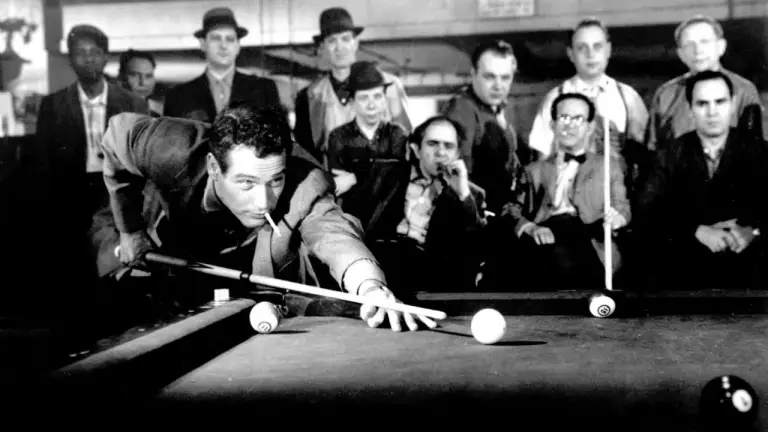
The Hustler is a character-driven drama focused on a solitary figure who navigates a journey of self-discovery and confrontation with his darker side through competitive billiards. Through this struggle, he develops a personal code and ethical framework, ultimately finding a unique interpretation of winning, success, and triumph.
Robert Rossen, an American screenwriter, director, and producer, worked in cinema from 1932 for three decades. His relatively small body of work focused on socio-political dramas, earning him multiple awards and nominations at prestigious festivals. Notable films include Body and Soul (1947), All the King’s Men (1949), and The Hustler (1961), the latter considered a landmark sports film.
Rossen’s accolades include the Golden Globe for Best Director for All the King’s Men and a nomination for the Golden Lion at the Venice Film Festival in 1950.
In 1961, Rossen adapted Walter Tevis’ debut novel The Hustler (1959), a story by an avid billiards enthusiast who later wrote the sequel The Color of Money (1984). Tevis’ other works include The Steps of the Minister, The Queen’s Gambit, and several short story collections.
The screenplay of The Hustler, co-written by Sidney Carroll and Rossen, starred Paul Newman as the protagonist Eddie Felson, aka “Fast Eddie,” and became a cult classic of American cinema. The film received nine Academy Award nominations, including Best Picture, Best Actor, and Best Actress, ultimately winning Oscars for Best Cinematography and Best Art Direction.
At the BAFTA awards, it won Best Film and Best Foreign Actor for Newman. The film also garnered numerous Golden Globe nominations and international festival recognition. Interestingly, 25 years later, Paul Newman reprised his role in Martin Scorsese’s adaptation of The Color of Money (1986), winning the Academy Award for Best Actor.
The Hustler centers on Eddie Felson, a young billiards prodigy who appears to play solely for money but is in fact driven by ego and the desire to assert dominance, achievable only through his skill in the game.
The narrative explores Eddie’s confrontation with his inner reality—what has prevented him from accepting the love of Sarah Packard (Piper Laurie) and instead driven him toward obsession with defeating formidable opponents like Minnesota Fats (Jackie Gleason). His struggle embodies false pride, ambition, greed, and the single-mindedness that defines his existence.
The film opens with a subtle yet precise introduction to Eddie’s character: a short scene showing his interaction with colleague Charlie Burns (Myron McCormick) as pharmaceutical salesmen. This moment establishes his dual talent for billiards and scheming to make money.
Eddie’s drive to play and win grows, culminating in a high-stakes match against Minnesota Fats, where his arrogance, inexperience, and lack of ethics lead him to a crushing defeat. This loss, however, is not merely about money; it reflects a deeply ingrained sense of failure that drives Eddie into a cycle of alcohol, aimless living, and complicated love with Sarah, through which they share their shortcomings and heal their wounds together.
Rossen creates a somber and emotionally restrained atmosphere, reflecting Eddie’s inner world in confined, cold, and detached spaces, which gradually softens as Eddie matures. By the end—after beating Minnesota Fats and resolving his conflict with Bert Gordon (George C. Scott)—Eddie experiences a subtle liberation, a glimpse of light, and perhaps redemption.
This implied liberation also marks a new moral outlook for Eddie. Following Sarah’s tragic suicide, he insists on playing against Fats again. Through this challenge, he surpasses his previous fear of losing and demonstrates a newfound inner strength that reshapes the game in his favor.
Even Bert’s threats cannot deter Eddie, who now recognizes the absence left by Sarah and achieves intellectual and emotional growth beyond the mere mechanics of winning and losing.
This nuanced reading of romantic and emotional dynamics, particularly in a predominantly male-centered film, highlights the writer and director’s intelligence. By understanding the drama’s needs and the protagonist’s unique requirements, they navigate an unpredictable yet compelling narrative, creating a film that is fresh, distinctive, and credible.
Thus, while The Hustler does not resolve its romantic subplot with a conventional happy ending, Eddie’s transformation through a short, intense experience of love gives his journey depth. His evolution offers a profound and authentic insight into the gap between losing and winning, both internally and externally, making his triumph feel genuine and earned.