



It is night. A young woman enters her home and calls for her mother. No answer comes. She begins searching the house, eventually finding her mother unconscious in the bathroom. Seti struggles with all her strength to drag her mother to the bedroom and lay her on the bed. This harrowing scene opens Bidād, directed by the young Iranian filmmaker Soheil Beiraghi in 2025, filmed inside Iran without mandatory hijab. From this first scene, it is clear that this film breaks taboos far beyond the absence of hijab on its female characters; it tackles subjects that are considered forbidden under the Islamic regime.
The first taboo is the presence of an alcoholic mother, played by Lili Rashidi—the furthest option from the audience’s previous image of her in TV series such as Zee Zigolo or Tā Be Tā, where she portrayed innocent, childlike characters. In Bidād, Rashidi plays Seti’s mother, a kind, loving woman who depends on alcohol to the point of unconsciousness.
The central character, however, is Seti. A young woman of Generation Z, passionate about singing, yet with no platform to showcase her talent. She faces both a depressed, alcoholic mother and a society governed by ruthless, oppressive rules that cannot tolerate her beautiful voice. The story pivots when Seti discovers a staircase in an alley she deems suitable to descend and sing in the darkness. Night after night, she sings at the bottom of the stairs, gradually drawing a crowd. Videos of her performances go viral on social media, bringing Seti from the underground to the surface—a decision that eventually leads to confrontations with law enforcement. This is when “Bebin” enters the narrative.
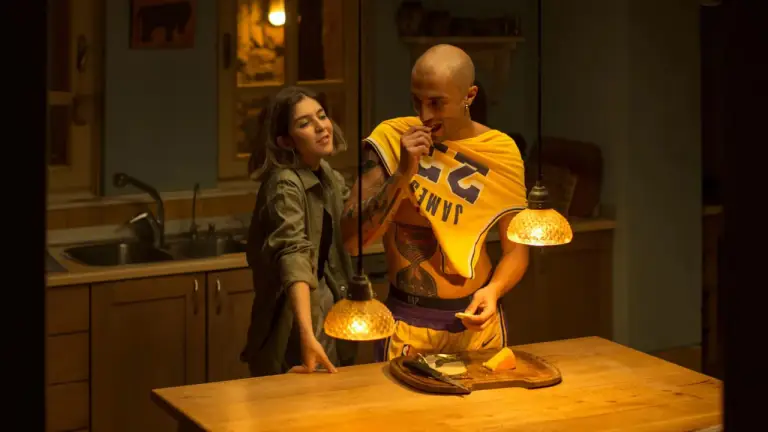
Bebin is a young man about ten years older than Seti, who rescues her from a confrontation with the authorities and drives her away. “Bebin” is a name Seti gives him, as he consistently avoids revealing his real name. From the start, it is evident that he is distinct from other young male characters familiar in mainstream Iranian cinema: his appearance, personality, and lifestyle are unique. Living alone in a house he cultivates, using his own plants, with a muscular tattooed body and a fully shaved head, he speaks in a distinctive manner. While eager to enter a relationship with Seti, he is respectful and patient, not rushing physical intimacy.
Servin Zabitian portrays Seti with clarity, purity, and beauty, while Amir Jadidi elevates his craft through Bebin, delivering a performance full of nuanced details using body language, facial expressions, and speech. Lili Rashidi also surpasses expectations as Seti’s mother, portraying a woman willing to endure humiliation for her daughter’s freedom, revealing facets of her talent previously unseen.
Bidād depicts injustice, oppression, and social inequality in post-revolutionary Iran spanning several generations. The mother represents the 1970s generation, Bebin the 1980s generation, and Seti embodies the newly active Generation Z. All three reflect burnt-out dreams and human longing, but Seti’s generation is more proactive, less fearful of authority, and equipped with access to free information. Determined to claim their natural and human rights, they resist threats and repression—much like Seti, who withstands detention, beatings, solitary confinement, and coercion without surrendering to authority.
Outdoor scenes feature women and girls in public spaces without hijab or wearing it voluntarily, underscoring the civil resistance of Iranian women today. The film stands as a historical witness for future generations—a testament to suffering, blood, tears, and acts of kindness and resistance.
Soheil Beiraghi’s previous works also reveal his concern for the violated rights of women in Iran, deprived of even basic freedoms under discriminatory laws rooted in religion, custom, and tradition. For making Bidād, Beiraghi and his team faced legal persecution and were tried on charges such as “encouraging corruption, propaganda against the regime, producing obscene content, and promoting immoral acts.” Despite fines and prison sentences, Bidād won the Special Jury Prize at the prestigious Karlovy Vary International Film Festival in the Czech Republic—a milestone that highlights the global recognition of independent Iranian cinema.
With Bidād, Beiraghi has created characters rarely seen in contemporary Iranian cinema: authentic individuals from society whose unfiltered, uncensored stories could only be told in Iran’s underground and independent film scene—an arena that increasingly asserts itself as the true, credible, and honorable voice of Iranian cinema.