



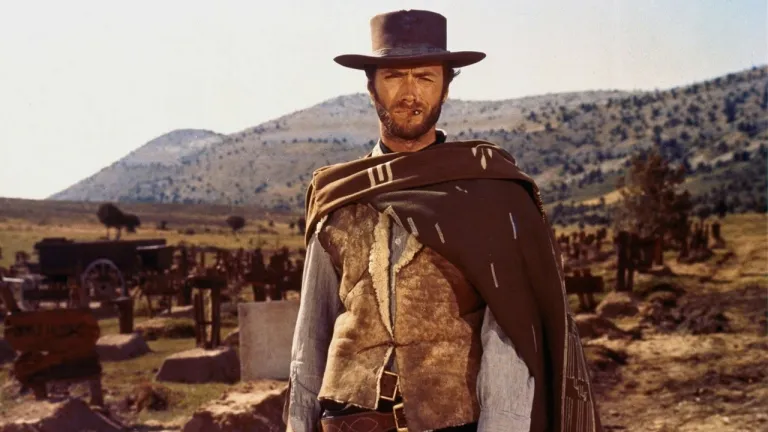
The Good, the Bad and the Ugly is an epic spaghetti western built on a distinctive reading of western films and their heroes. Through its layered, gripping, and conflict-driven narrative, the film expanded the boundaries of the genre and became the foundation for a lasting subgenre.
Sergio Leone, the stylistically singular Italian filmmaker, is widely regarded as the creator of the spaghetti western subgenre. His childhood and adolescence unfolded under the shadow of World War II and the rise of Mussolini and fascism in Italy.
Having served as an assistant to Vittorio De Sica on Bicycle Thieves (1948) and to William Wyler on Ben-Hur (1959), Leone took over directing the unfinished The Last Days of Pompeii, gradually paving the way for his own first independent feature, The Colossus of Rhodes (1961).
The 1960s marked a turning point for him, as he made three major films that gave birth to the spaghetti western: the trilogy known as the “Man with No Name Trilogy” or the “Dollars Trilogy.” These westerns—directed by an Italian filmmaker—presented a darker, more despairing world, more realistic character development, and, of course, Clint Eastwood’s iconic performances.
A Fistful of Dollars (1964), For a Few Dollars More (1965), and The Good, the Bad and the Ugly (1966) were made consecutively, each featuring the Man with No Name (Eastwood), while Ennio Morricone’s unforgettable score helped cement the trilogy’s place in cinema history.
Interestingly, Morricone never intended the films to form a trilogy, and Eastwood’s character—though similar—does have a name in each film. Even the chronology is reversed; the events of The Good, the Bad and the Ugly take place before the other two films. But the American distributor’s marketing strategy framed them as a trilogy to boost visibility—and it worked.
As the final entry in the trilogy, The Good, the Bad and the Ugly was based on a story by Luciano Vincenzoni and Sergio Leone, written by the screenwriting duo Agenore Incrocci and Furio Scarpelli, along with Vincenzoni and Leone, with dialogue by Mickey Knox.
Over the decades, the film has been nominated for and awarded by numerous major festivals and cinematic institutions, and it continues to be widely referenced. Clint Eastwood, too, achieved worldwide fame as the charismatic cowboy of western cinema, with this film solidifying his archetypal screen persona.
The story revolves around a hidden treasure buried in a remote cemetery (Sad Hill), which forces three characters—despite their contradictions and hostilities—to cooperate. Each, with their distinct personalities and motives, becomes bound to a shared dramatic need that pushes them into uneasy collaboration.
The Good/Blondie (Clint Eastwood), the Ugly/Tuco (Eli Wallach), and the Bad/Sentenza/Angel Eyes (Lee Van Cleef) each come into possession of a piece of information about the treasure, compelling them to work together.
This “what if…?” premise fuels a constant stream of tense confrontations and suspenseful situations, pulling the audience tightly through the three-hour runtime.
Although the U.S. release was about fifteen minutes shorter than the Italian theatrical version, the film’s box-office performance far exceeded expectations, earning more than 32 times its production budget.
Set in 1862, amid the chaos of the American Civil War, the film uses the unrest and disorder of the time as the backdrop for a soldier burying the treasure—a premise that brings the three strangers together.
Leone introduces each character individually through defining actions, then gradually brings them into conflict and confrontation.
Each character is tied to bounty hunting, banditry, murder, and—most importantly—scheming, deception, and double-crossing. At key turning points, they are forced into temporary alliances.
The motif of betrayal recurs throughout the film, pushing the characters to the brink of death each time. Yet some dramatic twist always prolongs their dangerous partnership—until the moment they no longer need each other, where the true nature of each man reveals itself.
This hidden dimension of character, embedded in the writers’ and director’s vision, is what earned the men their labels—good, bad, and ugly—and ultimately gave the film its title.
An intriguing detail: Blondie commits eleven killings in the film, Tuco six, and Angel Eyes three. But Angel Eyes murders an old soldier, his young son, and a sick man—making him morally “bad,” while Blondie and Tuco kill only criminals, corrupt officers, and bounty hunters, thus becoming “good” and “ugly.”
The Good, the Bad and the Ugly depicts a violent, bloody drama in the Wild West—an expression of life as a struggle for survival, revealing the raw human impulses shaped by morality, ambition, madness, malice, self-interest, and even love.
Thus, beneath the surface layer of treasure hunting, trickery, and gold, lies a deeper battle for survival. The characters are ultimately defined by their moment-to-moment choices—just as the Good, after taking his share of the treasure, chooses to free the Ugly, and the Bad meets his downfall despite his early advantage.
The film is, in essence, the visual embodiment of the three-way duel among the Good, the Bad, and the Ugly—figures who, beyond their names and circumstances, carry symbolic roles shaped entirely by their actions. They are embodiments of the ethical fabric of the drama.