



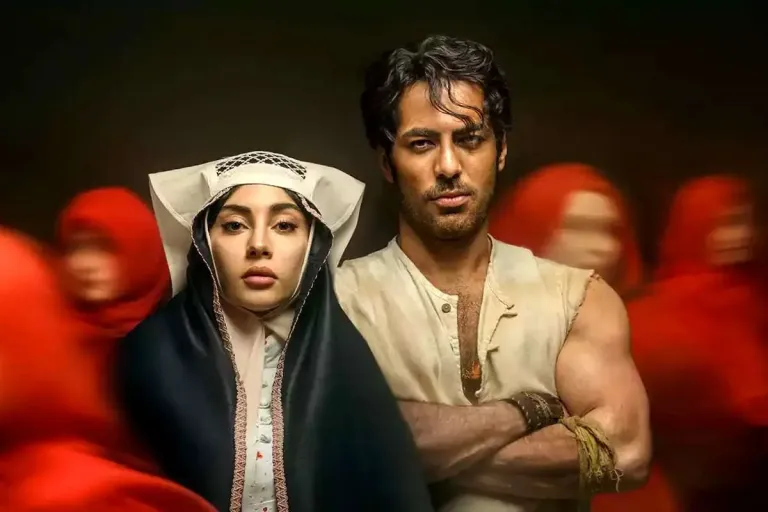
Bamdad-e Khomar is the title of a new series directed by Narges Abyar, whose first four episodes were recently released on the Shida streaming platform, following the conclusion of the first season of Savushun. The series is adapted from the novel of the same name by Fataneh Haj Seyed Javadi, published in 1995—one of the best-selling post-revolution Iranian novels. It has been reprinted dozens of times and sold hundreds of thousands of copies, though some critics describe it as “popular fiction.” As Abyar was simultaneously adapting Simin Daneshvar’s Savushun—the first novel written by a woman in modern Iranian literature—she also turned to this book and developed a series based on it.
The series opens with a young girl in Qajar-era dress—a black chador and white face veil—running from several men through what looks like an abandoned, ruined neighborhood. The opening credits follow, listing Navid Pourfaraj first, then Tarlan Parvaneh, and the rest of the cast. After the credits, however, the story jumps to wartime Iran in the 1980s, where Soudabeh, a girl from an affluent family, wishes to marry the son of a working-class samovar maker from South Tehran. Her parents oppose the marriage. Trying to escape their pressure, she takes refuge in the home of her aunt, Mahbubeh—played by Ehtesham Boroumand—who, during blackouts and air raids over Tehran, opens a sort of Pandora’s box and transports Soudabeh back to the years before 1920, when Mahbubeh herself was fifteen and the middle daughter of an aristocratic family. One older sister is already married, the younger is still a child at home, and Mahbubeh—beautiful and highly sought after—has many suitors, including her educated, Europe-returned cousin Mansour. But a dispute between his father and Mahbubeh’s father over inheritance leads Basir, Mahbubeh’s father, to promise her instead to the son of his business partner. Up to this point, Abyar succeeds in establishing a convincing atmosphere and drawing the audience in. Unlike her adaptation of Savushun, which was almost a one-to-one translation of the novel, here the screenwriter tries to preserve the spirit and narrative world of Bamdad-e Khomar while also making use of visual storytelling.
But in the very first episode, when teenage Mahbubeh—played by Tarlan Parvaneh—goes to the bazaar with her nanny Marhamat, portrayed brilliantly by Marjaneh Golchin, to inform the carpenter’s apprentice that the seamstress will be staying at her house for the engagement preparations, the series begins to falter. The apprentice is a neighbor of the seamstress. And here, the narrative and cinematic structure collapse simultaneously. With the arrival of Rahim—played by Navid Pourfaraj—who is first shown sawing wood, Abyar’s directing falls into what can only be called vulgarity. Slow-motion shots of his kohl-lined eyes, thickened eyebrows, bulging bare arms, open-collared white shirt, and exposed chest repeat so excessively and insistently that the viewer is left with no doubt: Rahim, the carpenter’s apprentice, is meant to be irresistibly attractive, sexy, and intoxicating—and Mahbubeh, of course, has no choice but to fall in love at the sight of that sculpted body, smoldering eyes, and wild curls. Rahim’s presence, in this stylized form, pulls the story out of late-Qajar Tehran and drops it straight into Paris and London fashion shows. It’s as if Navid Pourfaraj has leapt straight off a Gucci or Burberry catwalk into a Qajar-era set.
It is obvious that the actor’s physique was built in modern gyms—nothing about his muscular, hyper-defined body or his soft, manicured hands suggests someone shaped by carpentry work. Neither Rahim’s body, nor his makeup, nor his clothing feels remotely believable. Worse yet, the viewer cannot understand the purpose behind the camera’s excessive focus on the character’s sexualized features—especially in a cinematic context where even depicting the slightest physical contact between two people is prohibited, let alone scenes implying sensual intimacy.
If this hollow and gratuitous emphasis were limited to a single scene, it might be forgivable. But across the four episodes released so far, these exaggerations not only persist but intensify, now joined by Mahbubeh’s increasingly erotic glances. By episode four, Mahbubeh has visited the carpentry shop several times, removing her white veil without cause, even when Rahim hasn’t asked, in order to facilitate eye-flirting in scenes that feel aggressively radical and exaggerated. One wonders whether such scenes would have been allowed if the director were anyone other than Abyar. A similar lack of logic appears in Savushun as well—in scenes where Zari gushes over Yusef’s emerald eyes, or in the bedroom sequences filled with erotic gazes and longing. In Daneshvar’s novel, these interactions ultimately culminate in physical intimacy, but Abyar—unable to depict such scenes—has instead oversaturated the visual language of the gaze, turning every scene heavy-handed, overwrought, and difficult to watch. In Savushun, this excessiveness also shows up in the incessant handheld camera movements, which are so disorienting that the narrative becomes hard to follow. In the asylum scenes, the constant shakiness and their duration further exhaust the viewer.
Bamdad-e Khomar, which initially engaged the audience with its sets, costumes, and solid performances—successfully transporting viewers across a sixty-year time span and even making the actresses’ modern heavy makeup somewhat acceptable—collapses the moment Rahim enters. His sleeveless, button-less outfit is clearly designed to sexualize him, and worse, he appears in the exact same dirty “sexy” white shirt every time Mahbubeh visits him over several days. Rahim, with supernatural vision and hawk-sharp eyes, recognizes Mahbubeh from far away, even with her head covering. In episode four, he holds up the wooden horse frame and, with his hair falling over one eye and those kohl-lined eyes smoldering, sits facing Mahbubeh to lure the lamb into the wolf’s den—except that this lamb willingly visits the wolf’s den daily and needs no seductive looks, which feel more like they belong in a Bollywood film.
There was a time in Iranian cinema—during the same wartime era that forms the series’ present-day setting—when actresses were styled and dressed specifically to avoid any beauty or sensuality. The most famous example is The Mare (Madian) by Ali Jakan, starring Soudabeh Safavi. Safavi recounted that a Ministry of Culture monitor was present on set at all times to ensure she did not appear attractive in any way. Now, we’ve reached an era in which Abyar uses every tool at her disposal to make her actors appear as beautiful, attractive, sexy, and desirable as possible. While she has succeeded in doing so with Mahbubeh and Rahim, in Savushun she fails utterly with Yusef; despite all attempts by the director and camera, Milad Keymaram—with his artificial blue contacts, perpetual scowl, and arrogant body language—never becomes the charismatic, beloved Yusef Daneshvar. His performance, a repeat of his usual mannerisms, evokes no empathy whatsoever. As for Pourfaraj, we have yet to see much beyond his “Bollywood-style” gazes, but it seems Rahim’s role is significant for Abyar—his name even appears before Tarlan Parvaneh’s in the opening credits. Yet Parvaneh, though ten years younger, began acting at a much earlier age and has far more experience in film, theater, and television.
So far, it seems that Abyar’s understanding of the novel Bamdad-e Khomar reflects more the intoxication of Rahim’s eyes than the intoxication of Mahbubeh’s love for him.