



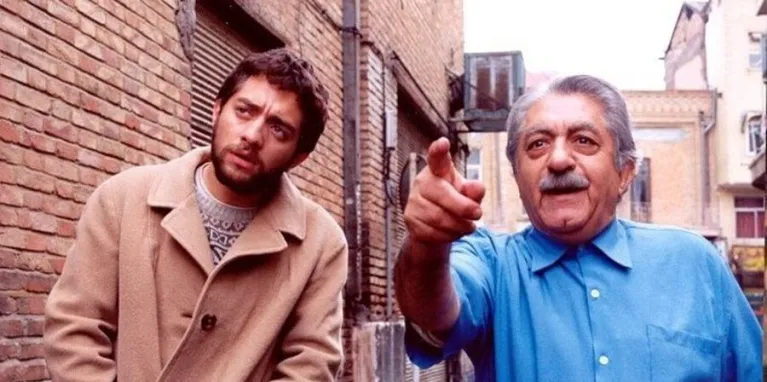
Gavkhuni is an adaptation drama centered on the subjective narrative of a young man who recounts his childhood, adolescence, and present life through interactions with the defining elements of his existence: his father, Isfahan, the Zayandeh River, and Gavkhuni. However, the film struggles to fully embrace the language of cinema and fails to elevate the novel from its pages as one might expect.
Behrouz Afkhami, a controversial director, has a history of projects—from television series to films—marked by his often misguided adventurousness. He has worked across genres without maintaining a consistent artistic vision or a unifying thematic concern.
From The Bride, Day of the Angel, Day of the Devil to The World of Pahlevan Takhti, Shokaran, Saint Petersburg, Azar, Shahdokht, Parviz and Others, and more, Afkhami’s works demonstrate this adventurous streak. Over time, his interest in classical cinema has waned, and his works have become more superficial and less memorable.
Gavkhuni, released in 2002, is based on a screenplay by Afkhami, adapted from a short novel of the same name by Jafar Modarres-Sadeghi, an Isfahani writer who built a personal and introspective story anchored in the geographical markers of his birthplace, creating a fluid stream-of-consciousness narrative.
The novel was first published in 1983 and reissued in 1991, earning Modarres-Sadeghi widespread recognition in Iran and abroad. It has been compared to landmark works of Iranian literature, such as Sadegh Hedayat’s The Blind Owl, and continues to hold a prominent place in the literary canon.
The film received three nominations at the 22nd Fajr Film Festival, winning the Crystal Simorgh for Best Supporting Actor for Ezzatollah Entezami and a Special Jury Prize for International Directing. It also won the (Viewpoint) award at the Seoul Festival and the NETPAC award at the Brisbane Festival, and was nominated for Best Screenplay at Cannes.
Like the original novel, Gavkhuni presents a subjective narrative through the voice of an unnamed young male narrator (Bahram Radan), who recounts his childhood memories connected to his hometown, Isfahan, the Zayandeh River, Gavkhuni, and his authoritarian father (Ezzatollah Entezami) across dreams, nightmares, and consciousness.
The protagonist’s real and objective world intertwines and blurs with his stream of consciousness, merging past and present with intuitive perceptions of future expectations.
While the filmmaker strives for a faithful cinematic adaptation, the novel itself is already fully visual and vivid on paper—imagery expansive enough to match any reader’s imagination—making a single visual perspective filtered through the director insufficient.
By adhering closely to the book, the director sacrifices personal reinterpretation in order to leverage the novel’s structural and visual richness. Consequently, the film elevates itself using the novel’s strengths, rather than the other way around. This comparison reduces some of the film’s shortcomings and allows it to establish a presence in the audience’s mind.
From the outset, the film employs an unseen first-person narrator, with the camera representing his point of view, and the visual representation relies on his stream-of-consciousness, capturing corresponding imagery. However, with overlapping timelines and no clear chronological distinction, the narrative flows fluidly through the narrator’s dreamlike consciousness.
This ambitious structure does not entirely succeed, and the narrator’s face is revealed only in the final act, coinciding with the reappearance of his deceased father from dreams and nightmares into the protagonist’s reality—a device that reinforces his connection to the world of the dead and foreshadows his own approaching death.
“I closed my eyes and kept them closed for so long that my eyelids grew heavy, and I was about to fall asleep. I thought if this were a dream and I fell asleep within it, then when I awoke from this second dream, I would still be in the first, and I’d have to wake up from this one too. I realized I must not let sleep take me, so I opened my eyes and saw my father… tall, broad, still laughing…”
The film, like the book, relies on a limited set of characters who can be read symbolically and metaphorically while maintaining their roles in the real narrative. From the tailor father and grief-stricken mother to the cousin/love interest/wife (Bahareh Rahnama), the fourth-grade teacher, Mr. Golchin (Soroush Sehat), and the narrator’s roommates, each plays a layered role.
Just as the novel’s locations—Isfahan, Si-o-se-pol, the Zayandeh River, and Gavkhuni swamp—anchor the narrator’s memories from childhood to adulthood, the film deepens their symbolic and metaphorical significance, touching on themes from patriarchal authority to entrenched misogyny and the precarious position of women as mothers, wives, and lovers.
For viewers familiar with the book, the film may feel one-dimensional or unsatisfying compared to the mental images and emotional experiences formed through reading.
However, for those unfamiliar with the novel, or willing to adapt their own mental images to the director’s vision, the film can offer a unique and empathetic experience, connecting the fragmented and troubled mind of the narrator to the broader anguish of contemporary human existence in a specific Iranian context.