


“Woman, Life, Freedom — The Point of No Return” is the title of a collection of interviews conducted with women in Iranian cinema — women who, following the Woman, Life, Freedom movement, chose not to, or could no longer, continue their professional careers after standing in solidarity with the protesters and removing their compulsory hijab.
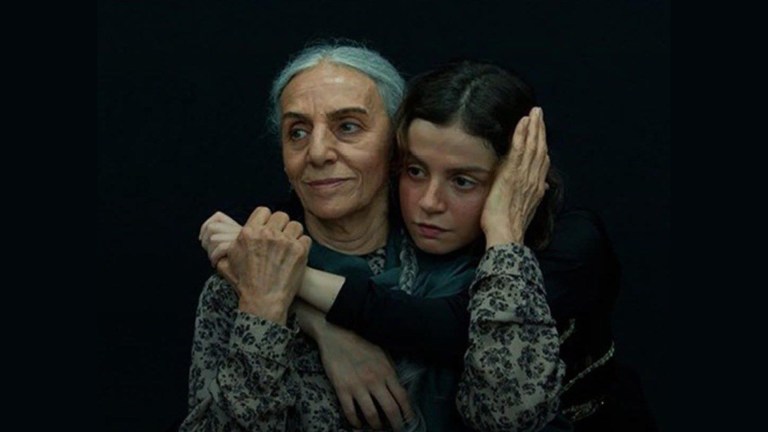
I always remember Maryam Boubani with her straight white hair — perhaps because she began acting later in life. Her calm, patient face, expressive eyes full of emotion, and that unforgettable, resonant voice of hers have stayed in my memory. Boubani, who has appeared in numerous feature and short films, as well as many television series, has not appeared in any productions since 2022. After the state killing of Mahsa (Jina) Amini, she posted a photo of herself without a headscarf — her long white hair neatly braided — and wrote:
“Decades of hardship never turned my hair white, but I now free this whiteness from the compulsion of the veil — in respect and solidarity with all the women and girls of my homeland.”
In recent years, Boubani has courageously appeared in several independent Iranian films without compulsory covering. Throughout her career, she has never remained silent in the face of oppression, injustice, and the suffering of her people. A brief look at her social media pages says it all.
Interview with Maryam Boubani
You have been active in Iranian cinema and television for about 30 years after the revolution. What led you, in October 2022, to remove your headscarf publicly? What about the killing of Mahsa (Jina) Amini brought you to that turning point?
Maryam Boubani: Honestly, the horrific and public death of Mahsa (Jina) Amini became a turning point in the inhumane treatment of women and girls in this country — treatment that has existed since the beginning of the revolution. Even before that tragedy, we had witnessed countless illegal and cruel acts across Iran, but the evidence surrounding her death reminded us how many boundaries had already been crossed. This was no longer about enforcing arbitrary laws — it had reached a point where, under the guise of religious ideology, those in power took a grave step forward to prove themselves right. And if no one raised their voice, such acts would soon become “law.”
In other words, the slogan “Either a veil or a beating” would inevitably evolve into “Either a veil or death.”
More importantly, the mindset of erasing women has persisted — justified by ever-changing laws and excuses. When I say Mahsa’s tragic death was a turning point, it’s because the struggle of women against such unlawful and oppressive behavior has always existed, in various forms. Removing the hijab — which might seem like a simple piece of cloth — actually meant tearing away at a fabric woven with decades of discrimination, exclusion, and pain, steeped in the blood of the women and girls of this land.
Did you know you would no longer be able to continue your career as an actress?
Maryam Boubani: Yes, of course. I knew that would happen. But compared to the price all the women and girls of this country — especially the grieving mothers of this era — have paid, it didn’t matter to me. Even though it directly affected my livelihood, it was a cost I was willing to bear.
You wrote, in response to being banned from travel, that you stayed in Iran even under the missiles and bombs of the Iran–Iraq war, and that you have no intention of leaving. Why is staying in Iran so important to you, even with a work ban?
Maryam Boubani: Iran is my homeland.
I’ve traveled abroad many times. The beauty of architecture, the quality of life, the individual and social freedoms, the pleasant climate, the comfort — all of it is wonderful and admirable. But within a week, I’d find myself longing deeply for my own people.
I don’t believe those who have left Iran feel entirely happy. Their quality of life may have improved, but I’m sure there are countless moments when they miss their country and their people — and I cannot endure that kind of longing.
Besides, I’ve seen many who lost their creativity and sense of purpose in exile, swallowed by the sorrow of distance. I am deeply rooted here, in a thousand ways. Perhaps for a young person who seeks education and scientific opportunity, leaving might be the better choice — since such opportunities are so limited in today’s Iran. But for me, at seventy-two, no. Even when I was young, I never dreamed of leaving, despite the stress, turmoil, and dangers I lived through during the revolution, the war, and all the crises that could each, on their own, break a person.
After the events of 2022 and your public support for the protests, were you personally harassed or targeted by the Islamic Republic? Did you lose any film projects?
Maryam Boubani: Inevitably, there were consequences. I was summoned two or three times. The first time, I didn’t have a lawyer, but soon Ms. Kian Arthi kindly accepted my case and followed it through. In the end, I was sentenced to a work ban, prohibited from posting anything about war or executions, and given a two-and-a-half-year suspended prison sentence.
That was the official part.
Unofficially, the online harassment began — threats, insults — extremely severe and frightening in the first months. But all of that eventually passed.
Last year, you appeared in an independent Iranian film, Shahid (“Witness”), in which you play a woman who witnesses the murder of another woman by her husband — a man affiliated with the Islamic government. Symbolically, you became a “witness” to this era of history. Where does your courage come from?
Maryam Boubani: Yes, Witness, directed by Nader Saeivar, was the second or third project I took on after being banned from official work. I read the screenplay, and because it was filled with the painful realities of women’s lives — truths long buried under the weight of imposed fear — I accepted the role.
Witness tells the story of three generations of women who, relentlessly and in silence or defiance, have fought across this landscape of suffering simply to live ordinary lives. From the father’s home to a society governed by laws that diminish your worth day by day — yet each generation, armed with greater awareness and the courage to say that magical word “No,” refuses to submit. They resist the inherited pain imposed by patriarchal oppression and strive toward what is humane, honorable, and free from violence.
I must also express my gratitude that I’ve had the chance to tell these stories with the help of men who have courageously broken away from the patriarchal traditions of their society — men who now stand among the most honorable, in resistance against ignorance and injustice.
Many actresses in Iran did not publicly support the women who removed their hijabs. Why do you think that is?
Maryam Boubani: Let me just say — I don’t know.
These days, we see women across Iran — even in smaller towns — walking in public without compulsory covering. In your opinion, what is the next step toward freedom?
Maryam Boubani: In answer to that, I would say: “The road will tell you itself.”
This is, after all, a land of wonders — and utterly unpredictable.