



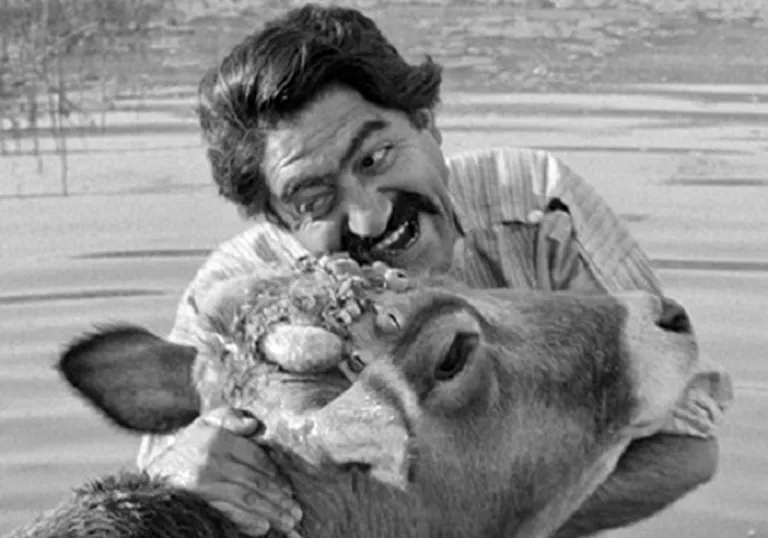
The Cow (Gāv) is an allegorical drama about a villager’s deep attachment to his cow — an attachment so profound that, after the animal’s death and the villagers’ attempt to conceal the truth, it drives him into a delirious identification with the cow, ending in his death — the inevitable conclusion of his gradual transformation.
Directed by Dariush Mehrjui, one of the most influential filmmakers of Iran’s New Wave, the film followed his earlier work Diamond 33, a film he later dismissed as an unworthy anomaly in his career. With The Cow, Mehrjui began his lifelong engagement with literary adaptation — transforming both Iranian and foreign literature into some of the most enduring works in the history of Iranian cinema.
Mehrjui studied cinema in the United States but graduated with a degree in philosophy before returning to Iran and embarking on his path as a director.
Released in 1969 (1348), The Cow was co-written by Gholam-Hossein Sa’edi and Mehrjui, based on Sa’edi’s short story “The Cow” from his 1963 (1343) collection The Mourners of Bayal. The story had earlier been adapted for stage and television, directed by Jafar Vali and featuring Ezatollah Entezami, Ali Nassirian, Jafar Vali, and Esmat Safavi.
Sa’edi’s collection consists of eight interconnected tales about the misery and decay of the residents of a remote, crumbling village named Bayal — a place ruled by death and desolation. The Cow is the fourth story in the book. During production, the film was tentatively titled Zangoolan (The Cow), but the original title was ultimately retained.
The film premiered at the Shiraz Arts Festival and was later released publicly in Iranian cinemas. It won the Best Screenplay Award at the Sepas Film Festival and the Second Prize for Best Film at the Tehran International Festival. Internationally, it was screened at the Cannes Directors’ Fortnight (without subtitles) and received the FIPRESCI Award at the Venice Film Festival. It also earned Ezatollah Entezami the Silver Hugo for Best Actor at the Chicago Film Festival and the Best Film (New Directors section) at the Berlin Film Festival.
The Cow remains a cornerstone of Iranian cinema’s global presence and is consistently ranked among its greatest films.
In both Sa’edi’s story and Mehrjui’s adaptation, the film depicts a timeless, placeless village through its daily rhythms and interactions — dominated by two recurring motifs: death and madness. These forces claim first the life of the cow and then its owner, Mash Hassan (Ezatollah Entezami), whose grief evolves into a delusional metamorphosis.
The film’s lack of specific geography or period gives its narrative universality, allowing audiences anywhere to relate to its portrayal of primitive existence — a world where owning a single cow confers dignity, respect, and social standing.
The emotional bond between Mash Hassan and his cow, subtly dramatized in the script, transcends material dependence. The animal is not merely a source of livelihood; it becomes a sacred symbol of fertility, continuity, and life itself — an emblem of identity and blessing in an otherwise decaying world.
The tragedy unfolds when, during Mash Hassan’s absence, his cow dies. To spare him the shock, the villagers — led by the pragmatic Mash Eslam (Ali Nassirian) — secretly bury the cow and invent a story that it has run away. To make this lie convincing, they weave a chain of deceptions, invoking the mythical “Belouris,” imagined enemies of the village who are blamed for every misfortune.
Yet the plan collapses under the weight of Mash Hassan’s love and identification with his cow. Unable to accept its death, he gradually convinces himself that he is the cow — an idea both terrifying and pitiful, drawn out through a masterful progression of psychological realism. Even the ostensibly rational Mash Eslam ultimately accepts this delusion, treating Hassan as a real cow while escorting him to the city for “treatment,” marking the total collapse of reason.
The film opens with a group of village children laughing as they taunt a local madman and closes with a similar scene, completing a fatalistic circle — life in this symbolic village repeats endlessly, steeped in ignorance, superstition, deceit, and despair.
By the film’s end, Mash Eslam perpetuates the cycle of lies once again, claiming that Mash Hassan, too, has “run away” — ensuring that the village remains imprisoned in its delusions.
Is there anyone left to awaken from this sleep of ignorance — a slumber whose only escape seems to be madness and death?
Alas, we are all asleep…