



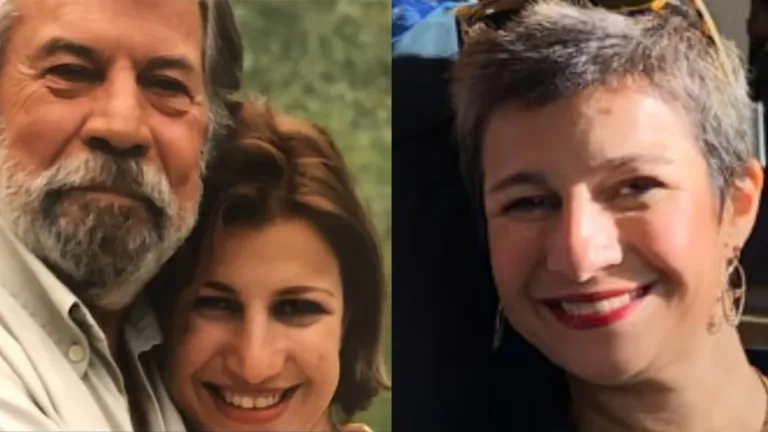
The Important Work Was Done by the People; We Were Only Followers |Woman, Life, Freedom — A Path of No Return: Leili Rashidi
“Woman, Life, Freedom — A Path of No Return” is the title of a series of interviews with women from Iranian cinema — women who, following the Woman, Life, Freedom movement, chose not to (or could no longer) remain in their profession after showing solidarity with the protesters and removing their compulsory hijab, resulting in professional bans.
I remembered Ehteram Boroumand from pre-revolution children’s television and Davoud Rashidi from Ali Hatami’s brilliant TV series Hezar Dastan. But I first met Leili Rashidi in middle school at Golshan Forootan. She was a sweet, witty girl, and even then, one could easily imagine her becoming an actress of note. Rashidi began acting in her aunt Marzieh Boroumand’s children’s programs on television. Her first major role came in the beloved puppet series Ta Be Ta (1994), at the age of 21 — a show adored by both children and adults, which introduced her to the public as an actress. However, it was on the theatre stage that she firmly established herself as a serious performer. Rashidi continued acting in theatre, cinema, and television in Iran until 2022 (1401 in the Iranian calendar).
She was among the female artists who, by sharing an unveiled photo of herself on Instagram with the hashtag #WomanLifeFreedom, wrote: “I will speak my truth.” In 2025 (1404), she appeared in the independent film Bidād (Outcry), directed by Soheil Beiraghi, with optional clothing. The film explores the important issue of women’s right to sing in Iran and went on to win the Grand Prix at the Karlovy Vary International Film Festival.
Interview with Leili Rashidi
Your father, Davoud Rashidi, was one of Iran’s most prominent figures in theatre, cinema, and television. Your mother, Ehteram Boroumand, was a well-known voice artist before the Revolution and remained active afterward. Your aunt, Marzieh Boroumand, is a prominent director, actress, and cultural figure. You grew up in an artistic family and began acting at a young age. What happened during the “Woman, Life, Freedom” movement that led you to remove your hijab?
Leili Rashidi: A difficult and shocking event took place in our country — one that changed everything. After that day, many of us realized we could no longer stay silent. I simply followed the people — especially the teenagers and young adults. On the day Mahsa was killed, and so many other young people as well, we suddenly understood that we had to take a step forward, to stop living with the duplicity and falsehood we had carried for so long. Those young people taught me a great deal.
You were living in Iran and continue to reside there. Were you aware that, after taking such a political and civil stance, you might no longer be able to work within the official art scene in Iran?
Leili Rashidi: Of course. Everything has a price — that’s clear. But at that time, people were losing far more important things than their jobs. My ability to work was the least of my concerns when so many others were losing their lives or were imprisoned. When I made that decision, I thought it would be temporary — that I’d step back for a while. I never imagined it would be forever.
I told myself I’d teach theatre instead, especially to children and teenagers — something I’d already been doing. But I refused to take part in any project that required me to lie to the audience again. Still, I wasn’t sure how long I could hold to that. Some people are stronger; others reach a point where they must compromise. I began teaching theatre nearly full-time — five or six days a week — both to keep working and to earn a living. It wasn’t easy. I faced many restrictions. Whenever I advertised my classes, the Ministry of Culture would call the venues and say, “Ms. Rashidi is not allowed to work.” But in places where I didn’t advertise publicly, it was manageable.
What was your family’s reaction? Did you receive any negative or positive responses from colleagues or other filmmakers? Did you lose any contracts or projects because of this?
Leili Rashidi: No one really tried to stop me. Those were extraordinary days — everyone was doing something in their own way. Many artists, especially women, expressed their solidarity publicly, while others quietly withdrew from work without saying anything. They shouldn’t be overlooked. Everyone was paying a price in some way.
I didn’t receive negative reactions. There were discussions, naturally — as in any political moment, family or friends may disagree. At the time, I was performing in a play, but after the Woman, Life, Freedom movement began, I chose to stop participating, though the group continued the show without me.
You were one of the few prominent actresses to appear in an independent Iranian film this year — Bidād by Soheil Beiraghi — in a role where you appeared with optional clothing. The film was shot in Iran, reportedly without official permission. Where does such courage come from?
Leili Rashidi: Actually, Beiraghi’s film had a production permit — the script was approved — but we appeared with optional clothing. My hair was very short, under three centimeters. Before this, I had acted in one or two smaller projects without compulsory hijab. Appearing in this film felt like the right thing to do. Everyone in Beiraghi’s team made that decision together, and we stood by it.
The film’s subject was important — the right of women to sing, and the freedom of expression. Art and artists have a duty to reflect what’s happening in their society. We cannot remain indifferent. These events inevitably affect our work. Of course our films must change. We must change. That’s what gives art its power — it should not be stagnant, like a swamp.
After the film’s success at the Karlovy Vary Festival, reports emerged of legal cases against the filmmakers. Could you tell us about those pressures? Are the authorities still harassing you and the team?
Leili Rashidi: Even before the screening at Karlovy Vary, we were summoned to court. Those days were consumed by legal issues — one day for the film, another for something we said, another because we weren’t wearing headscarves. Every day, we were being questioned or fined. But again, the price I paid was nothing compared to what others endured. The authorities confiscated the film during editing, we were summoned to court, and fined.
Many women artists joined the protests, yet many others — who also opposed compulsory hijab — did not participate. Some cite financial pressures, others fear of harassment or imprisonment, and continue working under the government’s rules. What is your view?
Leili Rashidi: We shouldn’t judge. What saddens me most is how quick we are to judge one another. The Woman, Life, Freedom movement taught me not to do that. Just as I have chosen my path, others have theirs. We each have our own struggles, our own difficulties. Some can pay a higher price; others can’t — but we’re all moving, slowly, toward the same goal.
Many artists didn’t make public statements, but we can see they haven’t worked in film for the past two years. Everyone’s situation is different. Some thought of acting as just another job — like a nurse who may oppose the hijab but must wear it at work. Similarly, some actresses wear it on set but not on the street. What matters is that a turning point occurred. Some were more vocal, some less — but everyone’s effort deserves respect.
Ultimately, it was the people, especially the youth, who did the important work. We were only followers.
How do you view the state of independent Iranian cinema, and how has the “Jina Revolution” (Woman, Life, Freedom) influenced its evolution?
Leili Rashidi: The wave of filmmaking that emerged after Woman, Life, Freedom is truly remarkable. Making films is no longer the way it used to be — you don’t need heavy equipment anymore. Young people are creating brilliant films with just their phones. The concept of the “superstar” no longer dominates. We have a wealth of talented young actors who perform beautifully in independent films.
There’s no longer any real need for government permits. The Ministry of Culture is only involved with a handful of mediocre commercial comedies. The independent cinema — the one that has something to say — has found its own path and no longer depends on the box office. And again, it’s the youth who are leading this change.
One of the most powerful things the Woman, Life, Freedom movement brought was the strong, creative presence of young people — in cinema and far beyond. They have so much to say, and they’re finally saying it.