



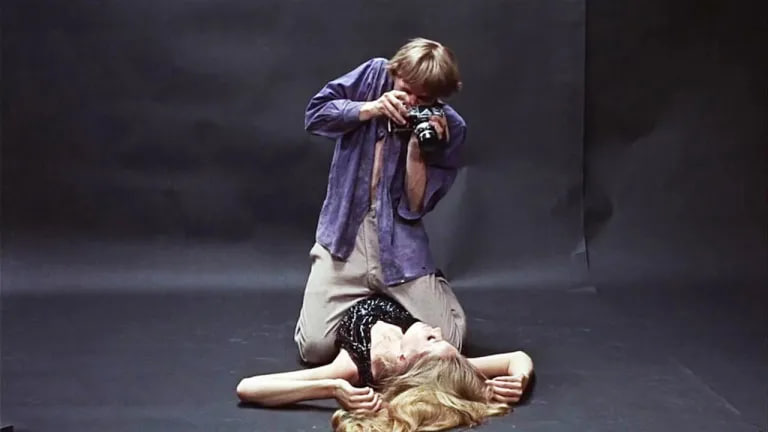
Blow-Up unfolds against the backdrop of a disenchanted photographer’s daily life, offering a critical reflection on various artistic tendencies of the 1960s—marked by a pervasive sense of despair, ennui, and abstraction. The film portrays humanity’s endless struggle to uncover truth as an eternal challenge stretching from the dawn of time to eternity.
Michelangelo Antonioni, the Italian auteur and stylistic innovator, entered the world of cinema in the 1940s, first through documentaries and later through narrative filmmaking. The result was a series of profound, enduring, and exemplary works.
Among his most significant films are the celebrated trilogy—L’Avventura, La Notte, and L’Eclisse—produced successively from 1960 onward. Each explores the inner and relational crises of couples, earning major international awards at the time and remaining relevant and luminous to this day.
Antonioni’s first Hollywood production, his first English-language film, and his first color film, Blow-Up, stands as a thought-provoking, complex, and unconventional work in both his career and the cinema of the 1960s. Made in 1966, it was inspired by a short story by Argentine author Julio Cortázar—one of the most prominent writers of the decade, known for his novels and short fiction and recipient of numerous literary prizes.
Based on a screenplay by Antonioni and Tonino Guerra, Blow-Up expands and reinterprets Cortázar’s story, enriching it with new subplots and characters while preserving the essence of the original narrative. The result is a challenging and layered film that defies conventional storytelling.
Guerra, the Italian screenwriter, also collaborated on several masterpieces of European cinema, including Antonioni’s L’Avventura, Fellini’s Amarcord, the Taviani brothers’ Kaos, Francesco Rosi’s Illustrious Corpses, and Andrei Tarkovsky’s Nostalgia.
Thus, the film’s distinctive script and narrative structure should be viewed in light of Antonioni and Guerra’s shared goal: to visualize and embody an abstract understanding of the modern human condition—its mental complexities and existential concerns. Blow-Up is not merely a story to be followed, but an experience to be contemplated.
The film enjoyed great success at major international festivals, winning the Palme d’Or at Cannes and earning nominations for the Academy Awards, Golden Globes, and BAFTAs in categories such as Best Film and Best Screenplay. It is also regarded as one of the most commercially successful art films ever made.
Blow-Up follows a loosely linear narrative centered on Thomas (David Hemmings), a London fashion photographer disillusioned with both his professional and personal life. Over its two-hour runtime, the film shifts fluidly among genres—social drama, crime mystery, philosophical reflection, erotic art film, and ultimately, abstract cinema.
The film’s title—meaning “enlargement”—can be seen as its central metaphor, expanding across every layer of the narrative: Antonioni’s perspective on different art forms (from photography to painting), on life itself (from social realities to emotional and sexual intimacy), and on leisure and play, where imagination ultimately prevails over reality. In the act of enlarging, in the attempt to see more clearly, truth becomes more elusive.
Through Thomas’s daily routines—from photographing the homeless on the streets to shooting models in his studio—the film reveals his growing dissatisfaction and detachment from his subjects. His camera becomes an unrestrained, wandering eye—an extension of his restless gaze that compels him to capture everything and everyone.
This wandering eventually leads him to a park, where, while photographing trees and passersby, he unintentionally records a mysterious encounter between a couple—or perhaps three people. The enigma that follows remains unresolved.
In a conventional film, such a discovery would lead to a crime narrative centered on solving the mystery. But Antonioni subverts this expectation. The event instead serves as a pretext for Thomas’s encounter with Jane (Vanessa Redgrave), who urgently seeks to retrieve the photos.
As Thomas enlarges the images and begins to grasp their possible significance, the film takes another turn. Even the apparent discovery of a body among the trees—and its subsequent disappearance—does not yield closure. The truth, magnified and dissected, slips further away.
Antonioni masterfully guides the viewer beyond straightforward interpretation, culminating in the film’s iconic tennis match scene, where the audience—like Thomas—watches players mime their game with invisible rackets and an imaginary ball. The scene crystallizes the film’s meditation on illusion, perception, and the tenuous line between the real and the imagined.
A central theme of Blow-Up lies in distinguishing between the wandering gaze and the inquiring gaze of the artist. This subtle differentiation allows the film to critique the artistic and cultural climate of the 1960s, reflecting shifts in creative expression and sensibility.
As noted, the pursuit of truth is a core motif. Through Thomas’s perspective, his futile search becomes emblematic of the human condition itself. Photography—his medium of choice—embodies this paradox: the closer one looks, the less certain reality becomes.
By the end, Thomas’s efforts to grasp truth dissolve into ambiguity: the photographs vanish, the body disappears, the tennis ball and rackets remain unseen. Yet illusion and imagination persist, expanding across the film until Blow-Up becomes a dream—or perhaps a nightmare—about humanity’s endless, wandering quest for meaning.