



Howard Hawks’s The Big Sleep is a labyrinthine noir, a detective tale that begins as a routine assignment and unfurls into a tangle of deception, corruption, lies, murder, and crime — all of it ultimately serving as the stage for a love story.
Hawks, the American director, producer, and screenwriter, created some fifty films over five decades beginning in the 1920s. Whatever the genre — comedy, western, adventure, or noir — his films share a signature precision: tightly wrought storytelling, an eye for detail, and performances shaped with exacting care. It is these hallmarks that have long led critics and cinephiles alike to call him an auteur. Strikingly, Hawks never shied from relying on novelists and screenwriters; he built his authorship not by writing every word himself, but by orchestrating the voices of others. A lesson, perhaps, for filmmakers who equate authorship with solitary authorship of the script.
Released in 1946, The Big Sleep — sometimes translated in Persian as The Heavy Sleep or The Eternal Sleep — was adapted from Raymond Chandler’s 1939 novel, a landmark in American crime fiction. Its intricate plotting and smoky atmosphere, steeped in detail and mystery, made it irresistible material for adaptation. It was here that Chandler’s private detective Philip Marlowe first came to life — a sharp, sardonic, inscrutable figure, witty and world-weary, committed only to the task at hand. In Hawks’s film, even he is drawn into an affair of the heart, though stripped of cliché and sentimentality, filtered instead through his own detached style.
The screenplay was crafted by William Faulkner, Nobel laureate and author of The Sound and the Fury; Leigh Brackett, later famed for Rio Bravo and The Long Goodbye; and Jules Furthman, another Rio Bravo veteran. That pedigree alone testifies to Hawks’s commitment to layered, muscular storytelling.
Decades later, the film would be honored by critics and institutions: awards in 1997 and 2017, and inclusion in the Library of Congress’s National Film Registry as a work of cultural, historical, and aesthetic significance. A later remake in 1978 by British director Michael Winner, with Robert Mitchum as Marlowe, shifted the setting to 1970s London and ventured into bolder thematic territory — but it never rivaled the elegance or enduring popularity of Hawks’s original.
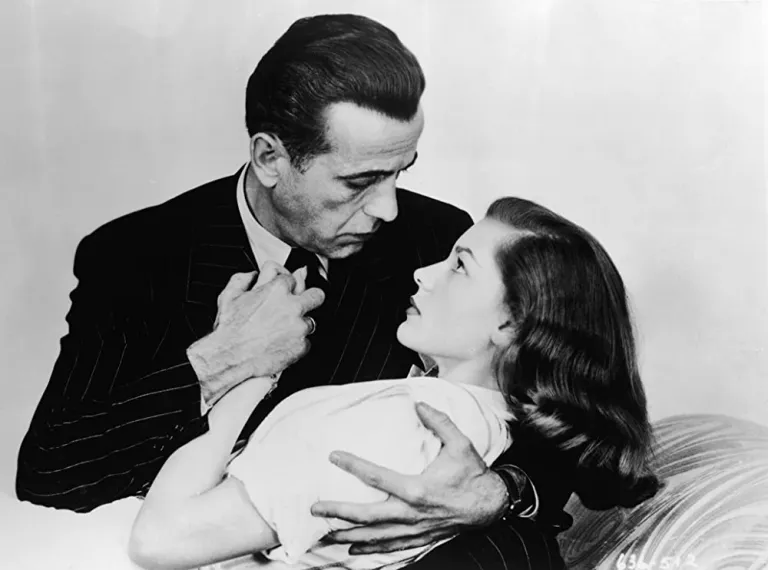
At the center of Hawks’s version is Humphrey Bogart as Marlowe, hired by General Sternwood to untangle the gambling debts of his daughter Carmen (Martha Vickers). From the moment he encounters Carmen’s older sister Vivian (Lauren Bacall), the case becomes more complicated — not only through the web of criminals and cons, but through the crackle of attraction between detective and heiress.
In true noir fashion, The Big Sleep presents a world governed by corruption and vice, a place where ambiguity rules and redemption is an illusion. Love itself becomes less salvation than fleeting reprieve — an experience as singular as it is unrepeatable. The narrative grows more tangled as it progresses; rather than clarifying, it introduces further shadows and secondary figures. Yet its suspense and allure never falter.
That power stems above all from Chandler’s Marlowe: charismatic, unpredictable, mordantly witty. Through Bogart’s performance, he stands alongside Rick Blaine of Casablanca as one of cinema’s immortal characters, inviting the audience to view the world — murky, cynical, dangerous — through his eyes.
The presence of Bogart and Bacall, married in life as well as onscreen, lends the film an added voltage. Their romance, sparked in To Have and Have Not and carried forward here, electrifies every exchange. Their dialogue is not merely flirtation but combat: a duel of words in which irony, barbs, and tenderness coexist. Their romance is not given, but earned through contest, which makes it endure in memory.
Visually, the film is built on chiaroscuro: a dance of shadow and light that mirrors its moral world. From its opening credit sequence — Marlowe lighting Vivian’s cigarette in silhouette — to its final image of two half-smoked cigarettes smoldering in an ashtray, the film frames its noir tale within a romantic cipher. Love, not crime, becomes the final code.
And yet one thing never shifts: Marlowe himself. However deep the case plunges into murder, blackmail, or passion, he emerges unchanged — a fixed point in a shifting maze. It is this immovable center, this hard brilliance of character, that gives The Big Sleep its permanence.