



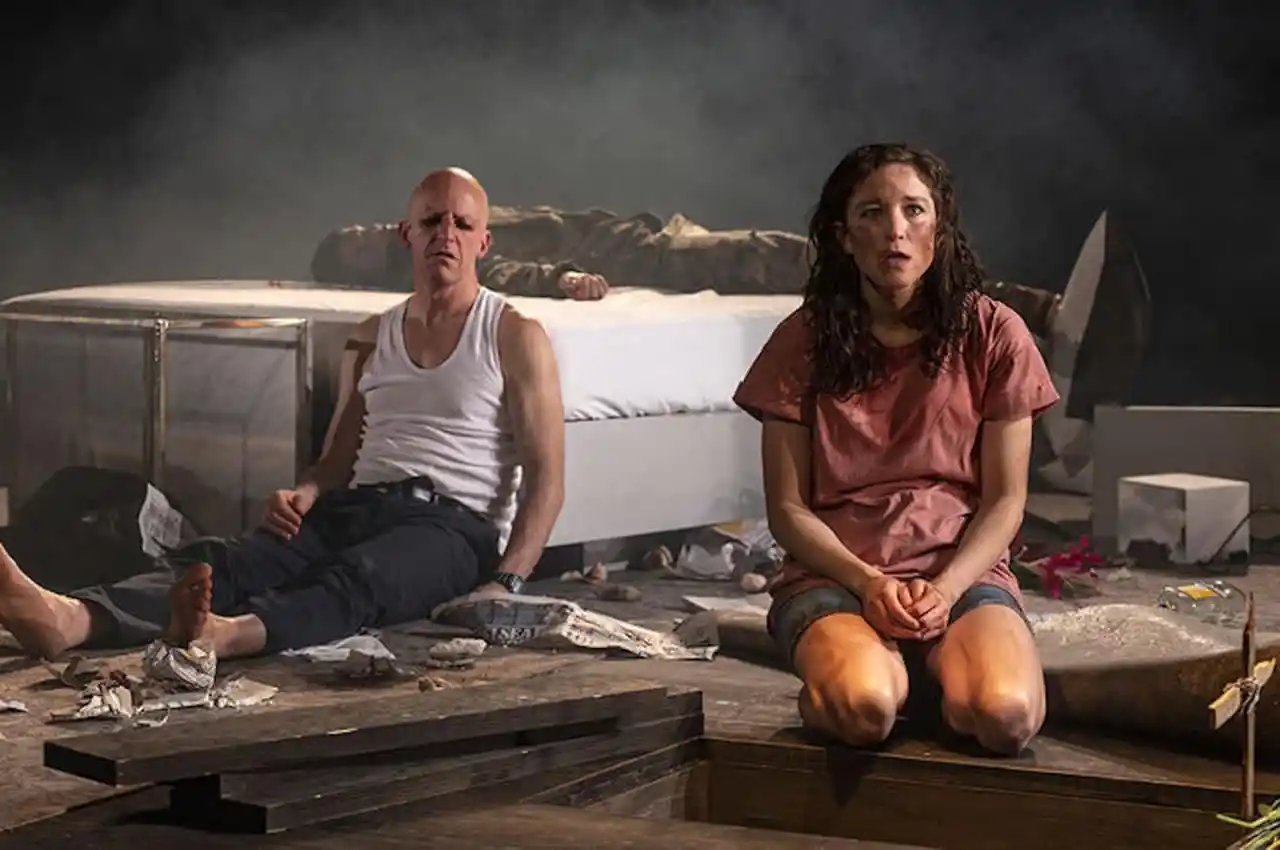
In-Yer-Face Theatre is a style of drama that emerged in Britain in the mid-1990s. The term was first used by the renowned British critic Aleks Sierz to describe a new theatrical movement that was gaining ground in the UK. In his book In-Yer-Face Theatre: British Drama Today, published by Faber & Faber in March 2001, Sierz analyzes the work of a group of contemporary British playwrights whose works share three defining elements: violence, aggression, and the death of sentiment.
Etymology of the Term
The phrase “in-yer-face” is defined in the New Oxford English Dictionary as “something aggressively or provocatively blatant, impossible to ignore or avoid.” The Collins English Dictionary further adds the adjective “confrontational” to its definition. This term first appeared in American sports journalism in the mid-1970s and gradually made its way into more colloquial usage over the following decades. Implicit in the phrase is the idea that one is forced to see something up close that has transgressed normative boundaries—an invasion of one’s personal space. In short, In-Yer-Face Theatre precisely characterizes a kind of performance that places the audience in this unsettling position.
Definition and Characteristics
The most comprehensive definition of In-Yer-Face Theatre might be: a performance that grabs the audience by the collar and shakes them until they get the message. This is a theatre of emotion and intensity—it pulls both actors and spectators beyond conventional responses. It provokes anger, shame, and discomfort, grates on the nerves, triggers alarm bells, and drives the viewer to the edge of anxiety. These plays often rely on shock tactics and, being unfamiliar in tone or structure, are bolder and more experimental, assaulting the audience’s ingrained expectations. They disrupt moral norms, insult dominant ideas about what can or should be shown on stage, and manipulate primal emotions—evoking unease, embarrassment, and self-confrontation by breaking taboos and invoking the forbidden. They uncomfortably remind us of who we really are.
The best examples of In-Yer-Face Theatre (unlike plays that allow us to sit and reflect passively) take us on a visceral journey, stirring our emotions, crawling under our skin, and causing real distress. In other words, this is a theatre of experience, not contemplation. Like other cultural forms, theatre offers a relatively safe space to explore such feelings—but experimental theatre is powerful precisely because it threatens that sense of safety.
Hot and Cool Variants
There is a notable distinction between the “hot” and “cool” versions of In-Yer-Face Theatre. The hot version—often performed in small studio venues for 50–200 spectators—employs an aesthetics of extremity. Here, language and action are explicit, and emotions are intensified. Aggression knows no limits, and the goal is to render the experience unforgettable.
Cooler versions use distancing techniques to temper emotional intensity. These are usually performed in larger theatres, follow a more naturalistic or traditional structure, and often employ comedy as an effective distancing tool—sometimes neutralizing situations that would otherwise be emotionally charged. After all, laughter is a common reaction to fear and anxiety. But whether hot or cool, In-Yer-Face Theatre must possess an unusual emotional force that disturbs the viewer and challenges their assumptions about identity and human nature. What angry audiences say often reveals the essence of this theatre—they almost always use words like “disgusting”, trying to define what is filthy, natural, or proper.
Genealogy and Major Figures
The greatest tragedies of ancient Greece explored extreme and abnormal emotional states—brutal deaths, horrifying suicides, excruciating pain, human sacrifice, cannibalism, rape, and incest. Thanks to Freud, even non-theatre-goers recognize Oedipus Rex as a landmark of incest taboo. Just consider the crimes and emotions explored in those tragedies—from infanticide to incestuous desire—in names like Medea, Phaedra, and Agamemnon. Tragedy arises where the chaos of fate meets our deepest fears. The Greeks understood that courage and despair are intertwined when facing the inevitable.
Among the many theories of tragedy’s purpose, perhaps the most provocative is the cathartic idea—that immersing oneself in a hell of fear, sorrow, and psychic stress can purge one’s inner demons. This idea forms the basis of experimental theatre. However, Greek drama likely sought not to attack the audience but to healthem, helping them cope with the times. This gives theatre a therapeutic dimension—a form of shock therapy.
The birth of In-Yer-Face Theatre is marked by the 1990s London staging of Blasted by Sarah Kane. Both in form and content, the play was extreme, bleak, and violent. Critics reacted with fury and outrage. Yet Kane’s play showed how provocative and controversial theatre could be. Its performance at London’s Royal Court Theatre became a catalyst for a wave of young playwrights sharing this bold perspective. These included Mark Ravenhill, Philip Ridley, Patrick Marber, David Eldridge, and of course Martin McDonagh.
From Kane’s works, it is clear she belonged to the “hot” camp of In-Yer-Face Theatre. McDonagh’s plays, by contrast—due to their grotesque humor and other traits mentioned above—fall under the “cool” version of this style.
In The Emancipated Spectator, Jacques Rancière argues that the spectator must be freed from the illusion of objective detachment—they must be drawn into the magic circle of theatrical action, replacing the privilege of rational observation with the right to fully engage all their vital energies. This statement seems especially fitting in the context of In-Yer-Face Theatre.