



The short story The White Stone by Ghazi Rabihavi is about the mechanics of an event. On the surface, the story is about the execution of a man who has been brought to a public square to be executed in front of a crowd. But if we pay attention to the architecture of the story, its narrative method, and the details the author chooses, we see that its real subject is not the execution itself but the execution ceremony: a carefully staged scene with a performer, spectators, a photographer, an official, specific tools, and a predetermined timetable.
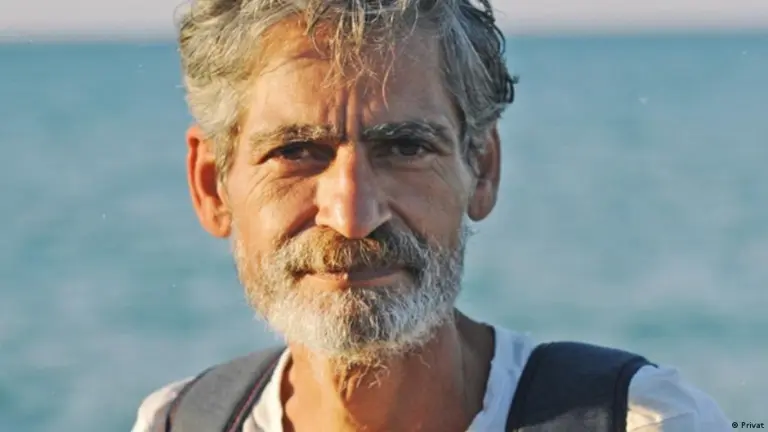
Ghazi Rabihavi, a writer and playwright from Abadan, has devoted a significant part of his career to portraying the lives of people caught up in revolution, war, repression, exile, and social violence. He has lived in London for many years, and his works have been translated and performed in several languages. The English playwright Harold Pinter was among those with whom he collaborated.
In The White Stone, too, we can clearly see traces of Rabihavi’s theatrical sensibility. The execution becomes less an act of killing than a performance. A photographer is there to record the moment; the officers are preparing the scene; the crowd is watching; and everyone is waiting for Haji to arrive. Even the moment of death is not officially recognized until he arrives. Death must take place in the presence of an official and before the eyes of others.
For this reason, the form of the story also approaches that of a play. The characters are less fully developed psychological individuals than roles: the officer, the driver, the photographer, Haji, the children, and the condemned man. None of them has a name or a meaningful past—not even the condemned man. Each occupies a position within the scene and performs a particular function.
This anonymity distances violence from an individual act and turns it into a collective and institutional mechanism. We are no longer confronted with a single killer; we are confronted with a system in which different people each participate in carrying out violence according to their particular role. Even the photographer, who appears to be merely an observer, is part of the mechanism. His presence demonstrates that the execution is not only about killing; the death must also be seen and recorded. Power takes control not only of a human being’s death but also of the image of that death.
But perhaps the story’s most important formal choice is its narrator: “we,” the first-person plural. This “we” does not refer to the entire crowd of spectators. It consists of the children in the crowd—children who are watching the execution and narrating events from their own perspective.
If Rabihavi had told the story through the condemned man, we would probably have been faced with a story of individual suffering. If he had narrated it through the officer, the logic of power would have come to the foreground. But choosing children gives the entire event a different meaning: they are not merely witnessing this ceremony; they are learning it. The driver’s statement is crucial here: “The future is in your hands.”
On the surface, this might seem like an ordinary remark. But within the story, it takes on a deeply disturbing meaning. The children have come to watch, and the driver tells them to stay and see. It is as if this ceremony is something that must be passed on to the next generation. Today, they are not photographers, officers, drivers, or Haji. But they are observing the relationships and rules of this world up close and learning how they work. In this sense, The White Stone is not only about the performance of violence; it is about the socialization of violence.
Violence reaches its most dangerous form when it no longer requires explanation or justification and becomes part of the ordinary routines of life. Rabihavi shows this normalization above all through the story’s language.
An officer tells the condemned man to put the rope around his own neck so that he can get used to it and not be terrified. The dark humor of the line lies precisely here: the condemned man is about to be killed within moments, yet the officer speaks in an almost friendly tone, worrying that he might be frightened by the rope.
Elsewhere, Friday morning is described as a beautiful morning for the children to watch an execution. They even regret having missed previous executions. An execution, which from the outside should be a shocking and exceptional event, has become, for them, a visual experience—something they can be curious about, watch, and even regret missing.
This is where the story brings us close to Hannah Arendt’s concept of the banality of evil—not in the sense that the story is a precise illustration of Arendt’s theory, but because evil here is reproduced through the behavior of ordinary people, everyday language, habit, and the performance of routine duties.
Violence does not necessarily require monstrous people in order to continue. It is enough for people to turn it into an ordinary part of their daily work. The ending of the story presents this process in a brief and concentrated form. After the condemned man dies, the children go off to warm their hands.
This ending is crucial because the story does not end with the man’s death; it ends with the continuation of ordinary life. There is no long pause, no mourning, no great moral reaction. The ceremony is over, and now the children, like the adults, warm their hands.
This gesture can simply be understood as a natural response to the cold. But if we look more closely, on another level they are repeating the behavior of the adults and seeking to become complicit with them. We cannot yet say that they have actually become accomplices to violence, but they are clearly being socialized into a world in which violence has been normalized.
They have witnessed the ceremony, understood its rules, and then returned to collective life. There is also an important symmetry in The White Stone: the condemned man’s eyes are closed, while the children see everything. And yet the condemned man is deprived of sight while the children are deprived of understanding. They see, but they do not yet understand the meaning of what they are seeing.
The reader occupies the space between these two conditions: seeing the scene through the children’s eyes while being able to understand its meaning. The condemned man, meanwhile, is stripped of almost every marker of identity throughout the story. We do not know his name; his past is almost entirely absent in this version; we never see his face, and his eyes are closed. Even at the beginning of the story, when he is still alive, one of the children calls him dead.
These details open the possibility of reading the story through Giorgio Agamben’s concept of Homo Sacer. Agamben uses the concept to describe a condition in which a human being is stripped, even before biological death, of the full status of a “person” and of political rights, reduced instead to a form of “bare life”—a life over which power can make decisions without the individual continuing to appear as a fully constituted political subject.
The condemned man in The White Stone appears in almost exactly this way: not as a character with a name, history, and face, but as a body that is to be executed.
His existential death has already occurred—not in reality, but in the eyes of others. When a child calls him dead while he is still alive, the story anticipates the way a death sentence can remove a human being from the status of an individual even before physical death.
Even the fact that the condemned man is brought in a hearse becomes significant. He is still alive, but the vehicle carrying him belongs to the dead. It is as though the institution of power and society have decided to place him among the dead before he has actually died.
It is worth noting that the story exists in two versions. The revised version, which almost entirely removes information about the condemned man’s past, is more effective than the earlier one. When his past, name, and face are withheld from us, he is no longer simply a specific character; he can become any human being who has been reduced to the position of the condemned—or, perhaps, to the position of the dead. Yet this same human being, from whom almost every form of agency has been taken, finds one small possibility for action at the end.
From the beginning, we know that he is going to be executed. The story’s suspense, therefore, does not lie in the question “What will happen?” but in how the ceremony will be carried out. Everything is prepared for the performance to begin. But at precisely that moment, the condemned man pushes the stone aside and hangs himself. This act alters the predetermined ending of the ceremony.
The condemned man does not wait for Haji’s command for the moment of his death to be officially declared. In effect, he refuses to allow others to direct the moment of his death. In a world where almost no agency remains to him, he spends his final possibility of agency on determining the end of his own life. From this perspective, The White Stone is not simply a story about the death of a condemned man; it is also a story about his attempt to reclaim the last remaining possibility of control. And this is where the story’s title becomes important.
On the most basic level, the stone is simply the object on which the condemned man is standing. But at the end, that same stone becomes his final means of action. The noose, the officer, and the sentence all belong to others. The stone is the one thing that remains beneath his feet, and by pushing it aside, he uses the last instrument available to him to alter the ending.
In this sense, The White Stone is a story of a strange contradiction: power has prepared everything necessary to stage a killing, but at the very moment the performance is about to begin, the victim takes its ending out of the hands of power.
Ultimately, The White Stone is less about an execution than about the mechanism that turns an execution into a ritual—a ritual with a stage, spectators, performers, a photographer, an official, and, most importantly, a future generation that is expected to watch and learn. At the end, a man dies, but the ceremony continues. And perhaps that is the most frightening thing about the story: the death of a human being can come to an end, but the culture that has made that death seem natural is only beginning to learn and reproduce itself.
© 2026. Phoenix Review