



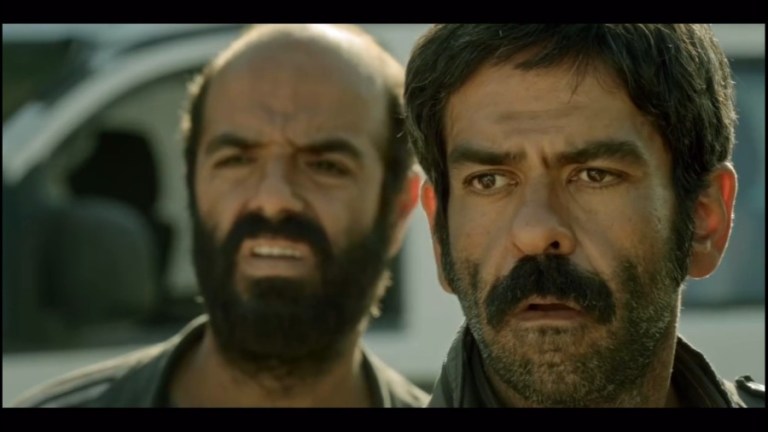
The film Cause of Death: Unknown possesses all the hallmarks of the “road movie” genre: travel, the open road, nature, endless horizons, character transformation, disorientation, death, and an open-ended conclusion.
Recently selected by the committee for consideration in the Best Foreign Language Film category at the Oscars, the film had long been banned and was even unable to screen at last year’s Fajr Film Festival. Cause of Death: Unknown is Ali Zarangar’s first feature film. Zarangar has also been active in theater, poetry, and photography, and he himself wrote the screenplay. The film is produced by Majid Barzegar, a notable figure in Iranian independent cinema.
The story begins at night. Several passengers travel from a small town near Kerman to the city of Kerman in an old passenger van: a young couple with their local friend, two middle-aged men, a mute woman, and a young man dressed in traditional eastern Iranian attire, who seems to be asleep in the back. The plot takes a dramatic turn when the van’s bumper falls off on the road, and the passengers are thrown forward by the driver’s sudden braking. It is then that they realize the man in traditional clothing was not asleep—he is dead.
This moment sets the film in motion, leading to a journey that reveals each character’s story amid a short but mysterious trip. Initially, all agree to call the emergency services to remove the body. The emergency center informs them that without a doctor to determine the cause of death, they cannot take the body—and no doctor is available. The mystery deepens when they discover thousands of dollars hidden in the dead man’s clothing. Each character reacts differently to the money, revealing their moral compass. Can humans, in extreme circumstances, remain true to ethical values?
A middle-aged man, played brilliantly by Alireza Sani-Far, suggests keeping the money rather than giving it to the police, fearing it will not reach the rightful owner. He confesses that his wife is seriously ill, and some of the money could prolong her life. The young man, Peyman, has previously been imprisoned for social media posts and now seeks to cross the border illegally, accompanied by a student girlfriend driven by love. The driver, a poor local man, loves the mute woman, who has been forced into temporary marriage by a wealthy man due to poverty. Another man, played by Banipal Shoomoon, has been temporarily released from prison to gather compensation money for a friend, whose execution looms if the debt is not paid. Gradually, each character confronts the fundamental question: why shouldn’t such money reach those in desperate need?
The film raises profound philosophical questions: Where lies the boundary between ethics, law, and justice? Who determines moral values and under what circumstances? How reliable are ethical principles in society? Victor Hugo, in Les Misérables, asks similar questions: is it just to imprison Jean Valjean for stealing bread to feed his starving family? Is theft ever itself a moral act?
In Cause of Death: Unknown, one character seeks the money to save a human life from legal execution, another to save his wife from death, and the driver wants some for the mute woman so she won’t have to enter temporary marriage to survive. The nursing student sees it as a way to continue their journey to Europe. Only Peyman refuses, asking his girlfriend to continue alone.
The film also confronts the audience with the question: does the value of a human life depend on ethnicity or nationality? The driver assumes the dead man is Afghan due to his accent, leading the characters to bury him in the desert and divide the money, only to later discover he is Baloch, and his pregnant wife and young daughter wait for him at the journey’s end. The film concludes with the horrifying realization of their mistake: the family of the man they buried in the desert has been left behind.
True to the road movie genre, Cause of Death: Unknown features an open-ended conclusion. Will the men return the money upon discovering the family, or will they remain powerless and self-interested? In a country where even death carries consequences—where no doctor is available, emergency services refuse, and police corruption is rampant—justice is uncertain. The filmmaker leaves the ultimate judgment to the audience.
Despite taking place almost entirely in the van and the desert, the film maintains a gripping narrative to the very end. Although it lacks major stars of contemporary Iranian cinema, the performances are fluid, consistent, and in many cases surpass the acting of more famous performers. The film’s selection for the Oscars alongside three other Iranian filmmakers from France, Canada, and Tajikistan underscores that independent Iranian cinema has found its own path, holding a position far more significant than mainstream Iranian films.
In one memorable scene, Bahareh tells Peyman: “I always imagined this scene in my mind. Me and my love in a van, heading to an unknown destination. In my imagination, the van had no windows, so we could do whatever we wanted.” Thanks to the courage and vision of Iran’s new generation of independent filmmakers, many dreams and aspirations have now found expression on the screen. May this continue…