



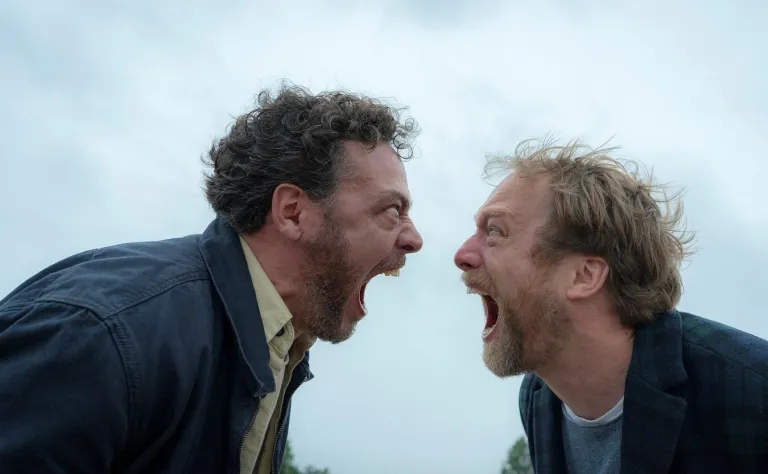
Speak No Evil (Gæsterne), directed by Danish filmmaker Christian Tafdrup, was released in 2022. Following the film’s international success, American director James Watkins made another version based on it in 2024. I have not seen the American version, and this article focuses on the Danish film.
Bjorn and Louise are a Danish couple who, along with their daughter Agnes, are invited to spend a weekend at the country home of Patrick and Karin, a Dutch family. At first, everything seems perfectly normal, but the hosts’ behavior gradually changes, and the atmosphere in the house takes on an increasingly sinister quality.
Speak No Evil is a film about fear, passivity, moral boundaries, and the price people pay for preserving politeness and adhering to established social and moral conventions. From the very beginning, the film places the viewer in a state of constant anxiety and suspense without immediately resorting to the conventional devices of the horror genre. More than being a film about humanoid monsters, it is about a situation in which people sense that something is wrong and threatening, that something dangerous may happen to them, yet traits such as conservatism, shame, and adherence to social conventions—being polite, avoiding confrontation, and feeling obliged to reciprocate hospitality—prevent them from taking those feelings seriously or voicing them.
At night, a car moves through a dark, deserted road with its headlights on, while Sune Kølster’s orchestral score creates an ominous and threatening atmosphere. We then enter the bright, seemingly peaceful world of a summer holiday, but the music and the opening image make it impossible to fully trust this apparent calm. From this point on, the film’s suspense is built around anticipation. The audience is constantly waiting for something horrifying to happen, but the narrative deliberately postpones the event. This delay gives the film its particular rhythm. Every conversation, every silence, every joke, and every small gesture by Patrick and Karin, the hosts, becomes a potential sign of imminent danger. At the same time, the calmness, naivety, and carelessness of the visiting couple intensify the situation and deepen the suspense. Rather than generating fear through a succession of ominous events, the film keeps fear alive in the space between them. As a result, many of the hosts’ seemingly ordinary behaviors gradually acquire a threatening and unsettling quality.
Patrick’s behavior is rude, aggressive, and disturbing—from his disregard for Louise’s discomfort and his treatment of their own child, Abel, to his violation of the guests’ privacy and his insistence that everyone should adapt to the rules of his house. Each of these behaviors might initially be dismissed as mere rudeness, a cultural difference, or simply evidence that the couple are strange or eccentric. But the film gradually turns them into links in a single chain.
Throughout their stay at Patrick and Karin’s house, Louise becomes increasingly uncomfortable with Patrick’s rude, arrogant, and aggressive behavior. This includes his deliberate disregard for her vegetarianism, as well as his treatment of his own son, Abel, in the scene where he forces him to dance with Agnes and follow the rhythm of the music. The dinner scenes, particularly Patrick’s deliberate disregard for Louise’s vegetarianism, can function as a form of deliberate misdirection. For a moment, the audience may suspect that Patrick and Karin are cannibals, especially when Patrick insistently makes Louise eat a piece of game meat and later violates her personal and moral boundaries again by ordering meat for her at the restaurant.
Yet the director’s primary purpose does not seem to be to suggest cannibalism, but rather to show the way Patrick uses food as an instrument of domination over Louise and her family. At first, he compliments Louise for being vegetarian, but then turns that personal principle into an object of mockery and pressure. He points out that she eats fish and accuses her of being morally inconsistent. By telling Louise that if she eats fish, she is not a “real” vegetarian, Patrick undermines and violates her moral boundaries. He forces her to defend herself while he is the one crossing the line.
Patrick is not genuinely defending environmental ethics. He wants to force Louise to justify her choices and, ultimately, to retreat from her own boundaries. From this perspective, Louise’s vegetarianism serves several important functions. First, it gives her a moral identity and establishes her sensitivity toward the environment and animals. Therefore, when she is forced to eat meat, the issue is not simply consuming a piece of food; it represents the breaking of her will and the violation of her identity. Second, the scene foreshadows Patrick’s later acts of violence. He is not hitting Louise yet, but he refuses to let her say no. This small act of coercion is a miniature version of what will later happen on a much more horrifying scale.
During the first half of the film, Patrick uses a soft and friendly manner of speaking to conceal his violence and the monster within him. His language does not reveal his true nature; it conceals it. As the narrative progresses, however, his language gradually changes as well, becoming more direct and increasingly violent.
Food, meanwhile, is also connected in the film to the body and to dehumanization. Patrick treats Louise in a bullying and deeply inhuman manner. He wants to bring her body under his control. This behavior is also connected to the final scene, in which Louise and her husband are stripped naked and stoned. The filmmaker deliberately creates a predatory atmosphere, presenting Patrick almost as a creature that consumes other people. He does not literally eat human flesh, but he is symbolically a cannibal. He consumes families as sources of pleasure, control, torture, and murder. Louise’s vegetarianism, therefore, is less a narrative clue pointing toward cannibalism than a device for showing the first stage in the swallowing of her independence. She is initially forced to eat against her will; by the end, she and her family are completely consumed by the cycle of violence perpetrated by Patrick and Karin.
The film’s central theme is its critique of shame and excessive social politeness. Tafdrup wants to show that evil can exist within an ordinary environment, at a friendly family gathering, and in the company of seemingly polite hosts—and that social norms can weaken people’s natural instincts, including the instinct to protect themselves and stay alive. Bjorn and Louise sense that Patrick and Karin are strange, disturbing, and dangerous, but each time they minimize and suppress their own feelings. They do not want to be rude, question their hosts’ hospitality, or appear ungrateful and discourteous.
The filmmaker transforms an ordinary and familiar social situation into a horrifying nightmare. In typical horror films, characters are usually attacked by evil or demonic forces, malevolent spirits, zombies, monsters, or supernatural creatures, and they struggle to escape from them. But in this film, the characters must first escape from their own social habits and obligations. They are incapable of saying something as simple as, “We’re not staying here anymore.”
Patrick and Karin exploit precisely this weakness. They do not need chains or walls to exercise power over their victims. Instead, they rely on shame, politeness, guilt, and the fear of being judged by others. Whenever the Danish family finally finds the courage to criticize their hosts’ behavior and tries to establish a boundary, Patrick and Karin restore the situation to normal with a joke, an excuse, or a brief apology.
At the end of the film, when Bjorn asks Patrick why he did this to them, Patrick replies: “You yourselves gave us permission to do this to you.” Bjorn is the film’s most complex character. His problem is not that he lacks anger, but that he is incapable of turning anger into action. He is excessively polite, shy, and calm. He is always smiling, apologizing, never protesting, and almost always trying to keep the social atmosphere peaceful. Yet in his conversation with Patrick, he admits that he carries a suppressed anger and violence within himself.
Patrick encourages him to be wild, but this invitation is in fact a deception. Patrick presents himself as free-spirited, fearless, and liberated from social constraints, while at the same time possessing a predatory, violent, and ruthless nature. Bjorn is both frightened by Patrick and, in a sense, envious of him, because Patrick acts out what Bjorn can only feel within himself.
In one scene, Patrick and Bjorn are driving along a road when Patrick plays him the song “It Never Ends,” a title that points toward the endless, repetitive cycle of Patrick and Karin’s crimes. One of the film’s most important moments comes when Abel opens his mouth to say something and Bjorn realizes that he has no tongue. Abel is trying to reveal a secret and testify to a truth, but his ability to speak has been taken away from him.
Patrick falsely claims that Abel was born without a tongue, but the child’s behavior tells a different story. His tongue has been cut out so that he cannot testify about Patrick and Karin’s crimes. Abel’s body therefore becomes evidence of the host family’s crimes. He cannot say, “These are not my parents,” or “They have hurt me,” but his severed tongue is itself a sign of that truth. Bjorn sees this sign but fails to recognize what it means and accepts Patrick’s explanation. Although Bjorn plays no direct role in silencing Abel, by accepting Patrick’s claim and ignoring Abel’s severed tongue, he contributes to the continuation of the child’s silence and voicelessness.
Passivity and the Normalization of Evil
A serious connection can be drawn between Speak No Evil and Hannah Arendt’s concept of the “banality of evil,” although the film is not, strictly speaking, a direct representation of Arendt’s conception of evil. Arendt used the term to describe Eichmann’s character and the way he acted, not to diminish the significance of his crimes. Her point was that evil can emerge from thoughtlessness, blind obedience, reliance on clichés, and an inability to see the world from another person’s perspective.
As noted above, Patrick and Karin do not resemble the conventional monsters of horror films. At first, they appear to be a warm, funny, hospitable, and even likable couple. Their crimes take place within an entirely ordinary, everyday environment and in the context of family relationships. This apparent normality brings the film close to Arendt’s notion of the “banality of evil.” Evil does not necessarily appear with a violent, demonic face or in the language of madness; it can hide behind ordinary behavior, a friendly tone, and familiar social habits.
Patrick and Karin deliberately plan their crimes, abduct children, and kill their parents. Therefore, their actions cannot simply be described as the result of thoughtlessness or ignorance. Their evil is not bureaucratic but calculated, precise, and deliberate. Yet the normalization of evil, silence, rationalization, and the inability to make a moral judgment are distinctly Arendtian. Bjorn and Louise see the warning signs but repeatedly walk past them. Instead of asking themselves, “What is actually happening here?”, they continually ask questions such as: “What if we’re being rude or offensive?” “Their behavior is strange, but perhaps it’s simply a cultural difference.” “They’re hospitable and good people.” “They surely don’t mean anything by it.” “It would be rude to complain.”
As a result, social conventions take the place of moral judgment. They retreat into clichés such as “A guest should be polite and grateful,” “We shouldn’t judge too quickly,” and “We shouldn’t ruin the friendly atmosphere.” These clichés may appear civilized on the surface, but in situations that demand moral judgment, decision-making, and action, they become instruments of passivity.
In Speak No Evil, Patrick and Karin consciously choose evil and take pleasure in the suffering of their victims. But the film shows how such deliberate evil can flourish in an environment of silence, politeness, and normalization. The film can therefore be understood not as a direct depiction of Arendtian “banality of evil,” but as a story about normalized evil and the social conditions that allow it to take root.
The Arendtian dimension of the film lies in the idea that evil can succeed when people stop thinking about reality and evaluating what is happening, instead choosing to normalize the situation. Patrick and Karin normalize their violence through smiles and gentle, seemingly benevolent language, while Bjorn and Louise, relying on politeness, social niceties, and their own modern moral codes, accept this appearance of normality and deny the signs of evil. Under such circumstances, no one needs to think of themselves as evil at every moment. It is enough for one person to lie, another to accept the lie, and the victims to remain excessively silent in order to preserve social order.
Speak No Evil demonstrates that evil does not arise solely from the will of those who commit crimes; it also draws strength from the passivity, silence, and thoughtlessness of those who see it but refuse to stand against it or speak out.
The film’s gradual transformation from a pleasant holiday into a horrifying nightmare is not entirely unlike Ari Aster’s Midsommar. The resemblance, however, lies primarily in the suspenseful structure and in the apparently peaceful yet internally charged atmosphere of the two films, rather than in their plots, characterization, cultural contexts, or mythological beliefs. Both films begin with an invitation and a journey into an unfamiliar environment, where the characters initially encounter a space that appears beautiful, peaceful, friendly, and intimate, only to gradually discover its hidden and violent rules.
Both films also move away from the horror genre’s conventional association between darkness and terror. A significant portion of Midsommar takes place in the intense daylight, among flowers, fields, and the natural landscapes of Sweden. In Speak No Evil, too, the hosts’ house, garden, roads, and rural surroundings are often presented in natural daylight. In both films, light is not a sign of safety but a cover for violence and hysteria.
The important difference is that Midsommar creates a world with a ritualistic, mythological, and uncanny quality, whereas Speak No Evil remains firmly grounded in an ordinary, everyday reality. In Midsommar, Dani and her friends enter the Hårga community, whose religious and ritualistic practices are unfamiliar to outsiders and guests. In Speak No Evil, the Danish guests likewise enter an intimate, seemingly trustworthy family environment without understanding the hidden rules of the house or the true nature of their hosts.
The fundamental difference, however, is that Hårga is a traditional community governed by an old and highly organized ritual order, whereas Patrick and Karin are criminals who conceal themselves behind the appearances of ordinary modern life. In Midsommar, the guests are invited into a terrifying and destructive cultural ritual and system of belief. In Speak No Evil, the victims are drawn into a horrifying, personal, sadistic, and criminal trap.
In both films, although the characters recognize the signs of danger, they hesitate when deciding whether to stay or leave and do not immediately get out. In Midsommar, horrific deaths and bizarre, disturbing rituals take place one after another, yet the guests continue to remain in the community. In Speak No Evil, too, Bjørn and Louise repeatedly witness their hosts’ disturbing behavior, but they fail to suspect them and, because of politeness, embarrassment, social awkwardness, and their fear of creating conflict, either stay or return to the house after initially leaving.
By the end of Midsommar, Dani is accepted into the Hårga community, while Christian becomes a sacrifice to their ritual. The film is ultimately about being absorbed into a ritualistic community and finding a horrifying sense of belonging—something that provides Dani with a kind of psychological and emotional victory. In Speak No Evil, however, there is no redemption and no acceptance. The Danish family is completely destroyed. Although their murder takes on the outward appearance of a ritual, unlike Midsommar, it has no ritualistic or mythological foundation. Instead, it is a symbolic and brutally naked representation of the victims’ passivity and absolute submission to violence and sadism. Patrick and Karin simply continue their cycle of murder, while Agnes is turned into a tool for luring their next victims.
Both films demonstrate that a beautiful, brightly lit environment and an apparently friendly, intimate, trustworthy atmosphere can become more terrifying than the darkest of places if we do not understand the hidden rules governing them. In Midsommar, evil takes the form of a cult community and an ideological-ritualistic system of belief. The Hårga’s violence is part of their social and religious order, justified through music, ritual, mythology, and the cycles of nature. In Speak No Evil, by contrast, evil is entirely individual and sadistic. Patrick and Karin have no elaborate worldview; they are simply ruthless serial killers who exploit people’s trust and naivety, lure them into their trap, and take pleasure in torturing and killing them.
Stylistically, Speak No Evil has a cold, realistic, minimalist tone. From its opening shot, the film signals to the audience that something threatening is already underway. One of its most important stylistic characteristics is its rejection of conventional horror tropes. The film creates fear without relying on the familiar devices of the genre. There are no dark houses, basements, ghosts, zombies, supernatural creatures, vampires, jump scares, or constant displays of blood and violence. Almost everything takes place in calm, ordinary domestic environments and brightly lit spaces: a country house, a dining room, a garden, a swimming pool, roads, and beautiful natural landscapes. Yet these very bright and seemingly trustworthy spaces gradually become sources of anxiety and fear. Tafdrup suggests that evil does not necessarily hide in darkness; sometimes it appears in broad daylight, behind smiling faces and seemingly polite behavior. Patrick and Karin’s house, unlike the typical haunted or horror-movie home, is not presented from the outset as a dark, abandoned place. Instead, its apparent tranquility and deceptive beauty gradually become a cover for violence and murder.
Unlike many conventional horror films, there is no exaggerated lighting or stylized production design. The interior scenes are mostly shot with naturalistic lighting and in a realist manner. Rather than relying on shocks and jump scares, the conversations, silences, and glances themselves become disturbing and anxiety-inducing. The horror, therefore, does not emerge from low-key lighting or dark imagery, but from the guests’ passivity and their inability to recognize the deceptive situation surrounding them—a situation that appears bright and harmless but is, in reality, threatening and dangerous.
Sune Kølster’s score also has a distinctly anticipatory quality. Before the image provides any clear reason for fear or suspense, the music warns us that danger is approaching. The tense orchestration, wind instruments, and percussive strikes intensify the tension within the conversations and make the situation feel increasingly unstable. In some otherwise ordinary scenes, the music has a level of intensity and volume that seems disproportionate to what is happening on screen. This mismatch tells the audience that something dangerous is taking shape beneath the surface of everyday life.
Thematically, the Danish family’s passivity is understandable. In terms of characterization, however, the film becomes difficult to believe at certain moments. The guests’ decision to return to their hosts’ house to retrieve Agnes’s stuffed toy, despite the numerous signs that something is seriously wrong there, is irrational and particularly weak. Bjørn also fails to tell his wife what he has discovered after learning the truth and uncovering the hosts’ real identities. The problem reaches its extreme in the film’s final moments. The parents offer almost no meaningful resistance when their child is kidnapped and tortured. This passivity, which extends the same silence and social obedience that have characterized them throughout the film, may carry symbolic meaning, but psychologically it is extremely difficult to accept that parents placed in such a situation would become completely passive and lose their instinct to protect their child.
The film could have conveyed the same bleak meaning while allowing Bjørn and Louise to put up even a futile resistance. If Bjørn had attacked Patrick, or Louise had fought to save Agnes, and they had ultimately failed despite making a genuine attempt, the ending would have been both more painful and more believable. As it stands, the film uses its protagonists less as fully realized, psychologically credible human beings than as symbolic figures representing politeness, shame, passivity, and absolute submission to evil—particularly when confronted with a direct threat to their child.
© 2026. Phoenix Review