



Jacques Lacan says that the end of psychoanalysis is the moment when the subject realizes that the desire for coherence, unity, and fulfillment is nothing but a “fundamental fantasy”, a false one, from which they can only liberate themselves by acknowledging the fragmentation of their own “imaginary/image-based identity” (2023, 87). Yet, this moment, for a subject who has always been reinforced by the illusion of an “ideal ego,” becomes a nightmarish and terrifying experience. It seems that much of the dread and anxiety generated by Lynch’s cinema stems from revealing the hollow nature of this very fundamental fantasy – and among his works, Lost Highway (1997) more than any other film in the history of cinema, depicts the radical groundlessness of the subject’s “reality.” Todd McGowan states that “among all of Lynch’s films, Lost Highway seems to offer the most critical approach to fantasy,” and shows that “phantasmatic satisfaction” is nothing but “failure” (2007, 175–176). The realism of Lost Highway is first shaped by a dark narrative about the fragile nature of the real world, and then it exposes the insufficiency and failure of any attempt to escape the nightmare of the Real through fantasy. Furthermore, the film’s sense of metamorphosis and metaphysical, existential horror—along with its delirious form and psychotic, fragmented narrative (which undoubtedly stems from a “structural necessity,” rather than a kind of deliberate and intimidating obscurantism)—may even dismantle the fantasy of the viewer-subject who is presumed to know (and to provide interpretation).
Nevertheless, Barry Gifford (who collaborated with Lynch on the screenplay) provides some clues that invite us to take the risk of proposing a kind of interpretive fantasy. He says Lynch’s initial conceptual idea began with a simple question: “What if one day someone woke up and discovered that they had become someone else?” This question—clearly reminiscent of Kafka’s The Metamorphosis—was apparently raised for Lynch following one of the most important trials of the century, related to the murder of Nicole Brown and the psychological state of O. J. Simpson. However, while the theme of murder and crime is part of the narrative structure in the neo-noir world of Lost Highway, for Lynch the deeper issue was the human capacity to create a new identity for oneself and present such a persona to others. The psychological state Lynch envisioned resembles what is often referred to in psychopathology as psychogenic fugue—a form of dissociative amnesia or escape—wherein the subject erases memories of a traumatic and intolerable event and, through a compensatory mechanism, detaches from their former identity and constructs a new one in order to fend off the pressure of reality and continue their psychic life. Forgetfulness, confusion, and distancing from elements that might evoke one’s former identity or home are all signs of psychogenic fugue, which enable individuals caught in criminal or life-threatening situations to don the disguise of a new identity and no longer remember they once were someone else. In fact, what fascinates Lynch is the way the mind can protect itself against extreme stress and deceive itself in order to escape the nightmare of reality.

David Bowie – whose song “I’m Deranged” hauntingly graces Lost Highway –recounts a story deeply connected to psychogenic fugue. He speaks of a visit to a psychiatric hospital in Austria that left a profound impact on him and later resonated in the melancholic grandeur of “I’m Deranged.” At the institution, Bowie was struck by a man known as the “Angel Man,” whose condition involved the belief that his being had split and, since 1948, he had become an angel. He believed his former self had vanished, replaced by an angelic presence that wholly possessed him—marking a kind of rebirth. The “Angel Man,” as an example of psychogenic fugue, reveals the state of a man unable to endure the self tethered to a traumatic catastrophe, compelled to transform himself into someone else as a defensive response:
“I’m deranged / and the rain falls / this is the angel man…”
David Lynch explains that during the making of the film, “The publicist was researching psychological disorders and came across a real condition called psychogenic fugue, where a person abandons themselves, their world, their family, everything about who they are—and assumes a new identity. That’s exactly Fred Madison. I love the term psychogenic fugue. In a way, the musical term fugue is also apt, because the film has one theme, and then another theme replaces it” (2009, p. 172). (It’s worth noting that the term “fugue,” from Latin origins, refers to flight or instability, and also to a form of polyphonic music built around several themes.) Though Gifford also mentions his own curiosity and research into the disorder, Lynch insists the film developed independently, and that he only learned about the condition after writing the script. Nevertheless, the nature of this disorder appears to at least partially explain the psychological world of the film.
In the first half of Lost Highway, Fred Madison, whose marriage with Renee is failing, murders her – suspecting infidelity – and ends up in prison. Unable to bear his past self and faced with a death sentence, he undergoes a fugue-state transformation, taking on a new identity as a young man named Pete. Fred’s seizure in prison, accompanied by luminous, brain-like imagery, serves as a cinematic punctuation mark to delineate the shift between two identities: on one hand, Fred’s perpetually failed self in a gloomy world haunted by dark forces – his hatred toward Renee and Dick Laurent eventually culminating in murder – and on the other, a reimagined, phantasmatic version of Fred who redresses the failures of his original world and, to some extent, finds success. Thus, the world of Lost Highway is cleaved between two realms: that of “desire and fantasy,” or more precisely, “reality and fantasy” (2007, p. 155). The first half of the film represents a reality marked by failed desire, and the second half portrays Fred’s healing fantasy.

Fred’s headaches and insomnia, along with memories of Renee’s murder and visions of the mysterious man’s cabin, drive him to the brink of madness. He looks upward, toward the source of light, in search of an escape route, and enters the lost highway to resort to a memory that completes his metamorphosis. Ultimately, he halts before Pete—someone Fred likely knew from the past and shared some connection with. The film offers no details to clarify this relationship, but regardless, Pete’s function is to provide a path toward a better life—one that might grant Fred fulfillment. In this new world, the “symbolic father” is no longer a harsh and treacherous superego figure (Dick Laurent), but a defeated and betrayed father (Mr. Eddy). “Lacan compares the scene of fantasy to a fixed image on a cinema screen; in the same way that a film can be paused at a particular moment to prevent the display of an imminent traumatic scene, the fantasy scene operates as a defense that masks castration” (1996, p. 61). In short, Fred seeks a world in which his castration is compensated by the phantasmatic power of the phallus. From the prison sequence onward, it seems the viewer enters Fred’s fantasy world. Thus, it makes sense that, from the perspective of prison guards and others, Fred disappears (for within the fantasy world, when we imagine ourselves as someone else, we construct its details and narrative in a way that others recognize our new self).
But how does Fred’s fantasy world (the second half of the film) compensate for his failures in the real world? The failed and defeated man of the film’s first half is transformed into an attractive young man who seemingly possesses a natural talent for attracting women and always succeeds in sexual relationships. Whereas in the real world Fred has a cold relationship with Renee (who had worked with and slept with Dick Laurent in pornographic productions), in the second half of the film, not only does Fred transform himself, but he also reconfigures Renee into a better, idealized version of her—Alice—who gives Fred/Pete the opportunity to steal the mistress of Dick Laurent and, in doing so, exact revenge on him/reality. With her blonde hair, light clothing, and unrestrained desire for Pete, Alice represents an idealized, luminous image of the woman Fred was deprived of in reality. Moreover, in Žižek’s terms, she embodies the “fantasy of excessive enjoyment” (2000, p. 22), or even jouissance. On the other hand, Pete’s other lover, Sheila, represents another dimension of fantasy, constructed to compensate for Renee’s betrayal of Fred, allowing Fred’s own desire to betray Renee to be fulfilled. Thus, Alice satisfies Fred’s desire to betray Dick Laurent, and Sheila satisfies his desire to betray Renee, meaning that Alice and Sheila may in fact be two different aspects of Renee herself.
Furthermore, in his fantasy, Fred also takes revenge on Andy (Dick Laurent’s associate), brutally murdering him. Likewise, other details in the film’s fantasy half can be interpreted as expressions of Fred’s unfulfilled desires now granted.

In psychoanalytic theory, the boundary between reality and fantasy is not a firm one, and elements of these two realms constantly interfere with each other. This implies that reality can never be fully “real,” and fantasy can never operate independently of reality: elements from both sides always infiltrate one another, threatening the structural coherence of each. In the film’s first part, which takes place in reality, the solidity of objective reality is undermined by the intrusion of Fred’s fears, doubts, memories, and instincts. Fred, who, according to Renee, despises video cameras, tells the detectives investigating the videotapes, “I like to remember things my own way, not necessarily the way they happened.” Fred remembers things on his own terms, but the videotapes, seemingly produced by the mysterious man, represent an objective perspective. Therefore, even in the first part of the film, the viewer is not presented with a fully reliable narrative, as details like shadows and the mysterious man at the party confirm.
In the second part, too, elements of reality infiltrate the structure of fantasy, preventing Fred from fully taking refuge in the dream of escape. The saxophone sound Pete hears on the radio, which gives him a headache, is the same saxophone Fred plays in the first half—a sound that seeks to pull him back into reality. Another example occurs when Pete sees a photograph at Andy’s house showing Renee alongside Alice. This induces another headache: the presence of the real Renee beside the fictional Alice facilitates the collapse of the fantasy mechanism, since Fred/Pete’s comfort within the fantasy of Alice is now threatened by the memory of Renee’s murder (and notably, from the objective point of view of the two detectives who also view the photograph, there is no Alice at all). Elsewhere, Pete’s parents speak about a man who was with Pete on the night of the incident; Sheila remarks that Pete has changed into a different person; and at Andy’s house, Pete enters Room 26 and encounters a woman who indirectly reminds him of Renee’s betrayal (this is the same hotel room from Lost Highway where Renee and Dick Laurent had their affair, and which we later learn is where Fred found and killed Laurent). All of these are moments where the reality of being Fred intrudes upon the fantasy of being Pete, bringing the collapse of the fantasy closer.
However, the complete breakdown of the fantasy occurs during the final lovemaking scene between Pete and Alice in front of the cabin. The music from Fred and Renee’s earlier failed lovemaking scene is replayed here, marking a structural parallel, but the entire fantasy collapses when Alice tells him: “You’ll never have me.” From this point onward, Fred (who is likely still in prison) returns mentally to reality, and sees the mysterious man who tells him that Alice never existed, and the woman’s name is Renee. One must assume that what follows is a distorted, delusional replay of Fred’s re-emerging memories (or a set of composite flashbacks for the viewer) after initial repression: perhaps revealing that he killed Dick Laurent even before Renee, and that a part of him informed him of Laurent’s death (at the party, he vaguely tells Andy that Dick Laurent is dead, indicating that the murder has been consigned to the unconscious). Thus, in these final scenes it becomes clear that Fred had taken Laurent to the desert cabin and, with the help of the mysterious man, killed him. And although it is the mysterious man who hands Fred the knife, it is immediately implied that this man does not exist, Fred carried out the act himself.
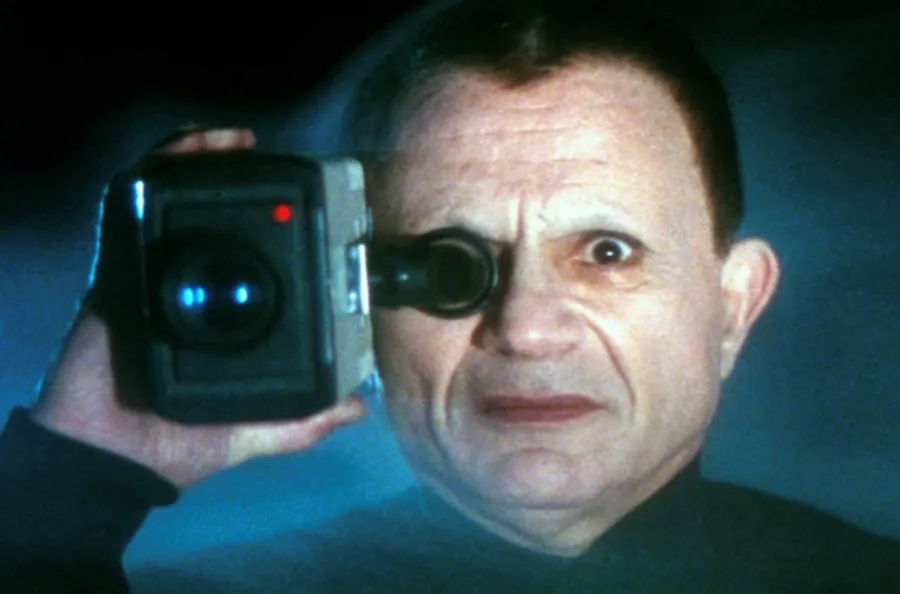
The film gives few concrete details, but the mysterious man’s nature likely oscillates between representing objective reality (with his video camera), Fred’s unconscious, instinct, the id, or perhaps even a demonic force. Alternatively, in Lacanian terms, we might say he occupies the place of “the Real” in the logic of the Borromean knot—intertwined with the symbolic (the mostly realistic segments of the first half) and the imaginary (the phantasmatic second half). It is a domain Fred discovers in the fissure of his own identity—when, early in the film, he steps into darkness, looks at himself in the mirror, and externalizes this force in the form of a shadow (a Jungian unconscious, perhaps?), which tells him: “You invited me in.”
Ultimately, Lost Highway, whose narrative structure seems modeled after a Möbius strip, brings Fred back to the point of origin—albeit from a different perspective. As Slavoj Žižek writes in The Art of the Ridiculous Sublime (2000), the film’s structure resembles that of psychoanalytic therapy, “in which, after taking a long detour, we return to the starting point from a different perspective” (2000, p. 22). And yet, the film’s conclusion bears little resemblance to any notion of recovery. Fred’s convulsive, manic fit as he speeds down the lost highway while being pursued by the police suggests the possibility that he has already been executed in the electric chair.

“Dick Laurent is dead”, and in the absence of the symbolic father (perhaps a metaphor for the death of God and the ensuing castration [the absence of the phallus, or dick]), not only Fred but any individual finds himself on the lost highway. This is the film’s most radical insight, Lynch’s cinematic masterpiece does not offer a resolution, but instead invites the viewer to reevaluate the complex relationship between reality and the psychic structure. Lynch shows us that the modern subject resembles a vagabond drifting across parallel worlds of reality and dream, self and other, consciousness and the unconscious. There is no unified, coherent subject who can fully attain the fundamental fantasy object of desire. Thus, the human being is portrayed as always already lost in his own dreams – the red curtain of Lost Highway, like the Red Room of Twin Peaks, signals this recursive entrapment.
These lost subjects function as barred subjects, split between the beauty of fantasy and the violence of reality. They resemble something like Marilyn Manson, who embodies the quintessentially split subject: the fantasized aesthetic image of Marilyn Monroe juxtaposed with the brutal reality of Charles Manson. Or perhaps one may agree with Žižek, who sees Lost Highway as offering a profoundly dark insight into life itself. As Žižek puts it, Lynch seems to suggest that “once you traverse the phantasmatic screen which lends a false glow to it, the only choice you are offered is the one between the sterile, meaningless boredom of social reality and the phantasmatic Real of self-destructive violence” (2000, p. 17).
Refrences
Barney, Richard A. David Lynch Interviews. University Press of Mississippi. 2009.
_ Evans, Dylan. An Introductory Dictionary of Lacanian Psychoanalysis. Routledge. 1996.
_ McGowan, Todd. The Impossible David Lynch. Columbia University Press. 2007.
_ Neill, Calum. Jacques Lacan. Routledge. 2023.
_ Zizek, Slavoj. The Art of the Ridiculous Sublime. Walter Chapin Simpson Center for the Humanities. 2000