



The most boring details of others’ lives, if narrated skillfully, can become the most fascinating.
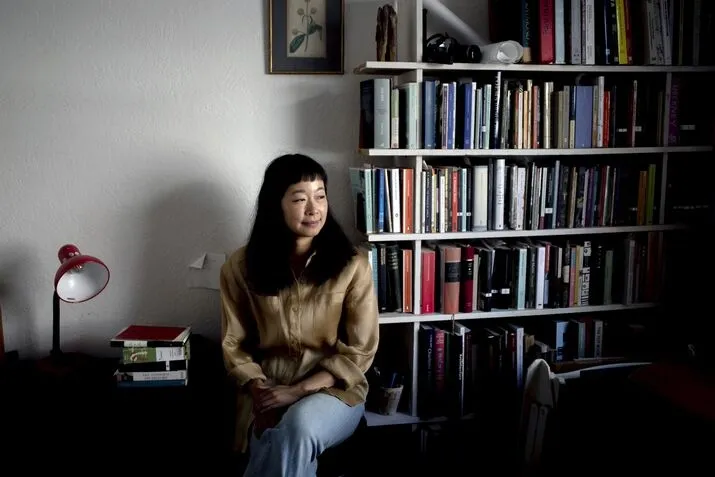
This time, I had a warm and intimate conversation with Jessica Au, author of the poetic novel Cold Enough for Snow. In this interview, she spoke about her Asian heritage, her admiration for Iranian cinema – especially the works of Asghar Farhadi and Abbas Kiarostami – her minimalist narrative style, and her effort to reflect the complexities of human relationships in her writing.
Could you tell our Iranian readers, who thoroughly enjoyed Cold Enough for Snow, a bit about your background?
I grew up in Melbourne, Australia. My mother is Malaysian, and her father, my grandfather, migrated from a village called Shantou in China to Malaysia. In many ways, I had a fairly ordinary childhood in the suburbs, though of course, it was also marked by the disruptions of being in a family that had moved between three countries and had experienced a lot of change. Maybe that’s why I was always drawn to books. For several years, I worked as an editor, bookseller, and fact-checker, all while writing on the side.

What experiences or inspirations led you to write Cold Enough for Snow?
I don’t think inspiration for writing comes from a single source. Rather, my goal was to create a narrative that reflected the realities of life – which, despite appearing simple, are often deeply complex. I was thinking about moments and emotions that are hard to express – deep truths that society doesn’t always allow us to voice. In Cold Enough for Snow, these emotions revolve around the deep bond between mother and daughter, the fragmented nature of history, and contemplations on existence and the value of art.
The title Cold Enough for Snow is both intriguing and mysterious. How did you come up with it?
The title came to me toward the final stages of writing. My original title was something like A Common Language, borrowed from the poet Adrienne Rich. But I knew that wasn’t quite right. A book’s title sets the tone for how a reader approaches the text and casts a kind of shadow over the whole work. In the end, I settled on Cold Enough for Snow because I liked how disjointed it felt. It could be a question, a line of poetry, or even a statement. I also felt it captured the transient tone of the narration – like a journey, like the mother, or like the snow that eventually melts and disappears.
Your narrative style was so compelling that I was immediately drawn in. I felt as though I were on holiday with the characters—on a train in Japan, trying new dishes in quirky cafés and restaurants, browsing galleries, and buying Japanese handicrafts. How did you arrive at that narrative form?
It was probably a combination of factors. Most of the time, I try to write as simply as possible, using minimal metaphors, techniques, or literary devices, in fact, I think I could have written even more simply. But at that time, I was also reading a lot of autofiction, and I was deeply influenced by their confessional, autobiographical tone. They were immensely readable and compelling. For me, the closer a story is to the texture of real life, the more powerful it becomes. That’s also why I like diaries—there’s something paradoxical about how the most mundane details of someone’s life, when narrated skillfully, can become utterly fascinating. And yet, this type of writing is still a form of storytelling. At the same time, I was reading a lot of 19th- and 20th-century Japanese literature—novelists like Natsume Sōseki, Jun’ichirō Tanizaki, and Yasunari Kawabata. Their novels struck a chord with me because of the elegance in their writing. Though their language seemed neutral, ordinary, and polite, it was full of emotion. I found myself drawn to this style—perhaps because it resonated more deeply with my way of life and family background. So I’d say the tone in Cold Enough for Snow is a blend of these two influences.

Your novel is set in Japan and explores the complex relationship between a mother and daughter. What led you to choose Japan as the backdrop for this story?
There had to be a certain dynamic between the mother and daughter, a layer of tension. In the end, I wrote a subtle inversion of roles, where the daughter takes on the responsibilities of the mother during their journey. For example, she plans the whole trip. She decides what they do, where they eat, where they stay, and where they sleep. Perhaps it’s because she has been to Japan before and speaks a little Japanese, whereas the mother, since leaving Hong Kong, has traveled very little. If I had set the story in Hong Kong, the mother would have been the one in control. At the same time, I wanted to create a space that felt evocative and nostalgic, allowing the narrator to reflect on her own childhood as well as her mother’s. Japan, even with its many differences, as part of East Asia, was close and familiar enough to make that possible.
Your narrator has a deep love for literature and cinema. I’m curious – how familiar are you with Iranian cinema and literature? Have you had a chance to watch some of Iran’s acclaimed films?
I love Asghar Farhadi’s films, especially A Separation. There’s a particular quality in his storytelling, how each character has their own reasons and motivations, and yet the intersection or conflict between them results in a kind of rupture or tragedy. That feels very true to life for me. It’s been a while since I saw A Separation, but I remember being aesthetically struck by the visual elements, especially his use of doors and frames. I read somewhere that he has a background in theatre, and there was definitely a theatrical quality to the way the film was shot. Abbas Kiarostami is another director whose work I’d really like to explore more deeply.
What motivated you to work in a bookstore? Was it mainly your love of literature, or were you also seeking valuable experience and a source of income? Could you share one of your most memorable experiences from that time?
It was probably a mix of all of those things. When I was younger, being in a bookstore felt calming, like a kind of safe haven. I still feel that way to some extent. When I’m in a new city, just wandering around aimlessly, I almost always step into a bookstore, even if just for a few minutes. I’m not sure I can point to one specific memory, but I remember that the conversations I had with my coworkers were among the most memorable experiences of my life. Everyone was incredibly thoughtful and eager to learn. Most of us saw life a little differently and tried to shape it according to our own values. I think I learned the art of reading there.
Your novel explores themes of isolation and connection. How do you see these themes reflected in contemporary society, particularly in the context of family relationships?
It’s difficult for me to make broad statements about society as a whole, primarily because, as a writer, I tend to focus on specific, individual experiences and the contexts that shape them. But I would say that the desire to be seen and understood is a deeply natural and human one. We all want to be recognized and accepted, but that’s not always possible. There’s the challenge of truly grasping what others are thinking. And perhaps this reflects a broader issue within society: a lack of appreciation for the complex, often difficult skill of “reading”, whether it’s reading literature or reading into the emotions and experiences of others with empathy. In families, I think people can be incredibly understandable and, at the same time, completely strange and confusing to one another. And those two states can often switch very quickly.

What does love mean to you? How do you perceive earthly love versus divine love?
I believe there are many different kinds of love, and sometimes it’s important to understand the kind of love someone else is capable of expressing. For me, being seen and accepted for who we truly are is deeply meaningful. It’s harder for me to speak about divine love. Some members of my family are Buddhist, and while I’m not religious, I think I lean more toward a worldview that focuses less on divine love and more on detachment. That is, living simply and peacefully, accepting, or at least trying to accept, the transient nature of everything in life, including our emotions, identities, or desires.
If you could have a cup of coffee with any person, famous or unknown, living or dead, who would it be, and why?
Honestly, I’d probably still choose my partner or my friends. I do love talking with people, but outside of genuine, spontaneous connection, I think it often takes a long time to truly get to know someone and for them to really know me. I don’t always want to meet the writers I admire, because they’re not the same as their books, and it’s the essence of their writing that I respect. Sometimes, the best conversations are those grounded in calm, humor, and shared experience.
Since travel plays an important role in your novel’s narrative, how has it influenced your worldview and creative process?
Travel reminds me to keep an open mind and to resist being limited by only my own experiences. When you travel, you’re exposed to a range of ways of living, and you learn to appreciate the uniqueness in each. It’s always a reminder of how vast the world is, and how life on the other side of the globe can feel both familiar and profoundly different from your own. I think there’s something childlike about traveling too, in the ideal sense, you’re temporarily free from obligations, work, and constraints. Yet, you also can’t rely on the routines of home. You have to pay attention to routes, stations, different networks, and languages. It’s like drawing back the curtains of your mind to welcome in all kinds of perspectives, opening the windows of your perception.
In one of David Lynch’s interviews that I was translating for our website, he spoke about the impact of meditation on intuition and creativity. Do you meditate?
I really wish I could meditate, but I find it difficult. I tend to prefer running or swimming as a form of meditation, because they help to calm my mind while also allowing me to focus on something. The repetition serves as a reminder of the physical world around us. I try to keep a consistent routine around that, and while I leave space for stillness or contemplation, I immerse myself in literature, visual art, and film. Ideally, that can create a space for intuitive, semi-subconscious ideas to emerge.
Are you currently working on a new project? If so, could you share something about its core ideas with us? And if not, what themes are occupying your mind for a future project?
I’m not sure I can say anything definite yet. Most of my writing process at this stage involves a lot of thinking and reflection, rather than actual writing. When I do work on something, I’m mostly trying to sketch out a mental path – to discover the shape or form of it – by following intuitively whatever fascinates me or feels mysterious. That process includes research, reading, observation, and a belief or hope that all of it will eventually coalesce into something new.