



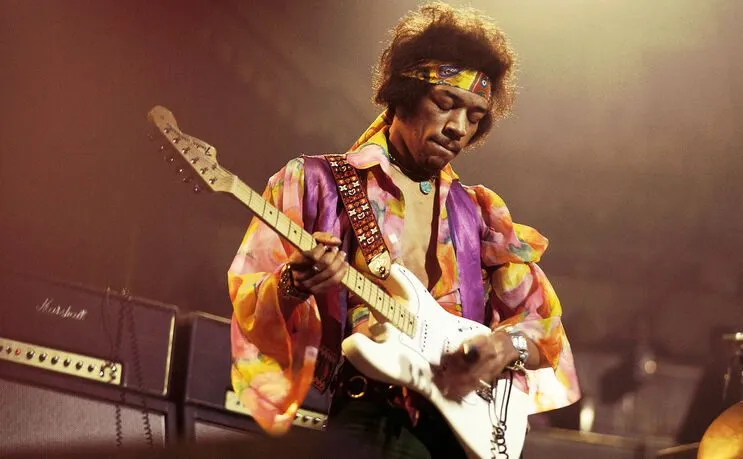
“I don’t really live by compliments… because they can distract me. A lot of musicians and artists, when they hear all this praise, they say: ‘Wow, I must have been really great.’ Then they get cocky and satisfied, lose their way, and forget their true talent.”
Jimi Hendrix was not just a musician; he was pure talent, an artist whose music felt like a conversation with the elements of nature. His interaction with the electric guitar was nothing short of a beautiful, mutual relationship. Hendrix didn’t just play musical notes—he created entire worlds of sound. His name is synonymous with innovative and groundbreaking guitar techniques. His life story, filled with highs and lows, stands as a testament to the power of artistic genius and the destructive forces that often accompany fame. Though his life was short, it left a lasting impact on music, society, and culture that continues to echo decades after his untimely death.
Born on November 27, 1942, in Seattle, Washington, Jimi Hendrix had a childhood marked by instability and hardship. His parents, Lucille Jeter and Al Hendrix, had a tumultuous relationship. Al was a strict father, and Lucille, who struggled with alcoholism, had difficulty being a consistent presence in Jimi’s life. This fractured family left young Jimi feeling alienated and searching for refuge. It was in this context that music became his sanctuary.
From an early age, Hendrix’s passion for music was evident. As a child, he would mimic playing a guitar with a broom until he finally managed to get a real one. His father’s reluctance to support his musical aspirations made acquiring that guitar a major triumph in itself. But once Hendrix began playing, his passion was unmistakable. A self-taught musician, he devoted countless hours to practice.
Hendrix’s journey to becoming a music icon was neither fast nor easy. Before finding fame, he worked the so-called “Chitlin’ Circuit,” a network of venues that primarily served African-American audiences. During this time, Hendrix played backup guitar for numerous jazz and R&B acts, including Little Richard, the Isley Brothers, and Curtis Mayfield. It was in these years that he began to shape his unique style—a fusion of blues, rock, and rhythm delivered with unmatched intensity. Still, his time in that scene was not without frustration. He often found himself confined by the limited expectations of the bands he played for. The dominating stage presence of Little Richard frequently overshadowed Hendrix’s attempts to showcase his creativity. The challenges he faced during these formative years ultimately fueled his desire for freedom and the development of his own sound, but the road was full of obstacles.

Despite these disappointments, his time in the U.S. Army—where he served in the 101st Airborne Division—proved to be formative. Although he disliked the strict discipline of military life, it taught him a level of self-control that would later become evident in his musical performances. After being discharged due to an injury, Hendrix turned his full focus to music.
Hendrix’s big break came in 1966, when he was discovered by Chas Chandler, former bassist of The Animals. Chandler saw something extraordinary in Hendrix’s style and brought him to London. There, Hendrix formed the Jimi Hendrix Experience with bassist Noel Redding and drummer Mitch Mitchell. The group quickly shook up the British music scene, and Hendrix became one of the most prominent figures in London almost overnight.
His live performances were astounding. His explosive energy, combined with unconventional guitar techniques, mesmerized audiences. Hendrix played the guitar with his teeth, behind his back, and even set it on fire—actions that elevated him to rock legend status. But his showmanship never overshadowed his musicianship. His technical mastery of the electric guitar was unparalleled, especially his use of distortion and feedback. Tracks like “Purple Haze,” “The Wind Cries Mary,” and “Hey Joe” showcased his ability to blend simplicity with complex melodic lines.
The release of his debut album Are You Experienced in 1967 cemented his reputation as one of the most innovative guitarists of his generation. The album offered a fusion of blues and psychedelic rock that set a new standard for rock music. His remarkable use of the guitar as a tool for emotional expression drew listeners in on both a musical and deeply emotional level. Hendrix’s music wasn’t just heard—it was felt.
When talking about Jimi Hendrix, the conversation inevitably turns to his guitar. But I think we need to look beyond his technical prowess. Hendrix didn’t view the guitar as a tool; he saw it as an extension of his body. In the book Becoming Jimi Hendrix, the authors explore how deeply personal his relationship with his instrument was. He practiced with such intensity it was almost spiritual. For Hendrix, music wasn’t about perfection—it was about emotion, raw and unfiltered.
Take “Purple Haze” for example. On the surface, it’s a psychedelic track, but musically it’s far more. Hendrix’s use of the E7#9 chord—often dubbed the “Hendrix chord”—creates a sense of tension that perfectly matches the song’s surreal atmosphere. This chord became a hallmark of his style—one that many guitarists have tried to imitate but rarely capture with the same nuance. It wasn’t just about complexity; it was about using complexity to evoke feeling. The track is considered one of the earliest examples of heavy metal and hard rock—genres that owe much of their early DNA to Hendrix.
What truly sets Hendrix apart, in my opinion, is not just his technical genius but the emotional range in his music. You can hear him shift from the delicate, almost tender phrasing in “Little Wing,” where the guitar feels like a bird in flight, to the raw aggression in “Voodoo Child (Slight Return),” which is brimming with sheer power. This emotional spectrum is something many modern guitarists lack. Many can play fast or complicated, but few can infuse every note with the emotional depth that Hendrix did.
In the book Electric Gypsy, Harry Shapiro thoroughly examines the wide-ranging influences that shaped Hendrix—from blues legends like Muddy Waters to the experimental jazz of John Coltrane. What’s fascinating is how Hendrix absorbed these influences and transformed them into something wholly his own. For instance, his improvisational approach was rooted in the blues, but his execution was closer to jazz. In tracks like “Red House,” you can hear that blues foundation, but his solos take the listener on a journey that feels less like following a formula and more like exploring new sonic landscapes.
The author writes, “As a guitarist, I draw inspiration from Hendrix’s use of the wah-wah pedal. Just listen to ‘Voodoo Child (Slight Return).’ The way he manipulates the pedal isn’t just for effect—it becomes part of the song’s dialogue, adding texture and expression to his playing. Many guitarists use pedals as crutches, but Hendrix wielded them like a master painter using colors to deepen a canvas. His innovative use of effects pedals was so original that imagining modern guitar tones without his contributions is nearly impossible.”
Hendrix’s music was so bold and forward-thinking that it approached the boundaries of danger to the establishment. While I don’t fully subscribe to conspiracy theories surrounding his death, it’s undeniable that his sound posed a direct, potent challenge to the era. His performance of “The Star-Spangled Banner” at Woodstock was more than a piece of music—it was a statement. Using distortion, feedback, and unconventional phrasing, Hendrix turned the national anthem into a critique of the Vietnam War and the state of the nation. It was one of those rare moments where music transcends entertainment and becomes a form of protest—a simple yet powerful expression of the cultural dissonance of the time.
There is something almost tragic in Hendrix’s music. It is filled with restless energy, as if he is always searching for something just out of reach. In the book Jimi Hendrix: The Man, The Magic, The Truth, Sharon Lawrence speaks about Hendrix’s inner struggles — how he was often in conflict with himself and wrestled between the pressures of fame and his desire for freedom. This tension is evident in songs like “Castles Made of Sand,” where the delicate melodies seem on the verge of collapse, reflecting the instability and fragility in the lyrics.
Hendrix’s music wasn’t always about flashy solos and technical prowess; it was sometimes deeply introspective. Many overlook the softer side of his music, in tracks like “May This Be Love” or “Angel.” These songs show Hendrix’s ability to express vulnerability — something rare in the male-dominated world of rock. For me, this complexity — this duality — is what makes his music so compelling. He wasn’t just a rock star; he was a poet, someone capable of accessing the full range of human emotion.
Beyond technical skill, Hendrix’s impact on society was profound. He rose to prominence during a time of social upheaval — the civil rights movement, anti-war protests, and the expanding counterculture. His music, filled with messages of peace, love, and rebellion, became the voice of a generation grappling with political turmoil.
As a Black man playing music largely perceived as “white music,” Hendrix transcended racial boundaries both subtly and powerfully. While many saw him as a revolutionary figure for Black musicians, Hendrix himself was notably indifferent to race. He often said he didn’t want to be defined by his skin color. It seems Hendrix was always striving to go beyond not only musical boundaries but also societal ones.
Hendrix’s identity was complex, woven into the racial and gender politics of the 1960s. His presence on stage, which challenged both racial and gender norms, provided a platform for him to exist outside stereotypical Black-and-white constructs. His theatrical acts — smashing guitars, overtly sexual performances — symbolized his resistance to the racial and gender limitations of his time.
Hendrix’s travels and success in the UK, during a peak of racial tensions in the U.S., demonstrated his popularity as a transnational figure. His racial identity was constantly debated: while some Black audiences viewed him as inauthentic, white audiences often saw him as exotic and captivating. Yet Hendrix succeeded in creating space for transnational Black musicians and maintained a strong connection to his roots while moving between cultures.
By breaking traditional notions of masculinity and playing with gender expectations on stage, Hendrix became one of the early figures to challenge heteronormativity in rock culture. His physicality, both in his music and public persona, was often seen as hypersexual, yet he constantly complicated and mocked traditional definitions of manhood.
His performances, especially in tracks like Voodoo Child, explored mystical and sensual themes, blending African, Caribbean, and American symbols to create a new, visual and musical language. This use of mythology and imagination framed Hendrix as a non-conformist figure, challenging not just racial norms but traditional gender roles too.

Hendrix even played a role in affirming or questioning American cultural narratives, particularly during the Cold War era when American exceptionalism was a central theme. While rooted in American blues traditions, his music carried strong political criticism, especially regarding U.S. involvement in Vietnam. His famous rendition of the national anthem at Woodstock was an iconic example of this political critique.
Lefkowitz argues that Hendrix was part of a broader movement trying to both affirm and challenge American cultural myths, ultimately playing a central role in the countercultural critique of U.S. policies.
However, like many artists, Hendrix’s success came at a cost. The pressures of fame, combined with personal troubles, began to take a toll. Struggling with depression, he turned to drugs and alcohol as a way to cope. His heavy use of LSD, amphetamines, and alcohol only intensified his inner turmoil. Despite his public image as a confident, charismatic performer, Hendrix was deeply introverted.
By 1970, even as his fame soared, Hendrix found himself at odds with his managers and the music industry. He felt creatively constrained and longed for more artistic freedom. His frustration with recording company demands and relentless touring intensified his emotional and psychological struggles. The final months of his life were marked by alienation and disappointment.
Jimi Hendrix’s death on September 18, 1970, has remained shrouded in ambiguity and speculation for decades. Officially, his cause of death was asphyxiation from inhaling his own vomit after consuming a lethal mix of barbiturates and alcohol. However, numerous theories and contradictions in the accounts of that night have raised questions about whether his death was merely accidental or involved foul play. Hendrix spent his last night at the Samarkand Hotel in London with Monika Dannemann. Her role in Hendrix’s final hours has been widely debated. According to Dannemann, Hendrix took nine Vesparax sleeping pills — far more than the recommended dose. While not necessarily fatal, these pills inhibited his body’s reflexes, preventing him from vomiting the food and wine in his stomach, ultimately leading to his suffocation. Official reports confirmed that Hendrix died from aspiration while unconscious. Still, questions remain about how he drank so much wine and why he was unable to expel it.
The theory of foul play in Hendrix’s death has been explored in books like The Covert War Against Rock, which suggests he may have been deliberately killed. The amount of wine found in his lungs has particularly drawn attention. Some theorists claim that the wine was not voluntarily ingested but was forcefully administered, perhaps while Hendrix was unconscious or under duress. Though controversial, these claims point to inconsistencies in the medical reports and the circumstances surrounding his death.
Tony Brown, a biographer who investigated Hendrix’s death, noted that the amount of wine in his lungs, combined with the lack of alcohol in his bloodstream, suggests that Hendrix died before his body could metabolize the alcohol. This, along with the substantial amount of wine on his clothes and in his throat, led Brown to theorize that Hendrix may have been forcibly given wine — possibly as part of a larger conspiracy.
Monika Dannemann, Hendrix’s companion at the time of his death, claimed that Hendrix was still alive when she sought help. Yet conflicting accounts from medical personnel indicate that Hendrix had been dead for several hours before emergency services arrived. Dr. Rufus Compson, who reviewed the case years later, noted the presence of rice grains in Hendrix’s stomach, which would have taken hours to digest — further complicating the timeline of his death.
These discrepancies have led many to believe that Hendrix’s death was not merely an accidental overdose but possibly the result of deliberate interference. Friends and collaborators, including Mitch Mitchell and Eric Burdon, have expressed skepticism toward the official narrative, with some pointing fingers at his manager, Michael Jeffery — a man with a shady reputation. Jeffery’s suspicious behavior following Hendrix’s death, including his absence from the funeral and lack of visible grief, only fueled conspiracy theories surrounding Hendrix’s demise.
Although Hendrix’s life ended tragically early, his influence on music and culture endures. He is widely regarded as one of the greatest guitarists in the history of rock music. His innovative use of distortion, feedback, and guitar effects paved the way for future generations of musicians. Many techniques Hendrix pioneered are now standard in rock, blues, and even jazz.
Moreover, Hendrix’s music continues to inspire artists across genres. From rock and blues musicians to jazz and hip-hop artists, Hendrix’s innovative approach to music left a lasting impact on how musicians think about sound and performance.
But perhaps Hendrix’s most enduring legacy is that he represented the spirit of artistic freedom. He was a man who crossed boundaries — in music, in society, and in expectations. Hendrix was an original artist whose music continues to inspire and captivate new generations of listeners.
In the years since his death, countless books, documentaries, and tributes have been made in his honor, each trying to capture the essence of a man who was both elusive and larger than life. But no matter how much is written or said about Jimi Hendrix, his legacy is best understood through the music he left behind — a body of work that speaks to the power of creativity, struggle, and the enduring beauty of art.