



From Au Hasard Balthazar to Eo: Animal, Suffering, and Transcendental Aesthetics in Cinema
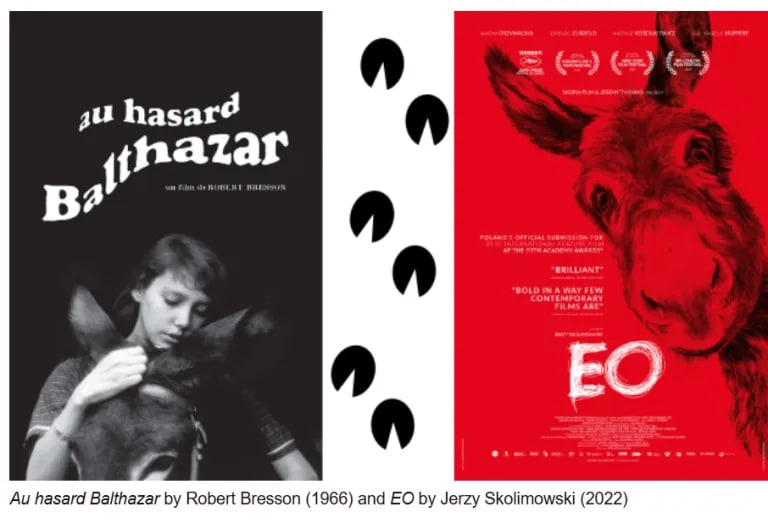
In 2022, Jerzy Skolimowski made the filmEO, which can be seen as a kind of tribute to Robert Bresson’s masterpiece Au Hasard Balthazar (1966). The main character in both films is a donkey, and both are narrated from the animal’s perspective. Skolimowski has said that the only film that ever brought him to tears was Bresson’s Au Hasard Balthazar, and this deeply personal experience inspired him to make EO. A modernist Polish filmmaker and one of the founders of the Polish New Wave cinema in the 1960s, Skolimowski was also a close collaborator of Roman Polanski, for whom he co-wrote the screenplay for Knife in the Water. After leaving Poland, Skolimowski continued filmmaking in the United States and other countries, but eventually returned to his homeland and avant-garde roots in 2008 with Four Nights with Anna, followed years later by EO.
Both EO and Au Hasard Balthazar focus on the life of a harmless, seemingly silent and passive animal, exploited and mistreated by humans, yet the filmmakers’ approaches and their modes of representation differ significantly. In Bresson’s film, the donkey Balthazar is passed from one owner to another, subjected to various forms of abuse and exploitation. Skolimowski’s donkey in EO undergoes a somewhat similar fate, though its encounters with humans are more varied and expansive than in Bresson’s work. Skolimowski even named his donkey EO after the braying sound of a donkey in Polish.
My intention here is to analyze how the world of donkeys is represented in these two films through Paul Schrader’s theory of Transcendental Style, and to demonstrate how Bresson and Skolimowski each employ cinema and its expressive possibilities to explore the inner world and emotional life of the animal. In my view, Au Hasard Balthazar adheres closely to Schrader’s definition of the transcendental approach, while EO, though incorporating certain elements of Schrader’s transcendental style, does not fully conform to that model.
In Au Hasard Balthazar, Bresson uses the donkey as a vehicle for reflecting the ugliness and beauty of the human world—a creature exposed, from birth to death, to violence, exploitation, neglect, and fleeting moments of kindness. The donkey’s silence, its ascetic endurance of suffering, and its lack of overt reaction lend the film a sacred, transcendental dimension. In Schrader’s terms, the donkey becomes a kind of earthly saint, bearing suffering without protest, forcing us to confront the harsh truths of human existence. Through his transcendental, minimalist style—slow pacing, austerity, and the elimination of ornamental elements—Bresson transforms this into a spiritual, meditative experience.
Skolimowski’s EO, by contrast, is not a sacred world. The film begins in a circus, where EO performs as a star alongside a young woman named Cassandra, whose bond with the animal borders on unhealthy obsession. Soon, however, a law banning the use of animals in circuses forces EO’s release, initiating a road journey filled with bittersweet encounters that eventually culminates, like Balthazar’s story, in tragedy. Yet unlike Bresson’s stillness and silence, Skolimowski elicits a visceral, psychological empathy with the animal—an experience more bodily and sensory than spiritual or contemplative. Where Bresson’s minimalist strategies draw us into a transcendental confrontation with the sacred beyond the everyday, Skolimowski seeks transcendence in intensity, in the immediacy of violence and cruelty within a modern, brutal world.
It should be noted, first of all, that neither of these films portrays the relationship between humans and animals in the Hollywood tradition. Neither grants the donkey human-like traits—a device common in animated, fantasy, science-fiction, or horror films, known as anthropomorphism: attributing human emotions, beliefs, thoughts, and behaviors to animals, non-human beings, or objects (as seen in King Kong, Godzilla, or Fantastic Mr. Fox). In popular culture, the donkey has long been a figure of ridicule, associated with stupidity, stubbornness, and clumsiness. Yet in both Au Hasard Balthazar and EO, the donkey is far from foolish: it is intelligent, aware of its tragic circumstances, and even capable of attempts at resistance and escape.
According to Paul Schrader’s definition, the transcendental style—associated with filmmakers such as Bresson, Dreyer, and Ozu—is characterized by minimalism, ritual repetition, emotional restraint and control, distancing, attention to mundane and non-dramatic moments of everyday life, and a focus on the spiritual or the unseen. Typically, this style unfolds in three stages: “the everyday,” “disparity,” and “stasis.” Yet Schrader does not restrict transcendental cinema merely to the representation of the sacred or the religious. Instead, he regards it as a formalist system, one that, through slow pacing, the elimination of unnecessary actions, emphasis on the details of ordinary life, and distance from heated, dramatic emotions, leads the spectator into a contemplative, meditative experience. In his view, Ozu, Dreyer, and Bresson are each, in different ways, classical exemplars of this aesthetic. Although Schrader argues that the transcendental style is not necessarily tied to Christian notions of the sacred or the theological, in Bresson’s Au Hasard Balthazar Christian symbols and iconography are indeed used to connect the donkey with the sacred. Thus, an analysis of Au Hasard Balthazar requires attention to the formal strategies Bresson employs to bind the donkey to the sacred in a transcendental sense. Skolimowski’s donkey in EO, by contrast, has no such relationship to the sacred and remains rooted in the earthly rather than the divine.
In Christian theology and the religious paintings associated with it, the donkey holds an important role in the narrative of Christ’s life. According to the Gospels, on Palm Sunday Christ enters Jerusalem riding on a donkey, greeted by the people. This event is a central moment in Christian culture, foreshadowing the Passion and the Crucifixion on Good Friday. Thus, the end of Christ’s earthly life is painful and tragic, just as the donkey’s death at the end of Au Hasard Balthazar is heartbreaking and tragic. Yet for Balthazar, as for Christians regarding Christ, death does not signify finality. Just as Christ is redeemed, Bresson ultimately redeems Balthazar. In paintings such as Pieter Bruegel’s Landscape with the Flight into Egypt and Rembrandt’s The Flight into Egypt, the story of Mary, Joseph, and the infant Christ fleeing Judea for Egypt is depicted with a donkey. Rembrandt’s Balaam and the Ass also recounts the story of a donkey refusing Balaam’s command to climb a mountain in order to curse Moses and his people.
As Schrader shows in his book, such paintings and saintly images of donkeys inspired Bresson—himself a Christian deeply influenced by Jansenism—in making Au Hasard Balthazar. The key feature of the donkey in these visual traditions is that, although ordinary and earthly, it is used for transcendental purposes, as a signifier of the sacred. For Schrader, Bresson locates traces of sanctity in the donkey and, through formal strategies, imbues it with transcendental quality. Skolimowski, by contrast, uses his donkey in EO for its own animal being, not as a symbol of the sacred. Schrader even argues that films like Mouchette, Une femme douce, and Au Hasard Balthazar do not achieve the same transcendental power as Bresson’s “prison cycle” (A Man Escaped, Pickpocket, The Trial of Joan of Arc, and Diary of a Country Priest).
Schrader, like Susan Sontag, also believes that all of Bresson’s films revolve around a common theme: imprisonment and freedom. Each of his films, in one way or another, grapples with captivity. This duality of bondage and liberation is central to Au Hasard Balthazar. The donkey constantly oscillates between freedom and captivity. The film begins with a rural family taking in a donkey foal. Marie, the daughter, grows fond of it, and with a boy named Jacques, christens it Balthazar. As the donkey matures, however, it falls into the hands of successive owners, each subjecting it to forms of enslavement. Balthazar escapes at times, but ultimately is killed in tragic fashion by Gérard, a cruel young man, and his companions. Shot and mortally wounded, Balthazar collapses to the ground, surrounded by a flock of sheep, and dies—his suffering echoing the Passion of Christ. For Bresson, this death signifies redemption. The film’s ending, accompanied by the sound of church bells and Schubert’s piano sonata, signals a liturgical mourning for saints. This moment embodies Schrader’s “stasis” or “decisive action,” or what Carl Plantinga calls a “scene of empathy”: a slowing or halting of the narrative, focusing on the inner emotional experience of a character, often conveyed through lingering close-ups or alternating shots between the character and their point of view.
Anat Pick, in her book Creaturely Poetics: Animality and Vulnerability in Literature and Film, argues that the silence of animals, their voicelessness in the face of human cruelty, grants them a sacred quality, turning them into saints or martyrs. Saints, after all, do not preach; they remain silent, faithfully bearing witness to the truth given to them. In Au Hasard Balthazar, Marie’s mother explicitly calls Balthazar a saint. For Pick, suffering becomes sacred when the sufferer refuses to articulate it. In Bresson’s film, Balthazar cannot speak, cannot protest or complain of his suffering. Marie’s father, too, shares a similar condition: though able to speak, he refuses to voice his pain despite illness and hardship. Unlike Balthazar, however, he is not redeemed after death. For Bresson, Balthazar is inherently saintly, for sanctity is divinely bestowed upon him. Moreover, in the film’s opening, Jacques and Marie baptize the donkey in holy water, invoking the Trinity—“In the name of the Father, the Son, and the Holy Spirit”—and name him Balthazar, after one of the Magi in the Gospels who brought gifts to the infant Christ. Though the donkey cannot perform religious rituals, the children’s innocence sanctifies him, situating him within the sacred. An untrained donkey thus becomes perfectly aligned with Bresson’s minimalist, transcendental style.
In Bresson’s transcendental style, the viewer’s emotional engagement and sensory involvement are largely controlled or postponed. Like Brecht, he creates a distancing effect between the audience and the scene. According to Susan Sontag, the explicit pattern of imprisonment and freedom in Au Hasard Balthazar functions as such a prominent formal device that it moderates the spectator’s emotions and prevents the film from becoming sentimental. Sontag notes that the focus on the relationship between Marie and the donkey, the emotional centers of the film, operates as one of these distancing techniques. Bresson achieves this through the film’s formal self-awareness, refusing to let the viewer sink completely into the emotional world of the characters. Sontag argues that although Bresson’s tone in Au Hasard Balthazar is cold and austere, it is precisely through this dryness that he can move the spectator—even to tears, as Skolimowski himself confessed.
Bresson’s spectators remain aware of the film’s formal organization, and this awareness delays the onset of emotional response. The more conscious we are of form in art, the more distance we maintain from it. As Sontag explains, Bresson’s avoidance of emotional immersion and his adoption of a reflective, observational stance compel viewers to look at the characters and events with distance, creating space for contemplation of the transcendental. Through his strict formal discipline, Bresson situates the audience outside the film’s world, thereby elevating the act of viewing itself. This approach, however, makes his films difficult to follow, especially for audiences accustomed to classical Hollywood narrative structures. With rigorous formal control—eschewing emotive music (except in rare moments), using non-professional actors with restrained, affectless performances, and emphasizing repetition and the banalities of daily life—Bresson creates a form that withdraws from conventional suspense and excitement, instead urging the spectator to sense a meaning beyond the everyday. In this way, Balthazar, a mute and seemingly passive donkey, becomes a medium for transcendental experience. The episodic, fragmented structure of Au Hasard Balthazar and Bresson’s emotional distancing often bewilder or alienate ordinary viewers, breaking their connection to the film. Yet viewers familiar with Bresson’s form find themselves distanced from the film’s world, reflecting instead on its inner mechanisms and the transcendental dimensions of his cinema. As always, Bresson used only a standard 50mm lens, employed music sparingly, shot in black and white, and relied primarily on close-ups and medium shots—often from the donkey’s low vantage point—rather than dialogue or expressive acting.
Schrader argues that the transcendental style, like religious ritual, transforms experience into a repeatable rite. He emphasizes its reliance on dualities: the irrational over the rational, repetition over variation, the sacred over the profane. These dualities are evident in Bresson’s films. In Au Hasard Balthazar, repetition predominates over variety—the recurring scenes of the donkey’s abuse, or the repeated shots of it turning the mill wheel, exemplify this. The tension between rationality and irrationality, wealth and indifference to material possessions, also permeates the film. Arnold, a poor drunkard, inherits wealth by chance, only to die immediately afterward. Balthazar has little agency of his own, subject to the will of others and to forces of evil, just as Arnold and Marie are. The difference is that Arnold and Marie appear to have free will, while Balthazar does not. Yet from Bresson’s Jansenist perspective, even their choices are divinely preordained. Though everything is imposed upon Balthazar, he nonetheless struggles to resist captivity whenever possible: returning instinctively to Marie’s home when freed, or refusing to drink water from a greedy landowner.
In EO, unlike Au Hasard Balthazar, no trace of the sacred or divine exists. At the end, a caption declares: “This film was made out of love for animals and nature. The welfare of animals on set was always our top priority, and no animal was harmed during filming.” Thus, as this statement makes clear, Skolimowski’s aim was not to sanctify the donkey, but to defend its rights as a voiceless creature in today’s violent, modern world. Moreover, he even visualizes the donkey’s surreal memories and fantasies—entirely at odds with Bresson’s Jansenist austerity. Unlike Bresson, Skolimowski deliberately creates an emotional space, encouraging the audience to empathize deeply with his donkey.
Although EO ends with the donkey slaughtered in an abattoir, unlike Balthazar it is not redeemed: the sacred is entirely absent. Its story instead foregrounds ordinary experiences of the animal world. Like Bresson, Skolimowski avoids anthropomorphism; the donkey remains an animal, and we experience the human world through its gaze. Close-ups of its impassive face and emphasis on its body force us to reflect on its condition and suffering as an animal. Unlike Balthazar, EO is not always exploited or mistreated: some humans, like Cassandra, love and care for it, and in one scene, EO even helps a football team win a match and is celebrated for it.
While EO, unlike Au Hasard Balthazar, does not pursue transcendence or sanctity, it still qualifies as transcendental cinema in Schrader’s sense, since transcendental style is not only about a sacred view of life but also about a formal and aesthetic approach. Skolimowski’s film embodies a kind of “formal austerity,” though not through the elimination of suspense or emotion, but rather by limiting human-centered narrative and granting perspective to an animal. The film deliberately avoids causal narrative logic, presenting a fragmented world built on sensory and aesthetic experience rather than plot. This emphasis on pure perception connects it to Schrader’s notion of the transcendental.
Yet Skolimowski’s EO diverges radically from Bresson in style. He uses rapid montage, energetic camera movements, vibrant colors, and resonant music. EO’s journey is depicted impressionistically, with dream sequences and hallucinations: flashbacks to the circus, or visions of itself as a robot. This highly expressive, sensorial aesthetic is the polar opposite of Schrader’s minimalist, meditative transcendence. Where Bresson achieves transcendence through calm, silence, and subtraction, Skolimowski seeks it through sensory excess and narrative fragmentation, forcing the spectator to abandon conventional storytelling and psychology and to confront the raw cinematic experience. In Schrader’s terms, both lead the viewer from the narrative surface to contemplative depth. EO, not in the religious but in the aesthetic-sensory sense, accomplishes this: the animal takes center stage, we are estranged from the human world, and in that estrangement we gain new insight into the condition of humanity and nature.
Instead of calm, Skolimowski offers sensory chaos; instead of silence, an explosion of sound and color; instead of linear narrative, disjunction. Yet this too fulfills the function of the transcendental style: breaking from mainstream cinema and guiding the viewer toward an experience beyond entertainment or mere storytelling. One might say that if Bresson represents the classical model of transcendental cinema, Skolimowski offers its modern adaptation, attuned to contemporary realities. EO also carries political weight, distinguishing it from Bresson’s Catholic vision in Au Hasard Balthazar, offering instead a devastating portrait of modern Europe.
Stylistically, EO employs elements associated with transcendental cinema—its focus on the mysterious inner world of a donkey, its creation of distance and moments of reflection through visual strategies. Its compassion and contemplative rhythms overlap at points with transcendental aesthetics, though its energetic editing and visual flourishes mark a significant departure from Bresson. Thus, unlike Schrader’s quiet, realist, meditative transcendence, EO is dynamic, experimental, at times surreal or impressionistic.
The essential difference between the two films lies in their divergent modes of representation and transcendental approaches. Bresson links the donkey’s silence to a Christian spirituality, transforming it into a kind of sacred martyrdom. Skolimowski, by contrast, fuses the donkey’s silence with the chaos of the modern world, rendering it tragic and even absurd. In Bresson’s film, Balthazar becomes saint or martyr; in Skolimowski’s, the donkey is a defenseless victim whose gaze exposes the moral and ecological crises of our age. Bresson seeks spiritual transcendence; Skolimowski provokes a sensory-ethical shock for the contemporary viewer.