



The films and graphic novels of Marjane Satrapi, much like the work of many Iranian diasporic filmmakers and artists, tend to approach contemporary Iran through a predominantly one-dimensional and emotionally charged narrative. In this framework, Iran is represented less as a historically complex, pluralistic society shaped by real contradictions than as an object of suffering or nostalgia. Iranian life is filtered not through the diversity of its social and political experiences but through recurring themes of loss, repression, longing, and collapse—a perspective that often resonates deeply with Western audiences.
From this perspective, the success of much Iranian diasporic cinema in the West cannot be attributed solely to its aesthetic qualities. It is also bound up with the political economy of spectatorship and the expectations of Western viewers. Western audiences have often embraced films about Iran that reinforce familiar, if incomplete, perceptions of the country as a troubled “Orient,” an underdeveloped nation, or an uncivilized society. Within this cultural framework, immigrant filmmakers may consciously—or unconsciously—gravitate toward representations that satisfy both the expectations of Western audiences and the demands of the Western cultural marketplace, even when doing so reduces the complexities of Iranian society and reproduces degrading stereotypes.
Seen in this light, Satrapi’s vision of Iran throughout much of her work rests less on historical or sociological understanding than on emotional distance and the imaginative reconstruction of both Iran’s past and present. While this approach has undoubtedly contributed to the success of her films within Western cultural institutions and international film festivals, it has often done so at the cost of depicting Iran and its people as fundamentally backward, defeated, or trapped in perpetual failure. The result is a distorted image of Iranian society—one that reflects not social reality but the internalized colonial imagination that frequently shapes segments of the Iranian diaspora.
Among Satrapi’s cinematic works, Chicken with Plums (co-directed with Vincent Paronnaud) engages less directly with Iranian society than Persepolis. Yet it remains rooted in the same intellectual framework and adopts the same perspective: one that views Iran not as a historically and socially complex reality but through the lenses of longing, emotional distance, and selective nostalgia.
Adapted from Satrapi’s own graphic novel, the film attempts to reconstruct a lost world—a poetic, dreamlike Tehran of the 1950s, suffused with melancholy and romantic yearning. Yet this reconstruction largely strips away the historical and social complexities of the period. Instead, it becomes an exercise in nostalgic simplification that invites criticism from the perspective of postcolonial theory.
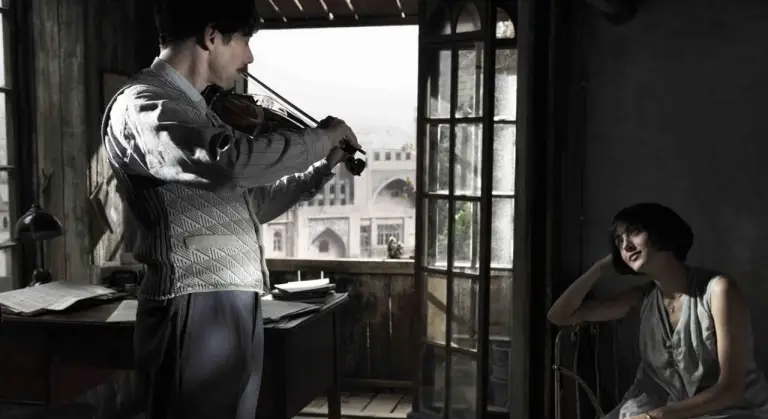
Although the story unfolds in Tehran during the 1950s—one of the most politically consequential decades in modern Iranian history—the film bears surprisingly little relationship to Iran beyond Persian names and recognizable locations. Its central narrative concerns Nasser Ali Khan (played by Mathieu Amalric), a gifted violinist whose life is defined by his love for a young woman named Iran (played by Golshifteh Farahani).
The filmmakers deliberately avoid depicting the turbulent political atmosphere of post-1953 Iran, following the Anglo-American coup that overthrew Prime Minister Mohammad Mossadegh. Political history surfaces only fleetingly through Abdī, Nasser Ali’s brother, whose communist sympathies are briefly mentioned before disappearing into the background. Instead, the film devotes almost all of its attention to Nasser Ali’s violin, his impossible love for Iran, his profound depression, and ultimately his suicide. This silence becomes especially striking when placed alongside the work of filmmakers who confronted precisely the same historical moment.
During those years, Farrokh Ghaffari made South of the City—later destroyed by SAVAK—and subsequently The Hunchback of the Night, inspired by One Thousand and One Nights, both shaped by the climate of fear that followed the 1953 coup. Around the same time, Ebrahim Golestan created Brick and Mirror, a masterpiece that held a mirror to the suffocating social atmosphere of post-coup Iran. There is nothing inherently objectionable about choosing to make an ostensibly apolitical film set during one of the decisive periods of Iran’s modern history. The more pertinent question is why the political conditions of the era leave virtually no trace upon the film—not even as distant background.
No political slogans appear on the walls of Tehran, Shiraz, or Rasht. Apart from a brief meeting between the two brothers at Café Naderi, political events produce neither echoes in the dialogue nor discernible consequences for the lives of the characters.
As in Persepolis, Satrapi presents pre-revolutionary Iran as a lost paradise. The Tehran of Chicken with Plums is colorful, lyrical, filled with music, romance, and beauty—a city seemingly untouched by political conflict, class tensions, or social crisis. This form of nostalgia closely resembles what Svetlana Boym, in The Future of Nostalgia, describes as restorative nostalgia. Unlike reflective nostalgia, which recognizes the irretrievability of the past and dwells on memory, loss, and critical reflection, restorative nostalgia attempts to reconstruct the past as an intact, harmonious, and coherent whole. For Boym, restorative nostalgia is not content merely to remember. It seeks to restore what has been lost, as though history itself could be repaired. It tends to erase contradiction in favor of an idealized image of an earlier society.
Reflective nostalgia, by contrast, accepts that the past cannot be recovered. Rather than rebuilding it, it reflects upon absence, fragmentation, and the ambiguities of memory. In this sense, restorative nostalgia declares: “Let us recreate the past exactly as we imagine it once existed.” Reflective nostalgia instead suggests: “Let us remember the past while acknowledging that it is forever inaccessible—and that its contradictions deserve to be remembered as well.”
It is this restorative impulse that largely shapes Satrapi’s reconstruction of Iran in Chicken with Plums. The film offers not a historically grounded portrait of a society suspended between modernity and political upheaval, but an emotionally purified memory—one in which beauty survives while complexity quietly disappears.
The Tehran that Satrapi presents in Chicken with Plums—the city through which Nasser Ali Khan and his beloved wander—is a serene, picturesque place where everyone appears content. No one seems burdened by sorrow except Nasser Ali himself, grieving over his broken violin and his lost love. Satrapi’s nostalgia for the Iran of the 1950s bears only a tenuous relationship to the historical realities of the period. To be sure, naming Nasser Ali’s beloved “Iran” can be read metaphorically as a signifier of a lost homeland—an Iran lost after the 1953 coup. Yet the film’s colorful, lavish, and almost cartoonish aesthetic ultimately neutralizes the force of this metaphor. Everything is sacrificed to a vision of nostalgia and fantasy whose appeal lies in seduction rather than historical insight.
In Satrapi’s reconstruction of the past, the 1979 Revolution is depicted as a catastrophic rupture that obliterated this beautiful world. The central problem, however, is not the film’s critique of the Revolution itself, but its complete omission of the realities that preceded it. Political repression, class inequality, dependence on the West, and the profound identity crises of Iranian society under the Pahlavi monarchy are almost entirely absent. Their erasure produces a form of historical cleansing that is driven less by analysis than by emotion and ideology.
Unfortunately, Satrapi and her French co-director Vincent Paronnaud’s cinematic recipe proves less successful than its culinary title suggests. Chicken with Plums inspires remarkably little credibility for Iranian viewers, whether in terms of narrative or characterization. One might argue that the filmmakers never intended to make a realistic Iranian film at all. Rather, their aim was to create a fantasy—a fairy tale in the vein of Jean-Pierre Jeunet’s Amélie—using Iran merely as the backdrop for a universal romantic tragedy centered on lost love, a story that could unfold almost anywhere.
If that is indeed the case, however, then the painstaking reconstruction of Tehran’s bazaars, the streets of Rasht, the Persepolis Cinema, and the legendary Café Naderi becomes largely meaningless. The film might just as well have been set in 1950s Paris with French characters, and many of its problems would arguably have disappeared.
Viewed from this perspective, other weaknesses become equally apparent. The romance between Nasser Ali Khan and his ethereal beloved, Iran, unfolds with little emotional vitality. His repeated suicide attempts, his encounters with Azrael, his forced marriage to Farangis, and his improbably coincidental meeting with Iran in her father’s jewelry shop all depend upon an exceedingly fragile narrative logic. Without the film’s highly stylized cinematography and its lavish production and costume design, many of these sequences would scarcely rise above the sentimental melodramas that characterized popular Iranian commercial cinema of the 1950s and 1960s.
The characters themselves possess little psychological depth or social complexity. Instead, they function primarily as symbolic archetypes. Nasser Ali embodies the familiar figure of the suffering artist—a romantic subject incapable of adapting to either modernity or social change. His love exists more as an abstract ideal than as a convincing human relationship.
Like a traditional folktale from One Thousand and One Nights, the film opens with the familiar cadence of “Once upon a time.” Yet the narrative proceeds retrospectively after Nasser Ali’s death, unfolding through eight days—or eight chapters—in an extended flashback that moves fluidly between past and present. The decision to cast Azrael, the Angel of Death, as the film’s narrator is an original and imaginative conceit, even if it necessarily reveals the protagonist’s fate from the outset.
The women in the film likewise remain confined to familiar stereotypes: the unattainable beloved, the domineering wife, or the suffering victim. Such characterization not only diminishes the gendered complexities of Iranian society but also renders them comfortably recognizable for Western audiences accustomed to these narrative conventions.
The recurring use of smoke to create an ethereal, dreamlike atmosphere—and to symbolize both the transience of memory and an escape into fantasy—is one of the film’s most promising cinematic ideas. Yet it is never fully developed and ultimately feels squandered. Unlike Persepolis, which was rich in wit and comic energy, Chicken with Plums offers only fleeting moments of humor.
This is particularly unfortunate given Mathieu Amalric’s extraordinary talent for comic performance. The filmmakers provide him with little opportunity to exploit those strengths, leaving much of his remarkable versatility untapped. Ultimately, the film remains content to skim the surface. The audience’s principal pleasures derive not from narrative or characterization but from its visual splendor, its brief yet elegant animated sequences, and the presence of an impressive ensemble of distinguished French actors—many of whom are confined to surprisingly inconsequential roles.
One genuinely memorable comic moment arrives during Nasser Ali’s attempted suicide, inspired by Socrates’ death. Like the Greek philosopher, he prepares to deliver a solemn final speech while his children gather around him. Yet the grandeur of the moment collapses when one of the children unexpectedly breaks wind, puncturing the scene’s carefully constructed dignity with disarming absurdity.
What ultimately makes Chicken with Plums—and much of Satrapi’s broader body of work—worthy of examination through the lens of postcolonial criticism is its representation of Iran as the “Other.” This “Other” exists either as an idyllic world irretrievably lost in the past or as a society trapped in tragedy and decline. Such a binary inevitably reproduces elements of the Orientalist gaze, in which the East is denied historical agency and acquires meaning primarily through its relationship with the West.
Rather than constructing a layered account of Iranian history, Satrapi, as an Iranian artist living in the diaspora, frequently turns toward an emotionally simplified narrative that aligns comfortably with the expectations of Western audiences.
In doing so, her work risks falling into what postcolonial scholars have described as self-Orientalism: the process by which Eastern subjects internalize and reproduce Western stereotypes about themselves. In Chicken with Plums, excessive nostalgia, the fantasy-driven reconstruction of reality, and archetypal characterization all serve a narrative that beautifies and sanitizes the past. Ultimately, the film reveals less about the historical realities of modern Iran than about the imagination of an émigré artist attempting to reconstruct the past while negotiating the complex terrain between memory, identity, and the expectations of a Western audience.
© 2026. Phoenix Review