



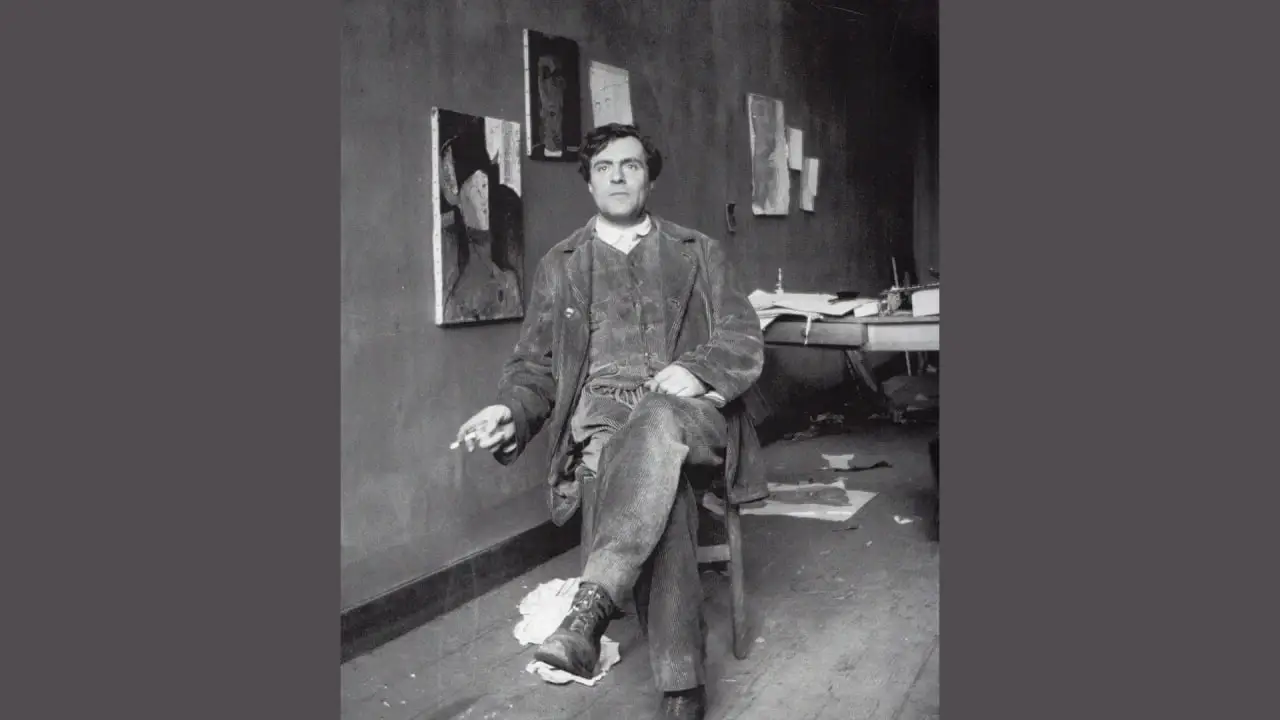
Throughout his short life, Amedeo Modigliani demonstrated an insatiable fascination with the human form. Through elongated shapes, soft color palettes, and elegantly simplified lines, he crafted a distinctive and deeply personal style. Especially in his portraits, Modigliani’s art evokes beauty, tenderness, and the complexities of human emotion, creating an intimate connection between the work and the viewer. Unlike many of his contemporaries, he developed a singular artistic voice—one that stands apart in its poetic sincerity.

Modigliani was known for capturing the physiological distinctiveness of his sitters. Margherita is a striking example of his unique approach to portraiture. Painted in 1916, this work comes from a pivotal and fruitful period in Modigliani’s career, in which his mature figurative style—marked by serpentine lines and stylized elongation—came fully into its own.
Though intensely personal, the painting adheres closely to Modigliani’s archetype of the feminine form: an elongated neck, oval face, wide eyes, and small, sealed lips. This balance of generalization and specificity, abstraction and realism, reveals his extraordinary ability to distill both the likeness and the essence of his subjects. This portrait, in many ways, is a depiction of the sitter’s “inner radiance.”

Among Modigliani’s most iconic works, Reclining Nude stands as a masterful convergence of classical idealism, sensual realism, and modernist innovation. It exemplifies his ambition to create an almost sculptural symbol of womanhood—what he called a “column of tenderness”—while simultaneously reflecting the gritty reality of his life as a struggling, immigrant bohemian in the poorer quarters of Paris.
This painting is more than a portrait; it is a hymn to the beauty of life, vibrating with movement and passion in every stroke and hue. It is realistic enough to captivate, yet stylized enough to shimmer like a dream. Widely regarded as one of the most celebrated nudes in modern art, it intertwines vitality, softness, sensuality, and a deep reverence for life, whispering of love and longing from within the paint.

Jeanne Hébuterne with Hat is among the most poetic and sublime portraits Modigliani ever painted of his beloved companion. The elegance and tenderness of the painting shine through the gentle curvature of Jeanne’s neck and the soft rhythm of her posture, flowing across the canvas like a quiet melody. The painting’s style evokes echoes of Mannerism, a term some have used to describe Modigliani’s later work, especially in the final years of his short yet fervent life.
Modigliani’s life and art existed in stark contrast. One was turbulent, excessive, and steeped in bohemian legend; the other was serene, graceful, and imbued with quiet dignity. Jeanne’s calm presence—her elongated neck and steady gaze—stands in haunting opposition to the chaos that surrounded the artist’s life. This painting feels like a refuge amid the storm, a moment of stillness in a world of unrest. Jeanne Hébuterne with Hat is more than the portrait of a lover—it is the embodiment of the serenity Modigliani perhaps always sought but never fully attained.
Modigliani died of tuberculosis on January 24, 1920. Two days later, Jeanne—nine months pregnant—threw herself from a window, ending both her life and that of their unborn child. Theirs is one of the most tragic stories in the history of art, second perhaps only to that of Van Gogh. Modigliani was an artist who placed his faith in life, in love, and in the beauty of the human form.