



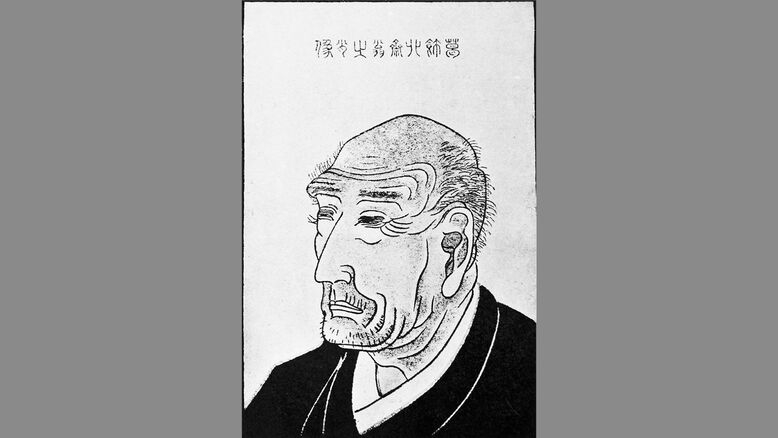
Katsushika Hokusai, the veteran Japanese master, was like fine wine — as he aged, his art became more refined, influential, and enduring. Unlike many artists whose work declines with time, Hokusai created his masterpiece, The Great Wave off Kanagawa, in his seventies; a piece that not only became an immortal symbol in global art but also had a profound influence on artists like Van Gogh and Monet.

The Great Wave is part of the series Thirty-Six Views of Mount Fuji, which depicts Japan’s sacred mountain in various seasons and conditions. Among these works, three images stand out the most: South Wind, Clear Sky, Wind and Rain Beneath the Peak, and of course, The Great Wave.
The Great Wave is one of the most famous and impactful artworks in the history of the world. The piece shows a colossal and surging wave, with its watery claws swallowing small fishing boats. In the background, Mount Fuji is seen in a tranquil state, contrasting with the chaos of the sea. This brilliant combination of nature and humanity has become one of the most recognized symbols of Japanese culture.

The perspective in this work, which is in the style of European art, is particularly noticeable, especially in the way the wave is positioned against Mount Fuji, creating a sense of depth. In traditional Japanese painting, perspective was not commonly used in this manner, but Hokusai, after studying European works, introduced this innovative technique into the ukiyo-e style. Ukiyo-e is a Japanese art style that primarily includes woodblock prints and paintings depicting urban life, natural landscapes, kabuki actors, beautiful women, and folk legends.
The Great Wave is described as the most reproduced image in the history of all art, and it is also considered one of the candidates for the most famous artwork in Japanese history. It has been widely used in modern design, posters, fashion, and even pop culture (such as anime and video games).

In this work (shown above), Mount Fuji is depicted at dawn, under a clear sky, bathed in a red hue. This image is one of the simplest yet most impactful prints from the series, presenting a serene and majestic view of the sacred mountain of Japan. In Japanese culture, Mount Fuji symbolizes endurance, strength, and immortality. This image, unlike The Great Wave, which is full of movement and dynamism, conveys a sense of peace and stability. The color change of the mountain from blue at the bottom to red at the top symbolizes the sunrise in summer. This piece shows how nature and national symbols can capture the identity of a nation within a single frame of art.
To explore the stunning variety of prints in South Wind, Clear Sky, one can refer to high-quality samples available in online museum collections. Much has been said about the influence of this design on Western painters in the generations that followed, especially regarding the similarity between Cézanne’s Mont Sainte-Victoire and this Hokusai piece. Both artists revered the mountain for its cultural and physical significance. While each created unique compositions to express it, their methods were so abstract and progressive that they transcended the boundaries of their time and reached beyond their respective eras.

This piece is another standout painting in the Thirty-Six Views of Mount Fuji series, in which Mount Fuji is depicted in a condition different from the other two pieces (The Great Wave and South Wind, Clear Sky). Unlike the tranquility and silence of South Wind, Clear Sky, here, storm and rain shadow the slopes of Mount Fuji, showing nature in a moment of turmoil and unrest. In this work, the upper part of Mount Fuji remains bright and calm, while the lower part is engulfed in lightning and heavy rainfall. The contrast between the calm summit and the turbulent slopes illustrates a duality in nature and life. This piece shows that Hokusai was not just a master of capturing the beauty of nature but could also convey its dynamism, power, and unpredictability in his art.
Hokusai was not only an exceptional artist but also a great thinker in the field of art. With his unparalleled ability to depict natural changes and Japanese symbols, he was able to transcend the boundaries of his culture and leave a global impact. The ukiyo-e style, which particularly utilizes woodblock printing techniques, is still recognized in the art world, and Hokusai’s works are considered some of the most important symbols of Japanese art globally.