



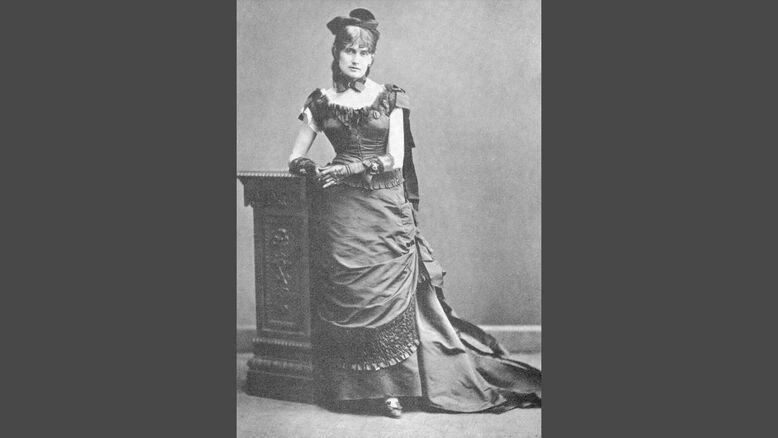
“How unfortunate that they are not men.” This remark was made by Édouard Manet in the mid-19th century about the two artist sisters, Berthe and Edma Morisot, when he first met them at the Louvre Museum. He was concerned that their works would almost certainly be overlooked by patriarchal institutions. The truth is that Edma soon gave up painting, married a naval officer, and moved to Brittany. However, Berthe Morisot continued to paint until the last moments of her life, which ended prematurely due to pneumonia. She held an exhibition at the Salon in Paris every year and created unique and radical depictions of contemporary women, showing that some of them were even painting themselves. Nevertheless, Manet’s prediction ultimately came to pass, albeit with a bitter truth.

Manet and Morisot were both key figures in the Impressionist movement: Manet was referred to as the “father of Impressionism,” and Morisot was the only woman who was part of the core group from the beginning. Morisot is considered in many ways the first lady of Impressionism. After studying with Camille Corot and exhibiting her works at the Salon in Paris, she put aside her hesitations and joined a group of bold, innovative artists led by Manet. As one of her close friends and her second great teacher, Manet painted eleven portraits of her. In the painting “Berthe Morisot with a Bouquet of Violets”, Manet portrays her as a young, confident, and beautiful woman at the beginning of her artistic journey, two years before she officially joined the Impressionist movement. Morisot later married Manet’s brother and became a prominent artist.
Morisot rarely painted men, and her feminine world is incredibly delicate and mysterious: faces of solitude, reading books in silence, contemplating, gazing through shining windows, sitting in gardens seemingly merged with the surrounding foliage, wearing elegant clothes that appear to have no connection to their inner world. For example, in the painting “Julie Manet with Her Greyhound, Laërte”, Julie is immortalized in time with her loyal greyhound. Morisot, with soft and delicate brushstrokes, captures a moment of serenity and empathy between the girl and her loyal dog. The light and color blend playfully in this scene, as if time has paused for a moment to preserve the softness of the hands’ caress and the nobility of the gazes in the memory of the canvas. A symbolic 18th-century blue chair is left empty next to Julie. Knowing that her mother passed away from illness less than two years later at the age of fifty-four makes this painting even more poignant.

A common criticism of Morisot’s work is that she only tackled light and delicate subjects, as if tenderness was a hidden code for being “non-serious” and ultimately “feminine.” But how can such an assertion be accepted when all of Impressionism is filled with light and joy? In the painting “Chasing Butterflies,” Morisot poetically captures a whimsical style, as if the breeze is flowing through the canvas, capturing a moment of weightlessness and freedom.

What distinguishes this “feminine” from the “feminine” works of Renoir, Degas, or Monet is not in the subject matter, but in the gender of the creator. Perhaps one could speak of “masculine Impressionism,” where Manet boldly celebrates nudity. But aren’t these boundaries nothing but chains on creativity? Perhaps if “Chasing Butterflies” did not bear the signature of a woman artist and instead were found among the works of the old master Renoir, no one would notice the difference, as it would silently and softly blend into his other works.
Morisot never settled on a fixed, recognizable style. She bore no resemblance to the men. She was in search of a new kind of authenticity, a way to express the truth of her life and create art that reflected that honesty. Morisot wrote: “Every day I pray that God will make me like a child, meaning that I will see nature and depict it in its simplest form, like a child.” At this point, Morisot decides to paint her sister Edma with her newborn daughter Blanche, just a few months old. The painting “The Cradle”, which became one of Morisot’s most significant works, shows Edma in a profile, carefully and attentively watching over her sleeping baby in the cradle. A soft, translucent fabric, like a light and floating veil, covers Blanche’s head halfway and casts a gentle shadow over her face. Edma, in a simple pale blue dress with delicate pleats at the collar and sleeves and a black ribbon around her neck, has a calm and nurturing demeanor. Her delicate, upturned nose, long eyelashes, and a look almost smiling, imbue her face with tenderness. The deep and affectionate bond between the mother’s gaze and the baby’s sleeping face conveys an endless sense of peace to the viewer.

However, this painting is by no means a sweet or cliché tribute to motherhood. The slightly disheveled hair of Edma and the heaviness of her cheek resting on her left hand reflect the exhaustion of a mother, even harboring a kind of hidden sorrow. The scene depicted— a mother watching over her newborn—does not reveal the climax of any specific event. There is nothing predetermined about it. The past and the future fade away before its presence. This painting is unique in its pure intimacy.
Perhaps character is destiny, both in art and in life. Morisot’s destiny was always in balance. Some might say she was never willing to pay the price of becoming a great artist. But equally, it can be said that she never wanted to carry the heavy burden that a great artist must bear.