



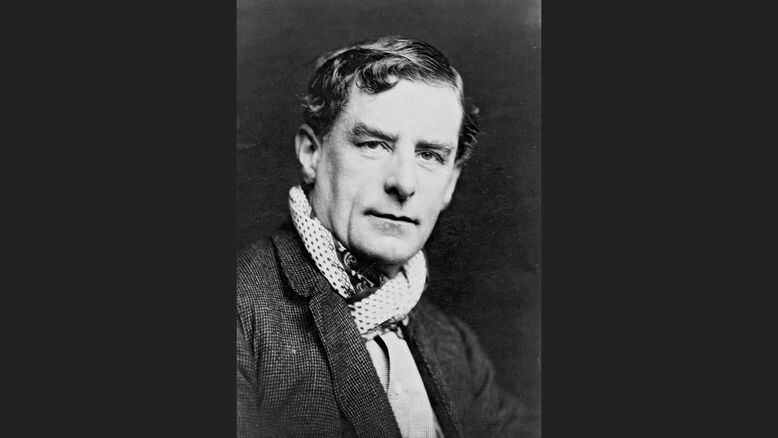
An American writer named Patricia Cornwell, one of the best-selling authors of crime fiction, who has earned over a hundred million dollars solely from the sales of her “Dr. Kay Scarpetta” series, claims to have discovered the identity of the infamous English serial killer, “Jack the Ripper.” According to her, the killer is none other than Walter Sickert, the famous English modernist and impressionist painter. Cornwell has spent over ten million dollars of her personal fortune on research and evidence gathering to prove this theory in her book titled “Portrait of a Killer: Jack the Ripper—Case Closed,” which was published in 2002.

For those who are unfamiliar with Jack the Ripper, it should be noted that he brutally murdered at least five female sex workers or prostitutes in the late nineteenth century, and his identity was never discovered. Most of these murders occurred in the impoverished Whitechapel district, home to many Irish and Jewish people. After the final murder, a chalked message appeared on a wall saying, “The Jews are not the cause.”
Patricia refers to the painting “Murder in Camden Town,” which is both the name of a famous criminal event in the newspapers and the title of the painting. She claims that this piece depicts Sickert fully dressed, lying next to a naked woman on an iron bed in a cold, lifeless room.

Patricia’s theory is based on the idea that Sickert painted what he had seen firsthand. His series of paintings bears a striking resemblance to actual murder scenes, from the position of the corpse to the furniture and other details that only the killer and the police would have known. Patricia states in an American TV interview, “I am 100% sure that Walter Sickert is Jack the Ripper.” She believes that Sickert’s genital deformity and his inability to procreate, despite three marriages, turned him into a serial killer.
The English are outraged by Patricia’s claim, as they consider Walter Sickert one of their greatest painters, someone who holds a place among William Turner and Francis Bacon. However, Patricia asserts that the watermark on the letters sent by Jack the Ripper to the police is identical to the watermark on Sickert’s letters. Watermarks are markings placed in the background of paper, stamps, or banknotes, which are not normally visible but appear when the paper or stamp is held up to the light. However, this theory is not taken seriously by most experts, primarily because Sickert was in France at the time of the murders, where he met the famous French painter Edgar Degas and was quickly influenced by his style.

This painting titled “Mornington Crescent” has also been interpreted as another example of Sickert’s violence against women. However, to accept this view, one must see Sickert’s impasto technique as an act of violence rather than an aesthetic choice inspired by Degas. Impasto is a technique in which paint is applied in a very thick and raised manner on the canvas or surface to create a three-dimensional, textured effect. I see a great deal of Degas’ influence in this painting, particularly in the beautiful use of blue and the almost pulsing brush strokes. To me, this painting is so full of life that it is hard to believe the woman is dead.
In the above painting, Sickert uses the impasto technique in a way that seems to have erased the woman. The vibrant, energetic colors inspired by Degas here give way to dark, dull browns, depicting the poverty and lifelessness that permeated Victorian England. This erasure was later proposed as further “evidence” of Sickert’s connection to Jack the Ripper. Of course, interpreting such motives in paintings is always challenging, especially when the sensitivities surrounding a famous killer add new dimensions of conjecture. Regardless of all these theories, Sickert’s nudes represent one of the most innovative perspectives on the human body in modern art, sparking a chain reaction in British art that continued from Francis Bacon to Lucian Freud and still persists today.