



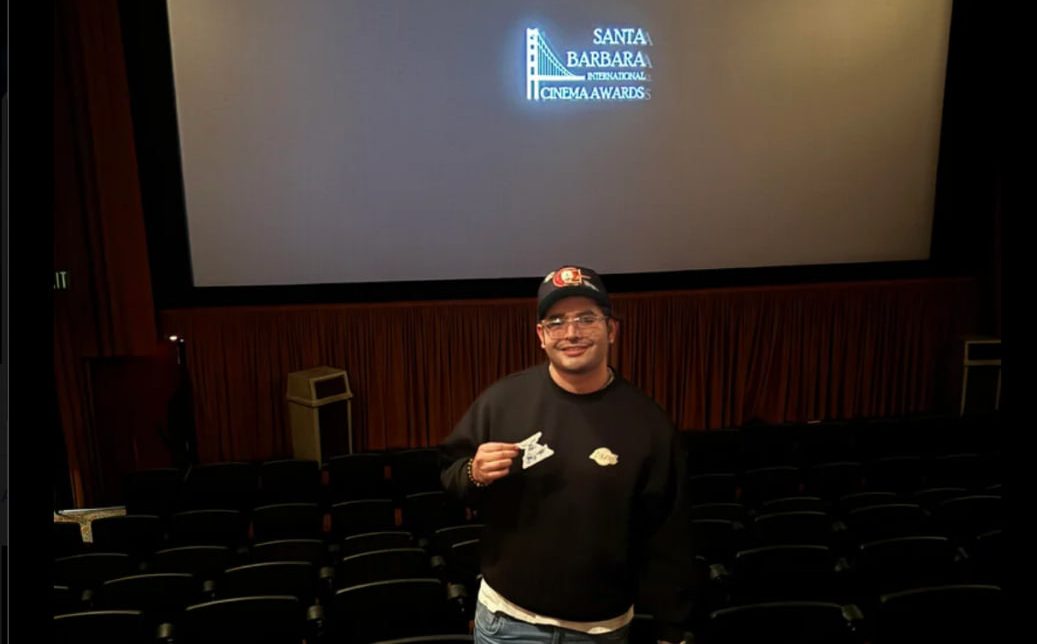
On December 1, Santa Barbara once again turned its gaze toward the screen as the new edition of the Santa Barbara International Cinema Awards unfolded—an evening built around a simple but increasingly rare principle: art for the sake of art. In a festival landscape where films are often judged first by their alignment with social or political narratives, this event positioned itself as a sanctuary for cinema that dares to exist on its own terms: formally bold, emotionally resonant, and unapologetically free.
From the outset, the festival’s ethos was clear. The programmers welcomed works that push boundaries—not in the name of a slogan or a campaign, but through risk-taking in form, narration, and image. Many of the films selected this year dealt with contemporary realities and human struggles, yet they did so without reducing characters to symbols or stories to messages. What united them was a shared commitment to cinema as an autonomous art form: a place where ambiguity is allowed, where style is not a luxury but a necessity, and where the audience is treated as an active participant rather than a target to be instructed.
The Best Feature Film award went to Santa Zeta, a work that encapsulated the festival’s philosophy. More than a conventional narrative, Santa Zeta unfolded like a visual poem—layering atmosphere, silence, and carefully composed frames to build an emotional world rather than a didactic argument. Its selection signaled a belief that cinema’s power lies not in telling viewers what to think, but in immersing them in an experience that lingers long after the credits.
In the short form, Malorum, winner of Best Short, stood out for its ability to condense a fully realized universe into a limited runtime. Rather than relying on a twist or a single high concept, the film used rhythm, tone, and meticulous visual detail to suggest a much larger world beyond the edges of the frame. It was a reminder that short films, when treated as artworks rather than calling cards, can reach an intensity and purity that longer formats sometimes dilute.
The documentary category offered another angle on the festival’s commitment to aesthetic freedom. Bodies of Work, awarded Best Documentary, approached its subject with a keen eye for composition and structure. Instead of simply documenting reality, it shaped it—using sound, editing, and visual metaphor to question how bodies, labor, and identity are seen and recorded. The film refused to choose between political awareness and artistic ambition; instead, it demonstrated how style can deepen substance.
In the realm of the experimental, HERMANDAD, winner of Best Experimental Film, embraced the festival’s call for risk-taking most explicitly. It played with repetition, fragmentation, and abstraction, creating a cinematic language that rejected easy interpretation but invited viewers to feel their way through it. That such a film could be recognized in a competitive program reflected the festival’s willingness to champion work that might be challenging, even divisive, but never indifferent.
Animation, too, had its moment in the spotlight. Bullet Time, recipient of Best Animation, combined technical precision with inventive storytelling, using the elasticity of animation to explore time, motion, and perception in ways that live action rarely can. Rather than treating animation as a “genre” for a specific audience, the festival positioned it as an equal artistic partner to live-action cinema.
Several craft awards underlined the importance of the often-invisible architecture that supports powerful storytelling. Afterglow took Best Director, confirming a vision that held its cast, images, and pacing in delicate balance. The award for Best Cinematography went to Greetings from Summerland, which impressed with its light, framing, and use of landscape not just as background but as emotional terrain. Irreplaceable, winner of Best Screenplay, was recognized for its careful construction of character and dialogue, proving that even in an image-driven festival, the written word remains a vital foundation.
Editing and sound, the two elements that most directly shape the viewer’s experience in time, were also highlighted. Best Mom Ever received Best Editing for its fluid, expressive cutting that guided the emotional rhythm without ever feeling manipulative. A Long Road to Tao, honored with Best Sound Design, used sound not merely as accompaniment, but as a narrative force—blurring the lines between interior and exterior, memory and present.
The acting awards anchored all this formal innovation in human presence. Jason Connelly, awarded Best Actor for his performance in KIWI, brought nuance to a role that could easily have fallen into cliché, blending fragility and resilience in equal measure. Tricia Gilfone, named Best Actress for The Days I Hold, delivered a performance marked by restraint and emotional precision, allowing small gestures and silences to speak as loudly as any monologue.
As the evening closed, what emerged from the second edition of the Santa Barbara International Cinema Awards was more than a list of winners; it was a statement of intent. In celebrating Santa Zeta, Malorum, Bodies of Work, HERMANDAD, Bullet Time, Afterglow, Greetings from Summerland, Irreplaceable, Best Mom Ever, A Long Road to Tao, Jason Connelly (KIWI) and Tricia Gilfone (The Days I Hold), the festival affirmed its belief that cinema’s true strength lies in its freedom—its capacity to surprise, disturb, enchant, and move us without first asking for permission.
In a time when art is often asked to justify itself through usefulness, the Santa Barbara International Cinema Awards chose another path: to defend the autonomy of art, and to trust that when filmmakers are free, audiences are the ones who ultimately benefit.